All species › Passerines › Crows and jays › Fan-tailed raven
Fan-tailed raven | Corvus rhipidurus
Waaierstaartraaf | Cuervo colicorto
A corvid you identify on shape alone and can then never mistake. The fan-tailed raven has a tail so short that it all but disappears in flight, and wings so broad that over the cliffs of the Dead Sea the bird rides the thermals like a small vulture. Anyone looking up at Masada and taking the soaring bird for a raptor is often watching this raven.

Voice
Thin and not very varied. The call is a high, hoarse, nasal kraah or aaark, more clipped than brown-necked raven's and without any depth, often in series from a rock edge or while soaring. There is also a dry rattle and, at the nest, a soft guttural note. Around hotels, viewpoints and car parks the birds can be heard all day; a group squabbling above a cliff produces a continuous high grating that echoes along the walls.
No freely licensed recording is available for this species yet.
Identification
Heavily built, broad-winged and strikingly short at the back: 46 to 47 cm, of which the tail is only a small part. On a perched bird the folded wing tips reach the end of the tail or fall beyond it, so the bird seems to stop behind its wings. In flight the outline is as broad as it is short: huge, fingered wings, a thick head with a heavy, strongly arched bill projecting well forward, and between them a short tail spread into a half fan when soaring. The plumage is glossy black with purple and bronze sheen; the throat feathers are short. Juveniles are duller and browner, with a shorter bill. Sexes alike.
Confusion species
Brown-necked raven shares the same country and is the only real comparison: it is slimmer, narrower-winged and shows a tail projecting clearly beyond the wing tips both perched and airborne, which makes the flight outline look long rather than broad and compact. Northern raven, in the Middle East a bird of the mountains and the desert edge, is a size larger and has a long, sharply wedge-shaped tail. On the Dead Sea cliffs Tristram's starling is the other candidate: also blackish and broad-winged at range, but much smaller, flashing orange wing panels in flight and giving clear whistles instead of a grating caw.
Habitat
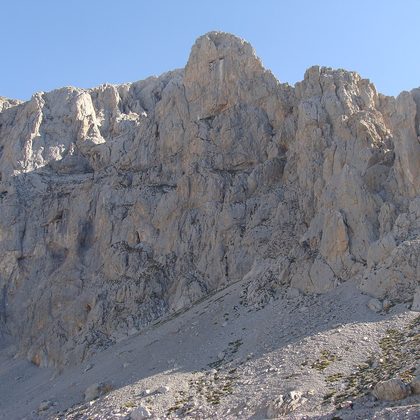
Rock faces are the core: gorges, canyons, escarpments and abandoned quarries in hot desert mountains, with the bare gravel and sand plains around them as feeding ground. It nests and roosts on ledges in those walls, often in loose colonies. It is also a thoroughgoing beneficiary of people, foraging on tips, at Bedouin camps, in car parks at tourist sites, around hotels and along roads, and taking what it can at date plantations and fish ponds. It is a flock bird — away from the nest you rarely see one alone.
Where the bird is most at home, classified with EUNIS — the European standard for habitats.



Range and movements
Within this guide it is confined to the far south-east: the Judean desert and the cliffs along the Dead Sea, the Negev and the Arava down to Eilat, and across the rift in Jordan, with Wadi Rum, Dana and the rock walls of Petra. Add Sinai and the Red Sea mountains of eastern Egypt. Beyond the region its range runs on across Arabia and north-east Africa to the massifs in the middle of the Sahara. Resident, but with daily flights of tens of kilometres between roosting cliff and feeding site, and gathering outside the breeding season into flocks that can run to hundreds.
- Resident
- Winter
- Migration direction
- dark = core range, pale = thinly spread
Where and when to look
Israel and Jordan, and preferably in the middle of the day — unlike most birds. As soon as the sun warms the walls the thermals start and the birds begin to soar, and that is exactly when the shape you need is on display: broad, short, with that half fan of a tail. Masada, Ein Gedi, the Dead Sea road, the Petra visitor centre and the Eilat tip are all reliable. In car parks they come within a few metres, so the heavy bill and the stub tail can be studied at leisure.
Conservation status
Not threatened (IUCN: Least Concern), with a large range and rising numbers in many areas. Tourism, refuse and desert irrigation have done it no harm: around visitor centres and hotels in Israel and Jordan it is more numerous than ever. As with other desert corvids, that increase raises questions about the pressure on smaller desert birds nesting on the same cliffs. Direct threats are few; locally the issue is disturbance of breeding colonies in gorges that have been opened up for climbing and hiking.