All species › Passerines › Crows and jays › Brown-necked raven
Brown-necked raven | Corvus ruficollis
Bruinnekraaf | Cuervo desertícola
The brown-necked raven is the raven of the desert, and several languages simply call it that: corbeau brun, cuervo desertícola, desert raven. Where the last bush gives out and nothing is left but gravel, sun and horizon, it is still there — on a telegraph pole, at a carcass, behind a lorry park. For anyone arriving from Europe it is the first crow that can look brown rather than black.

Voice
The most useful character at range. The call is a drawn-out, nasal and rather high aaargh or kraaah, with a plaintive rise at the end, usually repeated two or three times from a pole or in flight. There is also a dry rattle, a short barking kok near the nest, and soft muttering between mates. Anyone carrying northern raven's deep clonking pruk in their ear hears the difference at once: brown-necked raven sounds thinner, higher and far less resonant.
No freely licensed recording is available for this species yet.
Identification
A slim, long-winged raven of 50 to 56 cm, smaller and lighter than northern raven and much finer in profile. The plumage is black with a purple gloss, but head, neck and upper breast carry a warm brown-bronze wash that becomes obvious in full sun and on worn summer plumage and almost disappears on a freshly moulted bird in shade — do not rely on it blindly. The bill is long and fairly slim, its upper line straight until it curves just before the tip. The throat feathers are short and smooth, without the shaggy beard of northern raven. In flight it shows a narrow, long wing and a tail that is wedge-shaped but far less sharply pointed. Sexes alike; juveniles are duller and show almost none of the brown wash.
Confusion species
Northern raven is the species that matters, and in Morocco and Israel the two share the same ground. Three things decide it. The bill: on northern raven heavy and deep, with a strongly arched upper line and a thick brush of nasal bristles; on brown-necked raven longer, slimmer and straight almost to the tip. The neck: northern raven is black throughout with a blue-purple gloss and wears a shaggy, standing throat beard, while brown-necked raven has a smooth throat and that brown-bronze wash over head and neck. And the voice: northern raven clonks deep and full, brown-necked raven gives a higher, drawn-out, nasal aaargh that suggests a large gull more than a raven. In the Middle East fan-tailed raven stands alongside as well: that bird is shorter, broader-winged and has a tail barely reaching past the wing tips, where brown-necked raven trails a good length of tail behind.
Habitat
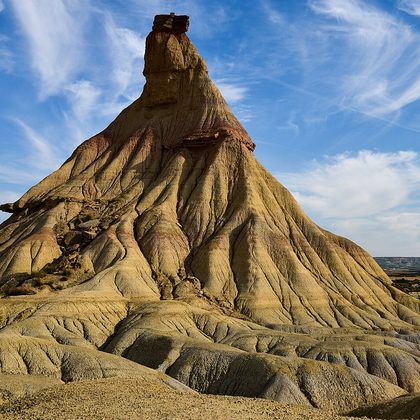
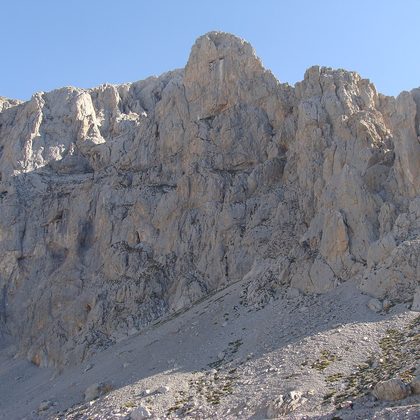
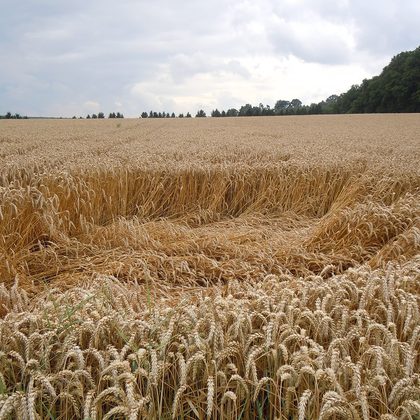
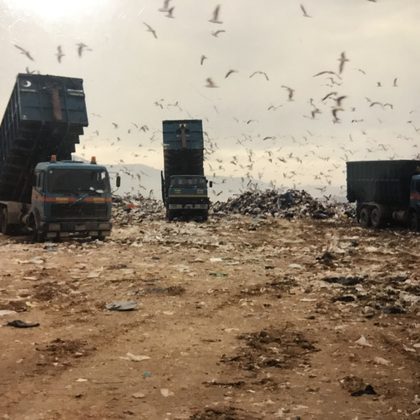
Desert and semi-desert in every form: gravel plains and hamada, sand desert with scattered acacias, wadis, salt flats and rocky jebels. Wherever people are, it moves in with them: oases and palm gardens, irrigated fields at the desert edge, tips, slaughter yards, camel markets, roadhouses and the verges of trunk roads, where it clears up roadkill. Omnivore and scavenger. The nest goes in an acacia or a date palm, on a rock ledge, or nowadays just as often on an electricity pylon.
Where the bird is most at home, classified with EUNIS — the European standard for habitats.
Range and movements
Within this guide, the whole desert belt: Morocco south of the Atlas, taking in the Draa valley, Merzouga and Western Sahara, eastwards through Algeria, Tunisia and Libya, all of Egypt including Sinai, and on into the Negev, the Arava, the Dead Sea basin and Jordan beyond Petra. Northwards it stops at the Atlas and the Mediterranean coastal strip, where northern raven takes over. Outside the region its range runs on into Arabia, Iran and Central Asia. It does not migrate but wanders widely for food and water; in Israel flocks of tens gather at roosts outside the breeding season.
- Resident
- Winter
- Passage
- dark = core range, pale = thinly spread
Where and when to look
Southern Morocco is the easiest introduction: the road to Merzouga, the Tagdilt track near Boumalne Dades, or any desert-edge tip will produce birds that let you close. In Israel and Jordan look in the Arava and around Eilat, often on the same rubbish tip as fan-tailed ravens — exactly the place to see the two side by side. Watch in the first or last hour of light, when the low sun lifts the brown wash on neck and breast; in the middle of the day every corvid over the desert is simply black.
Conservation status
Not threatened (IUCN: Least Concern) and numerous throughout its range. The species plainly gains from people: irrigation, landfill, roadkill and livestock at the desert margin have greatly increased the supply of food and water, and it is spreading in many areas. That is not good news everywhere — in Israel the increase has been linked to predation on the eggs and young of scarce desert birds and on juvenile tortoises. Persecution is local, and poisoned bait laid out for other animals takes it just as readily.