All species › Passerines › Cisticolas › Graceful prinia
Graceful prinia | Prinia gracilis
Gestreepte prinia | Prinia grácil
Step out of the airport at Tel Aviv or Eilat and this is the first bird you will hear: a scrap of eleven centimetres, nearly half of it tail, buzzing away inside a hedge like a grasshopper. It is the commonest small bird of the settled Levant and it never sits still.

Voice
The song is an insect noise rather than a tune: a dry, buzzing zrrp-zrrp-zrrp-zrrp in a long even series with a thin metallic edge, given all year round and through the heat of the day. The male also has a bouncing display flight above the bushes in which the wings produce a loud crackling rattle — as much a part of a Middle Eastern morning as birdsong itself. Calls: a sharp nasal tzeep, running into a scolding cherr-r-r when agitated.
No freely licensed recording is available for this species yet.
Identification
Sandy grey to grey-brown above, the crown and mantle finely dark-streaked in fresh autumn plumage and worn almost plain by midsummer. Creamy white below, warm buff on the flanks. The tail is long, strongly graduated and carried cocked; from below each feather shows a black spot just short of a white tip, so a fanned tail flashes a row of dots. Bill short, fine and dark, iris orange-brown, legs pink. Wings short and rounded, the flight weak and fluttering with the tail trailing behind. Sexes alike, and the tail is noticeably longer in winter than in summer.
Confusion species
Zitting cisticola shares the country but has a short, broad, fanned tail, a heavily black-streaked back, and delivers its dzip from a bouncing song flight high over the field; the prinia sings from a bush and rarely flies above hedge height. Streaked scrub warbler also cocks a long tail, but adds a sharp dark eye-stripe under a white supercilium, an obviously streaked crown and a much darker tail, and it works the stony ground of the desert rather than a garden. Cetti's warbler is bulky, dark rufous, wholly unstreaked, keeps to dense cover by water, and explodes into song rather than buzzing.
Habitat
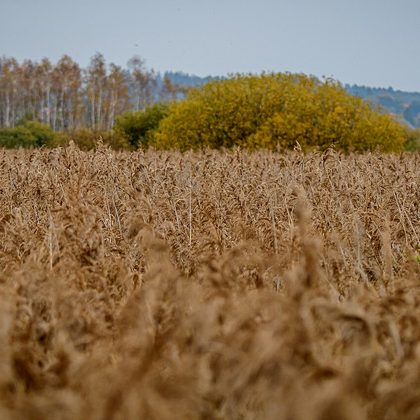
Anywhere low, dense greenery grows: hedges and town gardens, parks and hotel grounds, bougainvillea on a wall, orchards and sugar cane, rank growth along irrigation canals, tamarisk in a wadi, and the narrow reed fringes of the Jordan and the coastal streams. It avoids closed woodland and bare desert but follows people far down the Arava wherever there is water and green. The nest is a long woven purse of grass blades and spider silk, low in a bush or slung between reed stems, with the entrance at the side.
Where the bird is most at home, classified with EUNIS — the European standard for habitats.



Range and movements
The Nile valley and delta, Sinai, Israel and the Palestinian territories, Jordan, Lebanon, southern Syria and the south-eastern corner of Turkey, and east beyond this guide's map to Pakistan and India. It has never reached Europe, so for a visiting European birder it is a genuine Levant bird — not one to search for, but the bird that greets you in every hotel car park.
- Resident
- Breeding (summer)
- Passage
- dark = core range, pale = thinly spread
Where and when to look
Any morning in a town park, along a hotel hedge or beside a fishpond in the Bet She'an valley. Do not look for the bird; listen for the buzzing rattle, then watch for movement in the hedge — the flicked, cocked tail gives it away in two seconds. The wing-crackling display is most frequent in February and March, and that is also when males sit longest in the open on a twig top.
Conservation status
Not threatened (LC), abundant and if anything increasing. Irrigation, urban planting and gardens have enlarged its habitat across the Levant rather than reduced it, and it is one of the few birds that gains from building along the desert edge. Total clearance of reed fringes and hard-clipped municipal planting cost nests locally, but that is nothing against the gain.