All species › Waterfowl › Ducks, geese and swans › Harlequin duck
Harlequin duck
Histrionicus histrionicus | Harlekijneend | Pato arlequín
A small, short-billed duck that lives where the water hits the rocks hardest: Icelandic glacial rivers in summer, pounding rocky coasts in winter. At range the drake looks dark and unremarkable; only through a scope do the fine white lines and spots across head, neck and flanks come out. For a European birder Iceland is effectively the only address.

Voice
Unusually high-pitched for a duck. The drake gives a squeaking, almost mouse-like ee-ee-ee, the source of the old name sea mouse; the pitch carries over the roar of rapids and surf. The female answers with a lower, stuttering ek-ek-ek. Worth listening for at displaying parties on the river in May and June; vagrants on the coast are almost always silent.
No freely licensed recording is available for this species yet.
Identification
Compact, with a steep forehead, a short grey bill and a pointed tail often cocked upwards. Breeding drake: slate-grey body with chestnut flanks, a white patch in front of the eye, a small white ear spot, a rufous stripe along the side of the crown, and a series of black-edged white bars on the neck, breast-side and scapulars. In eclipse from July to October the drake goes dark and female-like but keeps the chestnut flanks and the face pattern. Female and first-year: uniform dark brown with two or three rounded white spots on the side of the head — a larger one at the base of the bill, a smaller one above the eye and a round one on the ear-coverts. No white in the wing in any plumage.
Confusion species
The breeding drake is unmistakable. Brown birds need more care. Female Bufflehead shows one elongated white stripe behind the eye and a white wing panel; Harlequin shows separate round spots and an all-dark wing. Female Long-tailed Duck is paler, with a white neck and a dark cheek smudge instead of white spots. Female Common Scoter is bigger and heavier, with an evenly pale cheek rather than crisp spots and a far more massive bill. All plumages are identifiable in Europe provided you get a decent view of the head: the combination of steep forehead, tiny bill and discrete white face spots occurs in none of the scoters.
Habitat
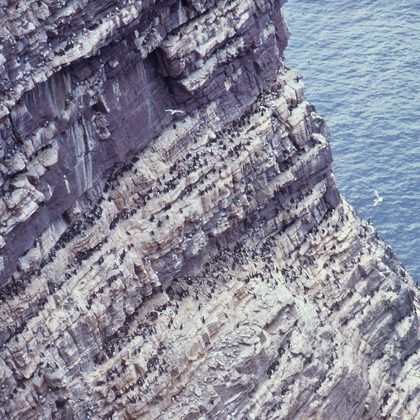
In the breeding season fast, clear rivers and streams with rapids and boulders, where the birds dive among the waves for blackfly larvae and caddis. Outside the breeding season rocky coasts and surf: birds ride just behind the breakers, rest on weed-covered intertidal rock and dive over shallow rocky bottom for winkles, crustaceans and small mussels. Sandy beaches and quiet inland waters are avoided.
Where the bird is most at home, classified with EUNIS — the European standard for habitats.



Range and movements
In Europe it breeds only in Iceland, with the River Laxá at Mývatn as the classic stronghold; beyond that in Greenland, north-east Asia and North America. Icelandic birds winter on their own coasts. Elsewhere in Europe it is a genuine rarity. Britain has around twenty-five records accepted by the BBRC, heavily biased to Scotland and above all the Outer Hebrides; England has had none since 1915. Ireland waited until October 2025 for its first, two birds at Maheroarty, Co Donegal. The Netherlands has a single accepted record, an unringed female at IJmuiden from December 1982 to March 1983.
- Resident
- Breeding (summer)
- Passage
- dark = core range, pale = thinly spread
Where and when to look
The reliable option is the Laxá between Mývatn and the sea, in May and June. Park at one of the bridges, walk the bank and look in the slack water behind midstream boulders; parties of five to fifteen are usual and they keep vanishing into the foam. On the Icelandic coast in winter, take a rocky point and work the first fifty metres of surf. At home the odds are best on a north-western rocky shore after a sustained north-westerly blow, and the thing to do is check every brown duck in a harbour mouth for round white head spots.
Conservation status
Not globally threatened, with a world population estimated at over two hundred thousand birds, and the Icelandic population is stable. The pressures are hydro schemes and river engineering on the breeding grounds, oil pollution along the coasts where the birds winter in tight groups, and disturbance from boating and angling on breeding rivers. The eastern Canadian population is small enough to be protected separately.