All species › Waterfowl › Ducks, geese and swans › Hooded merganser
Hooded merganser
Lophodytes cucullatus | Kokardezaagbek | Serreta capuchona
The smallest of the North American sawbills and the only one with a crest that opens into a fan. A displaying drake snaps that white, black-edged disc open and shut like a cockade, and it is one of the most striking performances any duck has to offer. In Britain and Ireland the question over every bird is whether it arrived under its own power.

Voice
Silent outside display. Displaying drakes produce a deep rolling growl that recalls a distant frog or a small engine turning over, usually written crrrooo; the female gives a hoarse barking gak or a rapid ge-ge-gek when flushed. Vagrants here are effectively mute.
Recording: Jonathon Jongsma — CC BY-SA 4.0 · Wikimedia Commons
Identification
The drake has a black head with a large white, black-bordered fan crest that can lie flat along the nape or stand fully raised; the breast is white with two black spurs running forward from the shoulder, the flanks are warm cinnamon and the black back is finely striped with white on the scapulars. The bill is narrow, black and serrated. The female is grey-brown with a loose rufous shaggy crest at the nape, a pale throat and a yellowish lower mandible. In flight the bird is small, long-bodied and fast, with a white wing panel reduced to a narrow bar on the female.
Confusion species
An adult drake is unmistakable. Two other problems are real enough. The first is female and immature birds, which are regularly claimed as Red-breasted Merganser: Hooded is considerably smaller and shorter-necked, with a short dark bill instead of a long red one, and a sharply defined white throat below a grey-brown head, where Red-breasted blends softly into the neck. Female Smew also gets confused, but shows a white cheek and a grey body with no rufous crest. The second problem is provenance: the species is a favourite in European wildfowl collections and escapes regularly. Check for leg rings, cut or deformed primaries, tame behaviour, and above all weigh date and place. A bird on a remote Irish or Hebridean loch in November counts for far more than a confiding drake on a park lake in March.
Habitat
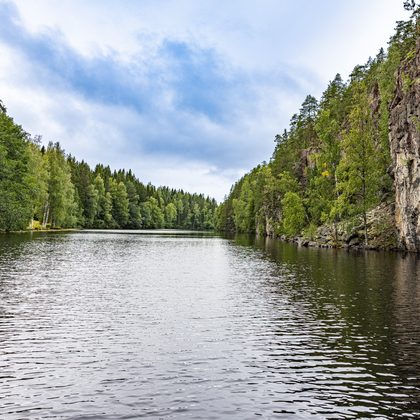
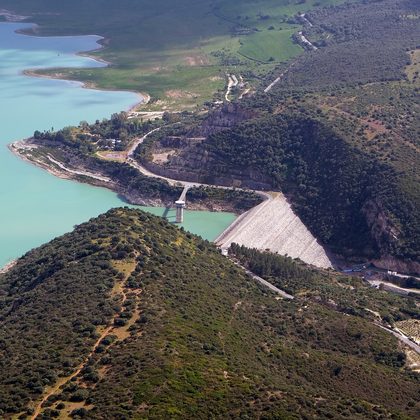
Sheltered fresh water with cover along the edge: woodland ponds, beaver pools, creeks, slow rivers and the quiet corners of lakes and reservoirs. It avoids open sea and rarely sits far from the bank; escaped birds turn up on town ponds and park lakes. Breeds in tree holes over or beside water.
Where the bird is most at home, classified with EUNIS — the European standard for habitats.

Range and movements
Breeds and winters in North America, from southern Canada to the Gulf coast. The first British record accepted as a wild bird was on North Uist in October 2000, and Ireland has a handful of records, alongside a long-established Dublin group that traces back to collection stock. Spain has a single accepted record, a first-winter bird on Tenerife from December 2001 to February 2002. Continental records are thin and many have been attributed to escapes, so any claim starts by ruling out a collection bird.
- Winter
- dark = core range, pale = thinly spread
Where and when to look
For a genuinely wild bird, late autumn in the far west is the moment: Ireland, the Hebrides and the South-West, ideally after a run of Atlantic depressions and often alongside other Nearctic vagrants. Search small sheltered waters with wooded edges and overhanging branches, not open coast. Always record the legs, the primaries and the bird's response to people; without that a record cannot be assessed.
Conservation status
The species is not threatened and North American numbers are rising, helped by nest boxes put up for it. The pressures are loss of old hole-bearing trees along woodland streams, channelisation and dredging of watercourses, and the loss of beaver pools and dead-wood ponds. None of that governs the European picture, which consists of scattered vagrants and birds that have left collections.