All species › Passerines › Grasshopper warblers › Lanceolated warbler
Lanceolated warbler | Locustella lanceolata
Kleine sprinkhaanzanger | Buscarla lanceolada
The smallest of the reeling warblers, a mouse of eleven to thirteen centimetres that breeds in Siberian wet grassland and turns up on Shetland, Fair Isle and the North Sea coast in October after easterly winds. It is one of the few vagrants you find on foot rather than through binoculars: it would rather not fly, and runs away through the grass in front of your boots.

Voice
In Britain it is almost always silent, but on the breeding grounds song is the quickest way in, and it is confusingly close to Grasshopper Warbler. It is the same kind of high, dry, sustained reel — srrrrrrrrrrrrr — but noticeably higher, thinner and a shade faster, with a buzzing, genuinely insect-like quality that suggests a bush-cricket rather than a sewing machine. Where Grasshopper Warbler sits at around four to six kilohertz, this species runs above it: at distance it is the first to drop out of hearing, and older ears sometimes miss it altogether. Bouts are shorter — ten to thirty seconds against Grasshopper Warbler's minutes — and they start and stop more abruptly, without the accelerating run of separate ticks that introduces Savi's. River Warbler cannot be confused with either: it beats out five to eight countable pulses a second, whereas here everything has fused into one tone. It sings at dusk and through the night from a grass stem or a low bush. The call, and this is what you may actually hear on Shetland, is a short hard pit or chik and a rasping drawn-out tsrrr, usually from somewhere invisible in a ditch.
No freely licensed recording is available for this species yet.
Identification
Everything about it is streaked, and that is the point. Crown, mantle and scapulars carry sharp black streaks on a cold olive-buff ground; the underparts are yellowish-buff to off-white with fine but clear-cut black streaks across the whole breast and — this is what settles it — right across the flanks and on into the undertail coverts. The streaking is crisp-edged, never diffuse. Beyond that: a small fine bill, a short primary projection, a short and fairly narrow tail and pale pink legs. The bird looks compact, short-tailed and short-winged, with a flat crown. Some autumn birds are yellower and more finely marked than others, but the flank streaks are almost never absent.
Confusion species
Grasshopper Warbler is the only real problem, and the case turns on the flanks. Both have streaked undertail coverts, but Grasshopper Warbler shows a clean or at most faintly spotted breast and completely unstreaked flanks; Lanceolated has sharp black streaks across breast and flanks alike. Grasshopper Warbler is also bigger, longer-tailed, warmer olive-green and longer in the primary projection, and its mantle streaking is finer and more diffuse. Savi's Warbler is warm red-brown and entirely unstreaked, so it does not enter the case. River Warbler is far bigger, plain above and smudged only on the breast. Note the classic trap: fresh first-autumn Grasshopper Warblers can be strongly yellow-buff with a spotted breast band — but the flanks stay plain.
Habitat
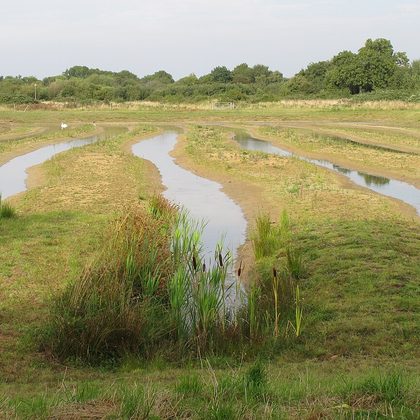
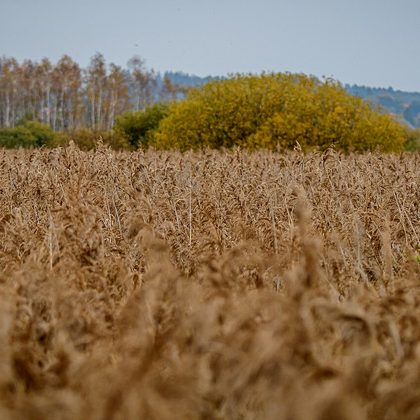
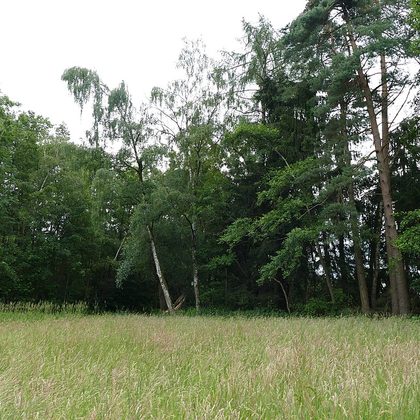
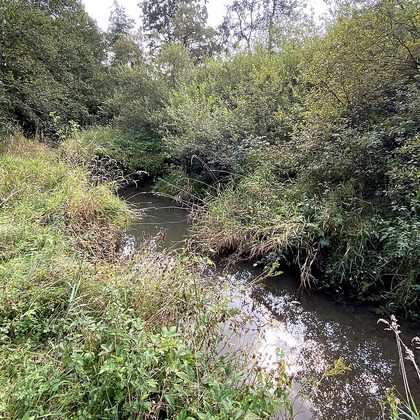
Wet grassland and sedge marsh in the Siberian taiga and forest-steppe: tall dense stands of small-reed and sedge in stream and river valleys, boggy clearings and infilling margins, with scattered willow and birch growth. Also damp hay meadows and rank field edges, provided the sward is tall and dense and the ground stays wet. On migration and in its south-east Asian winter quarters it takes comparable tall grass and rice fields. It forages on the ground, walking among the stems.
Where the bird is most at home, classified with EUNIS — the European standard for habitats.
Range and movements
Breeds from the Urals east across Siberia to Kamchatka, Sakhalin, Hokkaido and north-east China; winters from India and southern China to Indonesia and the Philippines. It does not breed within the area of this guide: the western edge of the range lies around and just east of the Urals. In western Europe it is an autumn vagrant with a strikingly concentrated pattern — the great majority of British records come from Shetland and above all from Fair Isle, in the last days of September and through October, after a spell of easterly winds. The Netherlands has a small number of accepted records, nearly all from the Wadden islands and the coast, and Germany, Denmark and Scandinavia have a few each.
Where and when to look
Fair Isle or Shetland, the first half of October, after several days of east to south-east winds. Walk slowly through the iris beds, the ditches and the last crop margins and watch the ground layer above all: this bird hardly flies, but runs off like a mouse and then freezes, sometimes at a metre's range. Flush it and you see no more than a small dark short-tailed thing that drops back into the grass after ten metres — after that, patience is the only tool. The same conditions apply on the Dutch and German Wadden islands; check every late Grasshopper Warbler for streaked flanks.
Conservation status
Not globally threatened. The breeding range is vast and the species is numerous over much of Siberia, so the European records say nothing about its numbers. The main pressures lie on the wintering grounds and along the flyway, where tall marsh grass is turned over to rice, embanked and drained. The rise in British autumn records since the 1970s probably reflects more observers and better identification rather than any change in the bird.