All species › Passerines › Grasshopper warblers › Pallas's grasshopper warbler
Pallas's grasshopper warbler | Helopsaltes certhiola
Siberische sprinkhaanzanger | Buscarla de Pallas
The richest-patterned of the reeling warblers: heavily black-streaked on crown and mantle, with a rusty rump and a dark, strongly graduated tail whose feathers carry white tips. It breeds in the marshy lake and river margins of Siberia and reaches Shetland, Scandinavia and the North Sea coast in October, usually as a bird that dives into cover once and is then gone. If you saw it go, that tail is enough. The species has since 2018 been placed in the genus Helopsaltes; that is a matter of classification and changes nothing about the bird.

Voice
Of the three reelers this is the one that does not reel. Instead of a minutes-long even trill it sings short repeated phrases of two to four seconds with a clear shape: a few hard separate ticks, then a fast buzzing rattle, and finally a short clear almost swallow-like flourish — roughly chik-chik-chik … drrrrrrr … chew-wee. Several seconds of silence follow each phrase, and that pause alone separates it from Grasshopper Warbler, which runs on without a break, and from Savi's, which purrs for half a minute or more. The tone differs too: the rattling part is lower, fuller and broader-band than the dry high reeling of Grasshopper Warbler, and the closing whistle has nothing mechanical about it. Some males weave in short imitations of other birds. It sings mainly at dusk and through the night from a willow top or a reed stem, sometimes in a brief song flight. In Europe all this is theory: autumn vagrants do not sing and give at most the call, a hard short chik like two pebbles knocked together, often repeated two or three times from cover.
No freely licensed recording is available for this species yet.
Identification
Bigger and heavier than Grasshopper Warbler, thirteen to fourteen centimetres. Crown and mantle are boldly and coarsely streaked black on a warm olive-brown ground, far more contrasting than in our own species. The wing feathers have dark centres with broad pale fringes, giving a scaled panel. Towards the tail the bird turns conspicuously rufous: rump and uppertail coverts are rusty red-brown and stand out against the dark, almost blackish-brown tail. That tail is strongly graduated and carries — this is the clinching mark — narrow white or off-white tips to the feathers, with a dark band in front of them. The supercilium is pale and fairly distinct, the underparts off-white with a buff wash on breast and flanks and usually no streaking; first-autumn birds are yellower and may show a finely streaked breast band.
Confusion species
Grasshopper Warbler is smaller and slimmer, olive-green rather than red-brown, and lacks both key marks: no rusty rump, no white tail tips. Its streaking is fine and diffuse rather than coarse and black, and its undertail coverts are clearly streaked, where Pallas's Grasshopper Warbler has them all but plain. Lanceolated Warbler is smaller still and streaked across breast and flanks. Savi's Warbler is warm red-brown but wholly unstreaked, with a plain mantle and an unmarked tail. River Warbler is plain above and smudged on the breast. Sedge Warbler also shows a rusty rump and a streaked crown, but its supercilium is broad and creamy, its tail is shorter and lacks pale tips, and its song is scratchy and erratic.
Habitat
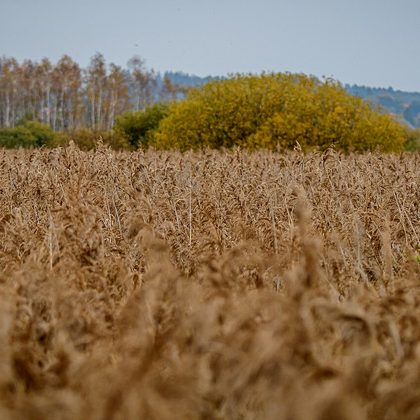
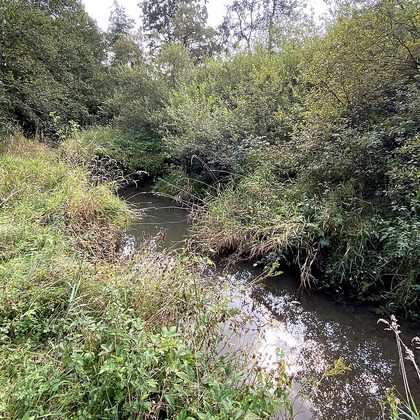
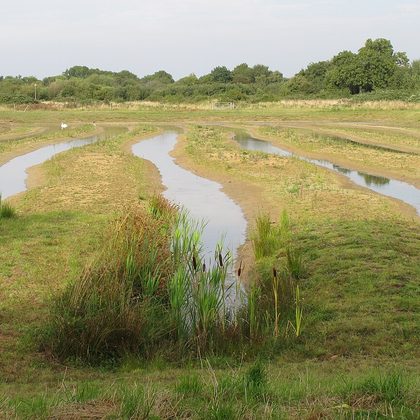
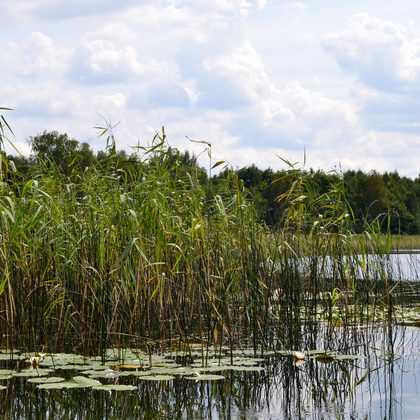
Wet, rank waterside vegetation in the taiga and forest-steppe: sedge marsh and reed fringes along lakes, old river channels and peat pools, boggy grassland with small-reed, and above all the willow and birch scrub standing among them. It wants the transition between open wet grass and scrub, with dense cover at knee height and water nearby. On migration and in its south and south-east Asian winter quarters it takes tall marsh grass, reed and rice fields.
Where the bird is most at home, classified with EUNIS — the European standard for habitats.
Range and movements
Breeds from western Siberia and northern Kazakhstan east through Mongolia and Siberia to Kamchatka, Sakhalin and north-east China, and winters from north-east India and Bangladesh to Myanmar, Indochina and Indonesia. It does not breed within the area of this guide. In western Europe it is a rare autumn vagrant, concentrated in the last week of September and the first half of October; Britain has several dozen accepted records with Shetland and Fair Isle well in front, and Norway, Sweden, Denmark, Germany and the Netherlands have a handful each. A good share of the continental records come from coastal ringing stations, because a bird that hides this well is more often found in a mist net than in the field.
Where and when to look
Early October, after a settled spell of east to south-east wind, at a coastal site with cover: an island, a dune slack with creeping willow and sea buckthorn, or a ringing station. Search the ground and the lowest half-metre, and for every brown warbler that dives away ask two questions: did the rump flash rusty, and were there pale tips to the tail feathers? If so, you have it. In the hand the outer tail feather settles the case at once. To meet the bird on its song post you have to go to the marshes of southern Siberia or the Baikal basin.
Conservation status
Not globally threatened: the breeding range covers many millions of square kilometres and the species is locally numerous within it. For the birds that reach Europe, numbers say more about September weather and about how many observers are working the coast than about the population. In the winter quarters the conversion of marshland to rice and arable reduces the available ground, but no decline has been documented.