All species › Bustards › Bustards › MacQueen's bustard
MacQueen's bustard
Chlamydotis macqueenii | Oostelijke kraagtrap | Hubara asiática
A desert bustard of central Asia recorded only a handful of times in Europe, and every claim now raises two questions rather than one: is it the right species, and is it a wild bird? Falconry has reshaped the species at both ends, as quarry and as a captive-bred product.

Voice
Effectively silent. A displaying male gives a low, breathy sighing audible only at a few tens of metres. Expect nothing at all from a vagrant.
No freely licensed recording is available for this species yet.
Identification
Slim and long-legged, smaller than Great Bustard but much longer-necked. Upperparts are sandy with black arrowhead markings, underparts white. A narrow black line of loose, elongated feathers runs down the side of the white neck and is fanned into a broad ruff in display; the crown carries a black-and-white crest. In flight a large white patch at the base of the primaries with a black tip is obvious, the neck held straight out, the wingbeats slow and easy.
Confusion species
Houbara Bustard Chlamydotis undulata of North Africa and the Canaries is smaller, darker and more densely marked above, with a shorter crest and less white in the wing; the Canary birds are that species only. Female Great Bustard is heavier, shorter-necked and lacks the black neck line. At long range in heat haze every bustard looks like every other bustard: work on neck length and wing pattern.
Habitat
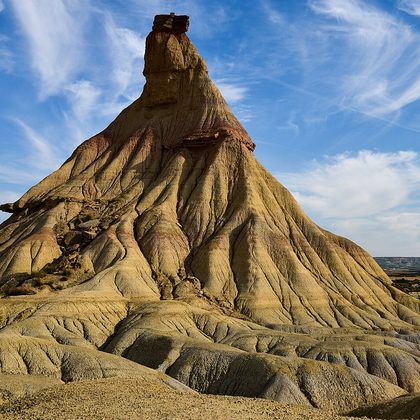
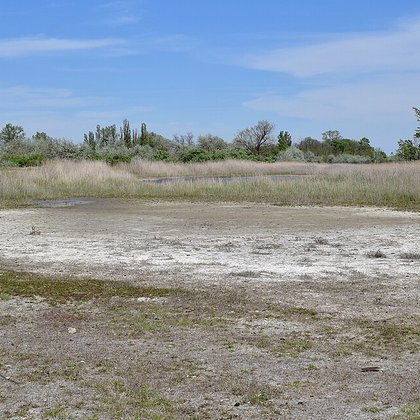
Semi-desert and dry steppe with scattered dwarf shrubs: wormwood, saxaul and saltbush on sand and clay flats, and bare gravel plains where the vegetation barely reaches the knee. Birds walk long distances here and rely completely on camouflage, flattening themselves when threatened and flushing only at very close range.
Where the bird is most at home, classified with EUNIS — the European standard for habitats.
Range and movements
Breeds from Sinai and Arabia east through Iran, central Asia and Kazakhstan to Mongolia, the northern birds wintering in Pakistan and north-west India. Britain holds four accepted records, in Lincolnshire in 1847, Yorkshire and Aberdeenshire in 1898 and the last in Suffolk in the late autumn of 1962. Elsewhere in Europe there are scattered old records from the Netherlands, Poland, Bulgaria, Greece and Italy.
- Breeding (summer)
- dark = core range, pale = thinly spread
Where and when to look
To see the species, go to Kazakhstan or Uzbekistan in April, or to the Rann of Kutch in Gujarat in December and January where wintering birds walk the salt flats. For any European candidate, photograph the legs and the base of the wing: rings, anklets or the wear left by jesses on the tarsus are the first thing a rarities committee will look for.
Conservation status
Vulnerable globally and declining across the breeding range through falconry hunting and steppe loss. At the same time tens of thousands of captive-bred birds are released each year in the Middle East and central Asia, and falconers' birds escape regularly. That makes the provenance of any European record hard to settle: a share of recent eastern Mediterranean and Middle Eastern occurrences goes back on released birds, which is exactly why the old records from before the breeding programmes carry more weight.