All species › Owls › Typical owls › Northern hawk owl
Northern hawk owl
Surnia ulula | Sperweruil | Cárabo gavilán
The Northern Hawk Owl is the most falcon-like of all owls: long-tailed, short-winged, and perched in broad daylight at the top of a dead tree from which it drops onto voles. First-time observers usually think of a Sparrowhawk or a Kestrel before they think of an owl.

Voice
From a treetop the male sings a long, rapid, bubbling trill oo-lu-lu-lu-lu-lu… that can run on unbroken for a quarter of a minute; the female answers higher and hoarser. Mainly from February to April and, unlike most owls, often in the middle of the day. When disturbed and around the nest it gives a sharp, falcon-like ki-ki-ki-ki and a shrill, drawn-out keeerl. Away from the breeding range the species is essentially silent: an irruption bird in western Europe is unlikely to be heard at all.
Recording: Jamescandless — CC BY-SA 3.0 · Wikimedia Commons
Identification
A medium-sized, slim owl with a small round head and no ear tufts, yellow eyes and a yellow bill. The pale face is bounded on each side by a broad black frame that hooks down along the cheek and continues around the nape; that black surround is the quickest mark. The upperparts are dark brown with white spots and the crown is finely speckled white; the underparts are white and covered from throat to under the tail with fine, even dark barring, which gives the species its European names. Equally characteristic is the long, wedge-shaped tail set against short, fairly pointed wings, producing a silhouette closer to a small raptor than to an owl. It is markedly diurnal, often perching leaning forward at the very top of a dead spruce, a post or a lamp standard, flicking its tail, and flying fast and straight low over the ground before sweeping steeply up to the next lookout.
Confusion species
The Short-eared Owl also hunts by day over open country, but is larger and far longer-winged, paler and sandier, with yellow eyes, a white face with black eye surrounds, a sharply defined black carpal patch and breast streaking that fades away on the belly; it also sails slowly and rockingly on stiff, raised wings, while the Hawk Owl is smaller and darker, finely barred right across the belly, and flies fast and straight. Tengmalm's Owl has a much larger, rounder head with a startled expression, lacks the black facial frame, has a short tail and is nocturnal. The Pygmy Owl is smaller still, shorter-tailed, and streaked rather than barred below. At range or against the light a perched Hawk Owl is regularly reported as a Sparrowhawk, but that bird has a small head with a slender bill and a narrow reddish eye-stripe, rarely sits so conspicuously on a dead treetop, and the owl looks straight at you with two yellow eyes.
Habitat
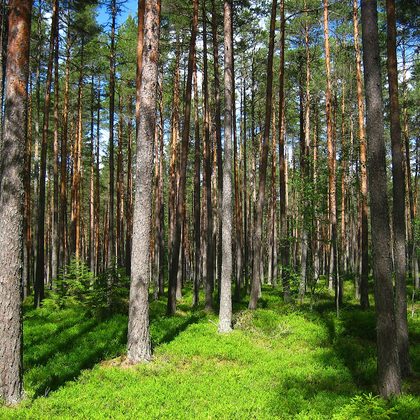
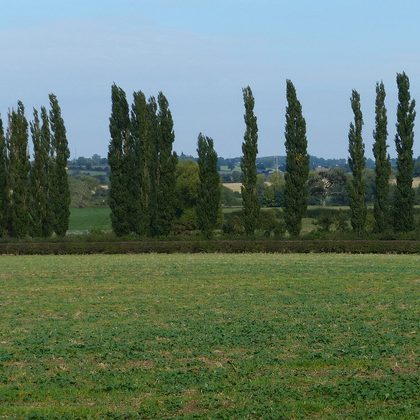
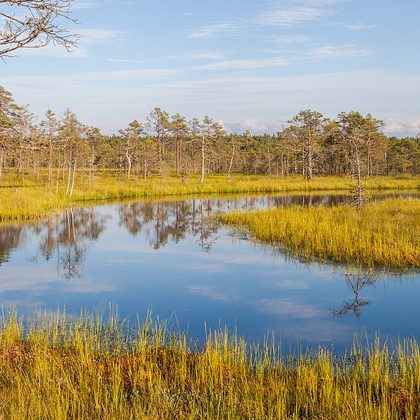
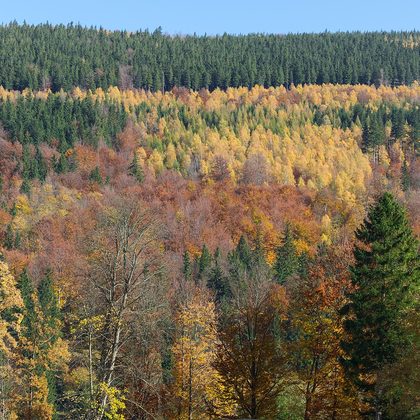
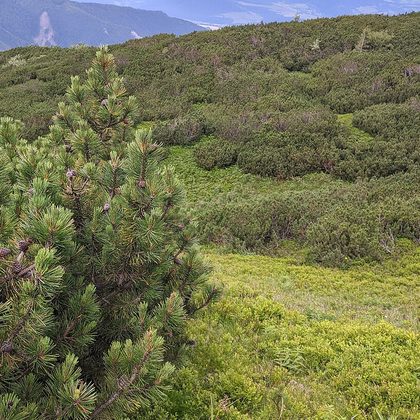
Open coniferous and birch forest of the taiga up to the tree line, especially where the forest is broken by raised bog, marsh, clear-fell and old burns, and where standing dead trees are left in place. It breeds in the hollow top of a broken stump, in an old woodpecker hole or in a nest box. In winter it keeps to the same open edges, and in irruption years also to roadsides, young plantations and farmyards.
Where the bird is most at home, classified with EUNIS — the European standard for habitats.
Range and movements
A breeding bird of the boreal forests of Norway, Sweden, Finland, north-western Russia and the Baltic states, with irregular nesting in Estonia. Numbers swing sharply from year to year with the vole cycle: in a peak year the birds lay large clutches and Fennoscandia holds several times the number of pairs of a low year, and when the voles then crash, young birds in particular move far south. Those irruptions produce the rare records in central and western Europe. In Britain it is a very rare vagrant of a handful of records, and in the Netherlands a rare vagrant as well, the best-known bird having wintered at Zwolle in 2013.
- Resident
- Breeding (summer)
- Winter
- Passage
- dark = core range, pale = thinly spread
Where and when to look
In March or April, drive slowly along forest edges, clear-fells and bog margins in Finnish or Swedish Lapland and scan the tops of dead trees systematically: the bird perches high, in the open and by day, so binoculars from the road are enough and there is no need to leave the car. The bubbling song carries far and often betrays an occupied territory before the eye finds the bird. For one closer to home, wait for an irruption winter and follow the reports between November and January after a vole crash in the north.
Conservation status
Not globally threatened (IUCN: Least Concern). The European population swings so widely with the vole years that a trend is hard to read, but the species remains widespread across its whole boreal range. The main pressure comes from modern forestry: clearing away standing dead trees and old stumps costs nest sites, while the suppression of forest fires and the tidying of clear-fells make the landscape less open. Leaving standing deadwood and small open patches in the taiga is the simplest measure.