All species › Owls › Typical owls › Eurasian pygmy-owl
Eurasian pygmy-owl
Glaucidium passerinum | Dwerguil | Mochuelo alpino
Europe's smallest owl, smaller than a Starling and with a head no bigger than a walnut. It is not strictly nocturnal but hunts at dusk, and in early spring and in autumn it will sit calling in the top of a spruce in broad daylight.

Voice
The territorial call is a soft, slow, clear whistle, dyuu … dyuu … dyuu, with about two seconds between notes and a slightly rising pitch; it carries a few hundred metres and sounds friendlier than an owl ought to. In September and October a second song is added: a rising scale of five to eight notes, tyu-tyu-tyu-tyú-tyúu, climbing step by step and breaking off abruptly. It sings mainly in the last minutes of dusk and in the hour before sunrise, peaking from February to April and again in autumn.
Recording: Domaszewicz — CC BY-SA 4.0 · Wikimedia Commons
Identification
Smaller than a Starling and very compact, with a small round head and no obvious facial disc: just small yellow eyes and a narrow, low-set white eyebrow line that gives it a stern look. Upperparts grey-brown with fine white spotting, crown densely speckled white, underparts white with brown streaks. The tail is proportionally long and dark with four or five narrow pale bars, and is often held cocked or flicked sideways. On the nape are two dark patches with a pale surround, the so-called false eyes, which from behind read as a second face. Flight is deeply undulating and woodpecker-like: a burst of fast beats, then a dip on closed wings. Females weigh 55 to 80 grams, males 47 to 65 grams, a difference not visible in the field.
Confusion species
Tengmalm's Owl often shares the same wood but is much larger, with a big round head, a broad pale facial disc with a dark rim and a surprised expression; its tail is short, its flight straight and even, and it appears almost only after dark. Little Owl is larger and longer-legged, with a flat crown, broad white eyebrows and fierce yellow eyes in a frowning face, and belongs in open farmland rather than closed conifer forest; it too flies low and deeply undulating like a woodpecker, so flight is exactly what does not separate the two. Scops Owl is slimmer, grey and bark-patterned, with short ear tufts, and is only a summer visitor. A small silhouette in the top of a spruce often turns out at range to be a Song Thrush or a Mistle Thrush.
Habitat
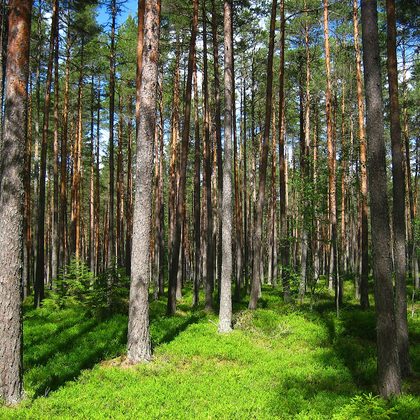
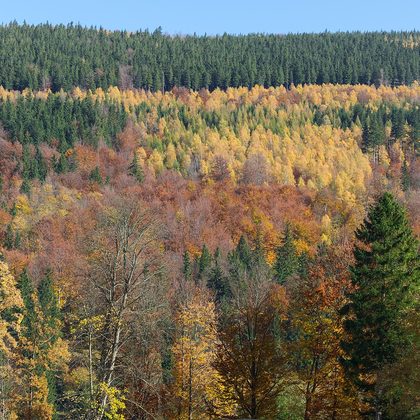
Old, varied coniferous and mixed woodland of the taiga and the middle mountains, with spruce and pine, clearings, felled patches, edges and plenty of dead wood. It depends on disused woodpecker holes, above all those of the Great Spotted Woodpecker, and hunts tits, Goldcrests and voles from low perches along edges and clearings. In autumn it stores prey in a tree cavity.
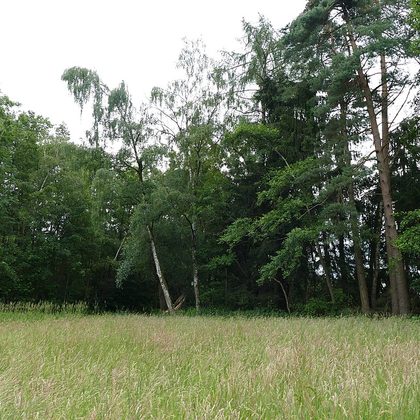
Where the bird is most at home, classified with EUNIS — the European standard for habitats.
Range and movements
From Scandinavia and the Baltic states east through the taiga to Siberia, and in addition in the mountain forests of central Europe: Vosges, Jura, Black Forest, Alps, Bavarian Forest, Carpathians and the Balkan ranges as far as Rila and Pirin. The species has been moving north-west for several decades; a small population holds in the Eifel, the Ardennes and the Hautes Fagnes, and that is much the nearest ground for a birder from the Low Countries or Britain. It has never occurred in Britain, and in the Netherlands it remains a major rarity with thirteen accepted records since 2002, mostly calling birds in conifer plantations. Resident, straying lower and further only in hard winters.
- Resident
- Winter
- Passage
- dark = core range, pale = thinly spread
Where and when to look
In March or early April, or else in October, go to old spruce forest with clearings in the Hautes Fagnes, the Eifel or the Ardennes half an hour before sunrise and stand still in a felled patch. Listening matters more than looking: the slow whistle gives the bird away long before you see it, and only once you have the direction do you scan the tops of dead spruces. A noisy, scolding party of tits and Goldcrests will often point it out. Do not use playback; calling birds are easily drawn out of their territory by it.
Conservation status
Not globally threatened (IUCN: Least Concern) and stable to slightly increasing in Europe, with a westward and north-westward expansion. The species depends on old forest: felling of hollow trees, tidying away dead wood and windthrow, and the conversion of varied mountain forest into even-aged plantation all make woods unsuitable. Where dead wood is left standing and woodpeckers can excavate, it holds up well. Disturbance by photographers and by playback at known song posts is a local problem.