All species › Owls › Typical owls › Eurasian scops-owl
Eurasian scops-owl
Otus scops | Dwergooruil | Autillo europeo
The Eurasian Scops Owl is a small, bark-coloured owl that you almost always hear before you see. From April into June its monotonous whistle sounds for half the night from a plane tree or an old olive, while the bird itself sits invisible against a branch. Around the Mediterranean the sound belongs to a summer evening as much as the crickets do.

Voice
The male sings a soft, flute-like and utterly monotonous tyuu, one note every two or three seconds, kept up hour after hour so that the sound runs for half the night. The note sits at about thirteen hundred hertz and carries a barely audible upward inflection at the end; on a still night it carries for hundreds of metres. The female answers slightly higher and often in two or three syllables, so that a pair together can seem to sing in double time. He sings from late March into early July, loudest in April and May, from roughly an hour after sunset and again shortly before first light. The main pitfall is the Common Midwife Toad, whose confusingly similar poo is shorter and flatter, lacks the inflection, comes from ground level — a wall, a stone heap, a bank — and is usually given by several animals at once at slightly different pitches, while the owl always calls from a tree crown and holds a single pitch.
Recording: GESHORS Yann — CC BY-SA 4.0 · Wikimedia Commons
Identification
Barely bigger than a Starling and clearly smaller and slimmer than a Little Owl: an elongated little owl with short ear tufts that it often lays flat. The plumage is a finely marbled and streaked mixture of grey and brown, exactly the pattern of old bark, with a row of white spots across the scapulars and a grey, finely streaked facial disc with a dark rim. The eyes are yellow, the bill lead-grey, the toes unfeathered. At rest it stretches into a thin upright stump with the tufts raised; relaxed it is round and ball-shaped. In flight it shows long, fairly narrow wings and a quick, straight flight that hardly undulates — quite unlike the deep bounding of a Little Owl. Besides the usual grey birds there is a rufous morph; juveniles are finer and more barred.
Confusion species
The Little Owl is squatter and far bulkier, with a flat crown, broad white eyebrows and fierce yellow eyes in a frowning face, brown upperparts with white spotting and legs feathered white; it often sits out by day on a post or roof ridge, flies low and deeply undulating like a woodpecker and is resident, while the Scops Owl sits upright in a tree and is only a summer visitor. The Long-eared Owl is the other owl with ear tufts, but far larger, with long, conspicuous tufts, orange-red eyes and a warm rufous plumage streaked the whole length of the underparts. In the east of the region the Pallid Scops Owl is the real pitfall: paler and sandier, with long straight streaks instead of fine marbling, and a song of short low hoots in a run rather than single spaced notes. On Cyprus the Cyprus Scops Owl is hardly separable by sight; it averages darker and colder grey and has no rufous morph, but in the field only the song and the location do the work.
Habitat
Warm, half-open tree country: old olive groves, almond and fruit orchards, dehesa, avenues of poplar and plane, village parks, cemeteries, gardens and farmyards with gnarled trees. It needs cavities in old trees, walls or nest boxes, and hunts mainly large insects — grasshoppers, crickets, moths and beetles — taken from a low perch. Closed forest and wholly treeless country are avoided.
Where the bird is most at home, classified with EUNIS — the European standard for habitats.
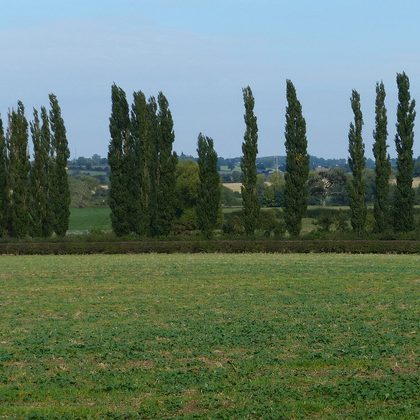

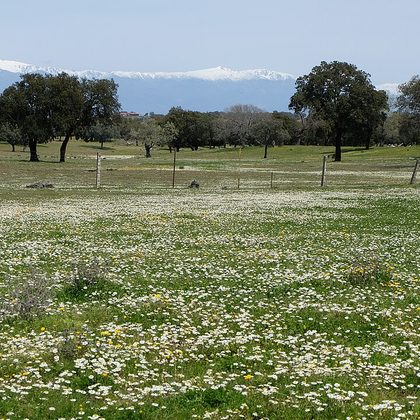
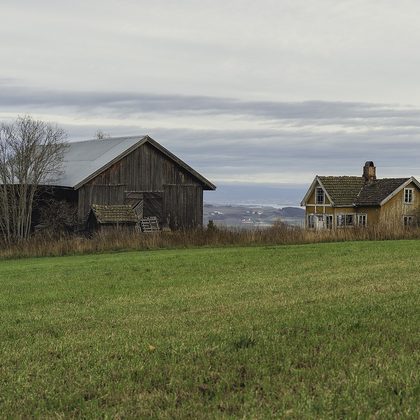
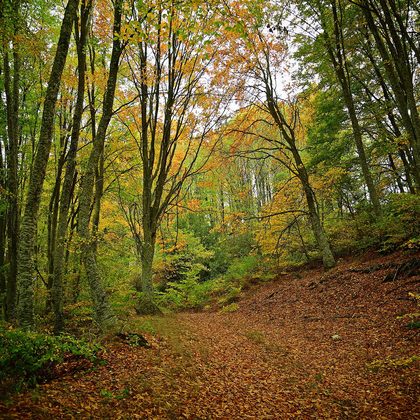
Range and movements
Breeds around the Mediterranean and across central Europe, from Iberia and north-west Africa east to the Caucasus and central Asia, with northern outposts in France, Switzerland, Austria and the Carpathian basin. The great majority leave in September and October for the Sahel; small numbers stay in southern Spain and on the Mediterranean islands. In the Netherlands it is a rare vagrant, a handful of records a year, usually a singing bird in late spring. Anyone wanting to see or hear the species looks for it in Spain, southern France, Italy or Greece.
- Resident
- Breeding (summer)
- Winter
- Passage
- Migration direction
- dark = core range, pale = thinly spread
Where and when to look
In May or June stand at the edge of a village about an hour after sunset where old plane, walnut or olive trees grow together, and listen for ten minutes before moving: the song almost always comes from a larger tree close to buildings. Then walk slowly towards it until you are under the tree and search the side branches against the last pale sky; a silhouette with two small points on the head is enough. Do not use recordings to draw the bird in — it goes on singing as long as you stand still.
Conservation status
Not globally threatened (IUCN: Least Concern) and still common in southern Europe. In the north of the range and in intensified farmland it is declining. The main causes are the loss of old hollow trees and of avenues and orchards, insecticide use that thins out the large insects it lives on, and road casualties along planted roads. In France, Switzerland and Austria nest boxes and the retention of pollards and old orchards work well locally; in Spain the species remains widespread.