All species › Owls › Typical owls › Cyprus scops owl
Cyprus scops owl
Otus cyprius | Cypriotische dwergooruil | Autillo chipriota
The Cyprus Scops Owl is a small grey owl found nowhere but Cyprus, where it is common in gardens, pine woods and village squares from the coast up to about 1900 m. It matches the Eurasian Scops Owl almost detail for detail; on the island it is the song that names it, a two-note phrase that runs through the night. It has been treated as a separate species on most world lists since 2015.

Voice
The male's phrase is made of two notes: a short, soft introductory note and immediately behind it the full whistle, which sits a fraction lower. The pair is repeated at the same slow beat as in Eurasian Scops Owl, about one phrase every two or three seconds, and goes on for much of the night; from a distance it sounds like two birds answering one another. That is where the difference lies. Eurasian Scops Owl gives one note per phrase and only exceptionally prefixes a short introductory note, whereas on Cyprus that doubling is the rule. The pitch itself falls in the same band in both, so it is the doubling and not the pitch that names the bird. It sings from February, loudest from March to May and again in autumn, from dusk onwards and on through the night.
No freely licensed recording is available for this species yet.
Identification
A small, slim owl with short ear tufts, yellow eyes and a lead-grey bill, barely bigger than a Starling. The plumage is a cool grey-brown, finely marbled and with thin dark streaks, on average darker and colder than in Eurasian Scops Owl; the rufous morph that occurs on the mainland is absent here. A row of white spots runs across the scapulars and the grey facial disc is finely marked with a dark rim. At rest the bird stretches into a thin upright stump with the tufts raised; relaxed it is round and ball-shaped. Flight is quick and straight on long, fairly narrow wings and hardly undulates.
Confusion species
The Eurasian Scops Owl is the only real problem, and by sight the difference is not reliable: Cyprus birds average darker and colder grey and lack the rufous morph, but that is an average and not a field mark. Migrant Eurasian Scops Owls cross Cyprus in March and April and again in September and October and are silent then, so a silent bird away from an occupied territory in those months cannot safely be named, while a singing one can. Of the island's other owls, the Little Owl is squatter and bulkier, with a flat crown, broad white eyebrows and fierce yellow eyes in a frowning face, and often sits out by day on a wall or a post. The Long-eared Owl is the other owl with ear tufts, but far larger, with long, conspicuous tufts, orange-red eyes and a warm rufous plumage.
Habitat
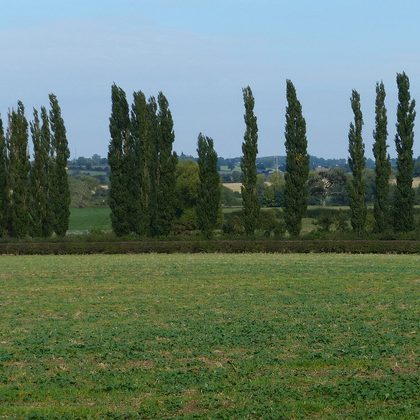
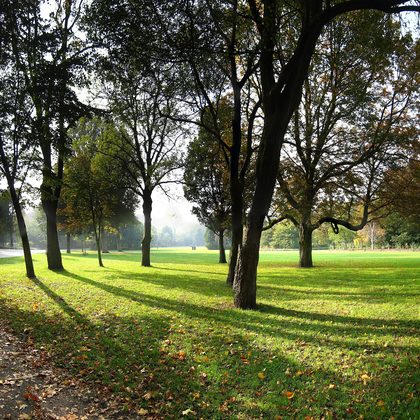
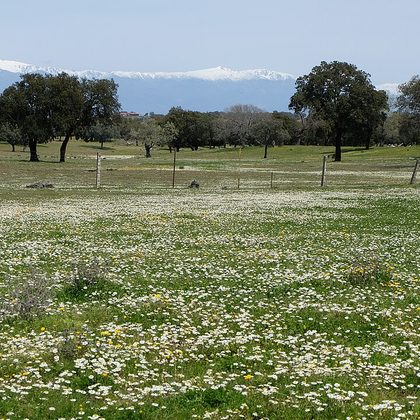
Almost any wooded landscape on the island below 1900 m: Calabrian pine forest, tree-lined village edges, gardens, parks and cemeteries, olive and carob groves and farmland with scattered old trees. It nests in cavities in trees, walls and buildings and takes readily to nest boxes; since Cyprus has no woodpeckers and Calabrian pine develops holes only when old, natural sites are scarce. It hunts mainly large night-flying insects taken from a low perch.
Where the bird is most at home, classified with EUNIS — the European standard for habitats.


Range and movements
The entire range lies on Cyprus: the species breeds across virtually the whole island, from the coastal plains and the wine villages up into the Troodos forests, with an estimated 5000 to 12,000 breeding pairs. It is resident and does not leave; in winter birds move down from the mountains to lower ground. It has not been recorded anywhere else. Eurasian Scops Owls from the mainland do pass over the island in spring and autumn, without the two mixing.
- Breeding (summer)
- Passage
- dark = core range, pale = thinly spread
Where and when to look
In March or April, after sunset, stand in a village in the hills behind Paphos, at Lefkara or on the southern edge of the Troodos, beside a cemetery or a lane of old trees, and listen for the double whistle. It is the commonest night sound on the island and there are usually several birds within earshot. If in doubt, count the notes in each phrase: two means the island species, one means a passage Eurasian Scops Owl, and silent birds are better left unnamed in March, April, September and October.
Conservation status
Not globally threatened (IUCN: Least Concern). Numbers are stable and the species profits from gardens, orchards and village planting, but its whole range is one island, which leaves it exposed to island-wide change. The clearance of old hollow trees, fire in the pine forests and insecticide use that thins out large night insects are the main concerns; nest boxes in villages and along wood edges are well used.