All species › Passerines › Larks › Oriental skylark
Oriental skylark | Alauda gulgula
Kleine veldleeuwerik | Alondra oriental
The eastern counterpart of the Eurasian skylark, and in this guide a bird of a single country. In winter it walks among skylarks on damp fields and along the fish ponds of the Hula and Beit She'an valleys in Israel, and the whole task is to pick it out there. Smaller, shorter-tailed, warmer in tone — and with not a scrap of white in wing or tail.

Voice
The song resembles the skylark's but is thinner, faster, drier and shorter-winded, with far more rasping and buzzing motifs and plenty of mimicry; the song flight is shorter and stays lower. Inside the area of the maps it is heard only in spring at the few breeding sites in the northern valleys. What you do hear in winter is the call, and the call is the whole story: a nasal, rasping, drawn-out bzeerr, sometimes doubled, dry and abrupt. Learn it and you will find the bird; skip it and you will walk past it dozens of times.
Recording: Mike Prince — CC BY-SA 4.0 · Wikimedia Commons
Identification
A skylark in miniature, which is the most useful description there is. Compact and short-tailed, with a small but distinct erectile crest, warm ochre-brown above with black streaks, creamy to rusty buff below with a heavily streaked breast and a plain belly. The bill is short, pointed and rather thick for an Alauda; the legs are pinkish. What matters most is what is missing: there is no white line along the trailing edge of the wing, at most a narrow dirty white or rusty buff fringe, and the outer tail feathers are creamy to rufous rather than pure white. The wing is short as well — the primaries project only a little beyond the tertials — which makes the bird look short-winged, long-legged and shorter-tailed still.
Confusion species
Everything turns on the Eurasian skylark, which shares these fields. Size: fourteen to sixteen centimetres against sixteen to eighteen — visible in a mixed flock, not on a lone bird. Trailing edge: skylark shows a crisp white line that lights up in flight, this bird nothing of the kind, only a narrow dirty or rusty fringe. Tail sides: pure white outer feathers on skylark, creamy to rusty here, so the tail stays plain as the bird flushes. Proportions: shorter tail and shorter hand, which makes it dumpier and more pipit-like. Tone: warmer, rustier, with a yellower wash over the breast. And then the clincher, the call: skylark rolls a dry chirrup, this species gives a rasping, nasal, drawn-out bzeerr that suggests a bunting more than a lark. One odd call out of a flock and you have it. Greater short-toed lark, which walks the same fields, is ruled out by its clean unstreaked breast with the dark mark on the side of the neck, and by its thick conical bill.
Habitat
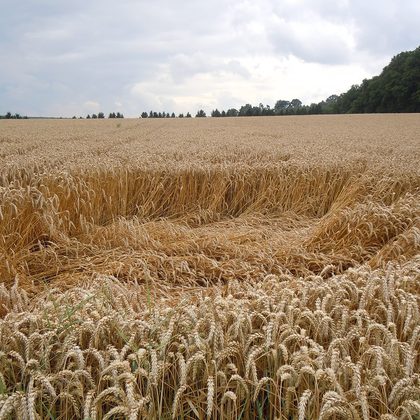
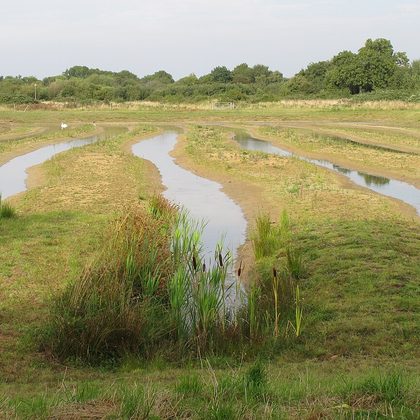
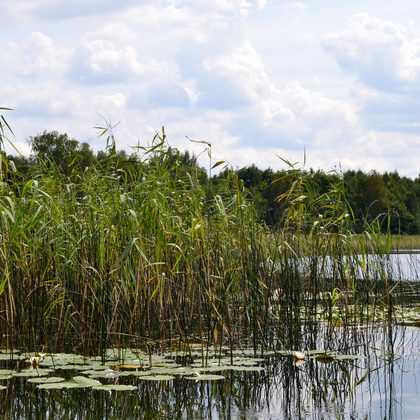
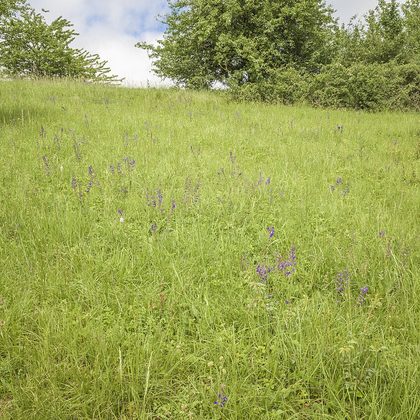
Damp, open farmland — not desert. Alfalfa and clover fields, stubble, closely grazed grass, the bare banks and bunds around fish ponds and reservoirs, and the edges of marshland. In Israel it comes down to the Hula valley and the Beit She'an valley, where irrigated farming and fish ponds lie side by side. It walks in low open growth and rarely strays far from damp ground.
Where the bird is most at home, classified with EUNIS — the European standard for habitats.
Range and movements
An Asian species: from Iran and Central Asia across the Indian subcontinent to China and South-East Asia, with northern birds moving south in winter. The western edge of that whole range lies in the Levant, and so just inside this guide. In Israel it is mainly a winter visitor, October to March, in the northern valleys, and a small number of pairs breed in the Hula and Beit She'an valleys. Elsewhere in the area of the maps it is a rarity, with a handful of records from Turkey and neighbouring countries. It does not occur in Europe.
- Winter
- Passage
- dark = core range, pale = thinly spread
Where and when to look
December to February, in the Hula valley or around the Beit She'an fish ponds, early in the morning. Drive the farm tracks until you find a flock of larks on an alfalfa field or a stubble, then work that flock properly — not a sweep with binoculars but a telescope, bird by bird. Check size and tail length first, then the trailing edge of every bird that flushes. Keep your ears open throughout, because the rasping call will give it away before the eye finds it. Allow half a morning.
Conservation status
Not globally threatened (LC): the Asian range is huge and numbers run into many millions. At the western edge, in Israel, the picture is different. There it is a small, local population wholly dependent on irrigated farmland and on the fish ponds of the northern valleys; lose those ponds, or switch the crops to ones without low open cover, and the bird goes with them. Trend figures for Israel are scarce, and because the species is so hard to separate from skylark the numbers are almost certainly underestimated.