All species › Passerines › Larks › White-winged lark
White-winged lark | Alauda leucoptera
Witvleugelleeuwerik | Calandria aliblanca
A steppe lark with a three-coloured wing: chestnut shoulder, snow-white secondaries and black primaries. The moment it flies the case is settled — which is just as well, because sitting in the grass it is simply a big pale lark. This guide places it with the Skylark in the genus Alauda rather than with the calandra larks.

Voice
The song resembles a Skylark's but has shorter phrases, a higher pitch and a busier delivery, with rapidly repeated motifs and plenty of mimicry; it is not sustained for minutes on end. The male sings in a high, wide song flight that can reach tens of metres above the steppe and ends in a steep drop, and also from a clod or a fence post. The call is a strong, low chirrp, fuller and less rolling than a Skylark's, and a dry chrit in flight. It sings from April into July.
No freely licensed recording is available for this species yet.
Identification
Slightly larger and heavier than a Skylark, with a thicker bill and a short tail. The male has a rusty crown, rusty ear-coverts and scapulars, a whitish face with a fine eye-ring, and pale unstreaked underparts marked only with a few spots on the breast sides. The view that counts is in the wing: the lesser coverts are chestnut, the greater coverts and the whole secondary tract are white, and beyond them the black primaries stand out. In flight this gives a broad white field across the inner wing, rather like a Snow Bunting. The tail has white outer feathers. The female is duller, with less rust on head and shoulder and a greyer, more finely streaked look, but keeps the white wing panel.
Confusion species
Skylark is the starting point: it has only a narrow white trailing edge, never a white field covering half the inner wing, no chestnut shoulder and no rusty crown. Calandra Lark is bigger and heavier, has black neck patches and a sooty-black underwing, so in flight it looks dark rather than pale. Bimaculated Lark shows no white in the wing at all. At range a flock of White-winged Larks in flight can suggest Snow Buntings, but those have a black-and-white wing without any chestnut and an entirely different tinkling call. On females and young birds the white secondary panel remains the deciding mark.
Habitat
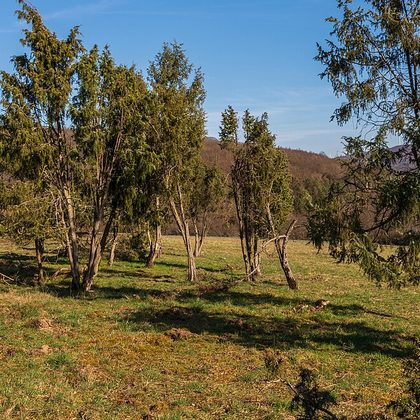
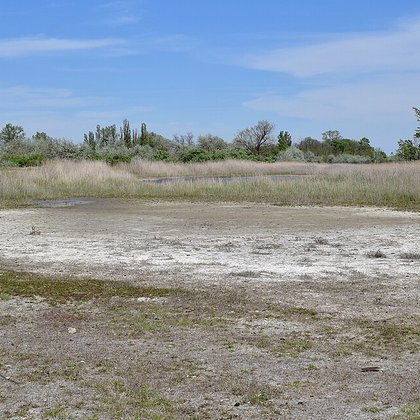
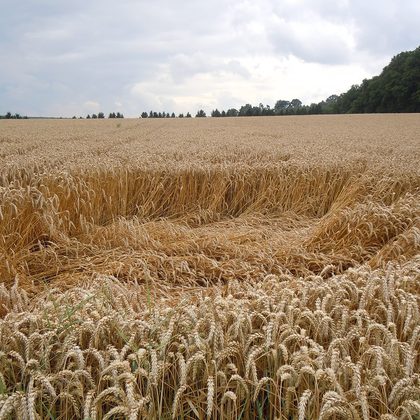
Dry herb-rich feather-grass and wormwood steppe, abandoned and rank arable, short-grazed pasture and the margins of saline hollows around steppe lakes. It likes slightly taller, denser cover than Black Lark and avoids genuinely bare ground. Outside the breeding season it works stubbles, roadsides and snowy steppe in flocks, often together with Skylarks and Black Larks.
Where the bird is most at home, classified with EUNIS — the European standard for habitats.
Range and movements
Breeds on the steppes of southern Russia — from the Don plain and Rostov across Volgograd, Kalmykia and Saratov to Orenburg — and eastwards through Kazakhstan into south-west Siberia. Only that western edge falls inside the map area; the bulk of the range lies well beyond it. In Ukraine it once bred regularly and now does so at best irregularly. In winter the birds move to the northern Black Sea, Crimea, southern Ukraine, the north Caucasus and the Caspian lowlands; in hard frost flocks appear as far as the Balkans and Turkey. Further west it is a vagrant, with only a handful of records for western Europe.
- Breeding (summer)
- Winter
- Passage
- dark = core range, pale = thinly spread
Where and when to look
May and June on the steppe of Rostov, Kalmykia or central Kazakhstan. Walk out into feather-grass steppe and wait: the song comes from high overhead, and the instant the bird drops in or a small party lifts, the white secondary panel flashes. Make sure you get the wing, and never try to name a bird on the ground; in a doubtful case it cannot be separated from Skylark while perched. In winter, work the same plains until the mixed flocks flush.
Conservation status
Not threatened (LC) at world scale, but doing badly along the western edge of its range. In Ukraine and European Russia the species has thinned out sharply within a few decades; the ploughing of the last feather-grass steppe, the conversion of pasture to arable, the end of extensive grazing and the drying of the saline hollows all amount to the same thing. Numbers in Kazakhstan are still large, but the fallow that fell out of use after 1991 is being brought back into cultivation there too. The remedy is the same as for every steppe bird: large unploughed plains under extensive grazing.