All species › Passerines › Swallows and martins › Pale crag martin
Pale crag martin | Ptyonoprogne obsoleta
Vale rotszwaluw | Avión isabelino
The crag martin of the desert: a small, sand-coloured bird that sails to and fro all year in the gorges of the Negev, the wadis of Jordan and the rock walls along the Nile. In Egypt and Israel it is by now just as much a town bird, plastering its mud cup under the balcony of a block of flats.

Voice
A quiet bird that you rarely hear before you see it. The song is a short muffled twitter of a few seconds, given in flight in front of the nest face or from the rim of the cup. Besides that a dry trrt that recalls house martin, and a thin high twee as a contact note between two birds passing each other. At the nest a soft rattling conversation goes on between the pair.
No freely licensed recording is available for this species yet.
Identification
A small, pale hirundine, about a sixth smaller than Eurasian crag martin and far more lightly built, with a short, square-cut tail. The upperparts are sandy brown to dull grey, pale enough to melt into a limestone face. Throat and upper breast are pale greyish white with at most a trace of fine speckling, and shade gradually into the off-white belly. The decisive mark lies under the wing: the coverts there are pale grey-brown, so the bird looks even and pale from below, with no dark armpit. The undertail coverts are pale too, which keeps the rear end light. The spread tail shows a row of small white spots, smaller and on fewer feathers than in Eurasian crag martin. Flight is light and agile, with quicker beats and shorter glides than its big relative. Sexes alike.
Confusion species
From Eurasian crag martin the quickest separation is from below. Hold the bird against the sky and look at the wingpit and the undertail: in Eurasian crag martin both are dark to blackish brown, so the bird looks two-toned underneath with a heavy dark rear; in pale crag martin everything there is pale and even, and that contrast still reads at range. In the Moroccan mountains you also see that these are two different worlds: Eurasian crag martin holds the high Atlas and the damp gorges, pale crag martin the low, hot wadis, the oases and the desert edges. Sand martin and brown-throated martin, which pass through the Near East on migration, have a notched tail with no white spots and hunt low over water rather than along a face; sand martin also has the sharp breast band. House martin is blue-black with a white rump. Swifts are far larger and wholly dark.
Habitat
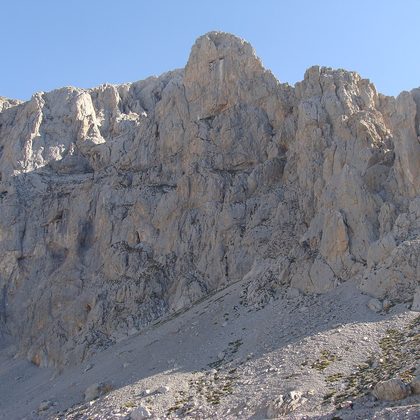
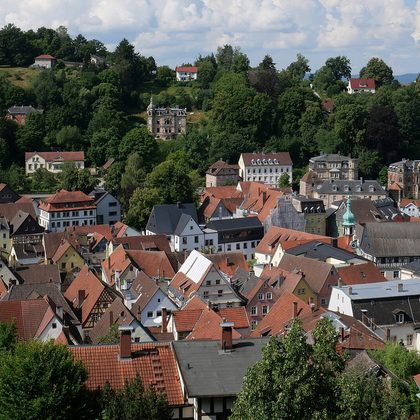
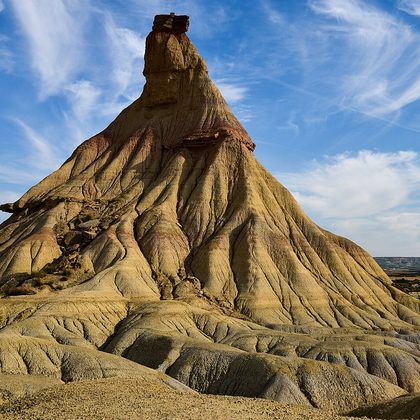
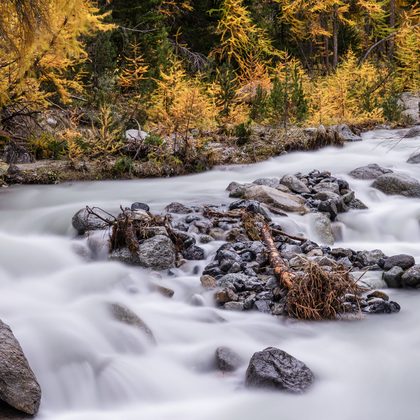
Cliffs, gorges, wadi walls, weathered limestone crags and the rims of desert plateaux, from below sea level at the Dead Sea to high in the mountains. Artificial faces are taken just as readily: dams, bridges, viaducts, temples, forts, hotels and blocks of flats, right into the middle of Cairo. It hunts along the face and over the bare gravel and dry slopes in front of it, and gathers willingly above a pool, an irrigated field or an oasis, which in dry country is where nearly all the insects are. The nest is a half-cup of mud built against an overhang.
Where the bird is most at home, classified with EUNIS — the European standard for habitats.

Range and movements
The desert belt from North Africa to south-west Asia. Within the map area: Morocco and Algeria, where it is scarce and keeps to the southern slopes and the Saharan edge; Egypt, where it is common along the Nile from Abu Simbel and Aswan into the cities of the Delta; Sinai, Israel and the Palestinian territories; and Jordan, where it is among the commonest birds of Petra, Wadi Rum and the Dead Sea gorges. In Israel it has only become common since the 1970s. Beyond the map area the range runs on across Arabia, Iraq and Iran into Pakistan. It does not migrate; at most mountain birds drop lower in winter.
- Resident
- Winter
- Passage
- dark = core range, pale = thinly spread
Where and when to look
Petra at first light, or the gorge at Wadi Rum, or a viewpoint above a Negev dam: stand with the sun behind you and let the birds turn overhead. Only from below do you see what matters — the pale wingpit and the pale undertail — and when one spreads its tail the spots light up. In Egypt you need not leave town: from a hotel balcony in Aswan or Luxor they pass along the facade, and in the evening they wait for insects at the street lamps.
Conservation status
Not globally threatened, with a large and growing range and rising numbers. Like its bigger relative it profits from everything people stand upright in the landscape: dams, bridges, temples, hotels and flats supply cliffs where there is no rock, and irrigation supplies insects where there was no water. In Israel that has turned it from a local bird of crags into an ordinary town bird within half a century. There are no threats of consequence; only pressure-washing or renovating a building in the breeding season strips a colony of its nests in a morning.