All species › Owls › Typical owls › Pallid scops owl
Pallid scops owl | Otus brucei
Gestreepte dwergooruil | Autillo persa
A scops owl for the dry edge of the region: pale sandy grey, unhurried, and at night given away by a call that simply will not stop. Where the Eurasian scops owl belongs to the Mediterranean, this one belongs to the date gardens and riverside poplars of the Jordan valley. It is the only scops owl you can hear calling in the Levant in midwinter.

Voice
The male gives a low, hollow, dove-like whoop, roughly one note a second, with the regularity of a metronome. Counts run to sixty-five and even ninety notes a minute — two to three times the rate of the Eurasian scops owl, which delivers one note every two or three seconds in a far higher, more whistled tone. Of all the scops owls of the region this is the lowest-pitched. The opening is the pleasure of it: he starts almost inaudibly and lets the series swell in volume and pitch over several minutes, so that you first suspect you are imagining it and then cannot unhear it. The female answers with a short hoarse note. Song begins in March and peaks in the second half of April; wintering birds in Israel are usually silent.
No freely licensed recording is available for this species yet.
Identification
A small owl with short ear tufts, marginally bulkier and broader-headed than the Eurasian scops owl, but at any distance recognised by what it lacks. The plumage is pale sandy grey and looks plain, marked with long, thin, dead-straight black shaft streaks like pencil lines — no fine marbling, and none of the cross-vermiculation that breaks up the pattern of its relative. The facial disc is pale cream with a narrow dark rim, the eyes yellow, the bill horn-grey. A useful mark that binoculars will show: the feathering of the leg carries on over the base of the toes. There is no rufous morph; every bird is sand-coloured. In flight it is narrow and direct, with a steadier, less flicking action.
Confusion species
The Eurasian scops owl is the only real confusion, and three things settle it. First the pattern: the pallid scops owl carries only long, separate pencil streaks on a plain ground, without the cross-barring that turns its relative into a piece of moving bark. Second the leg: on the pallid the feathering runs out onto the base of the toes, on the Eurasian it stops higher and the toes are bare. Third, and easiest, the season: in the Levant the Eurasian scops owl is a summer visitor while the pallid is present in winter, so a small eared owl in a date garden in January needs no further argument. The songs also separate them at once — see below. A little owl in the same wadi is shorter, broader and flat-headed, without tufts, and sits out in the sun by day.
Habitat
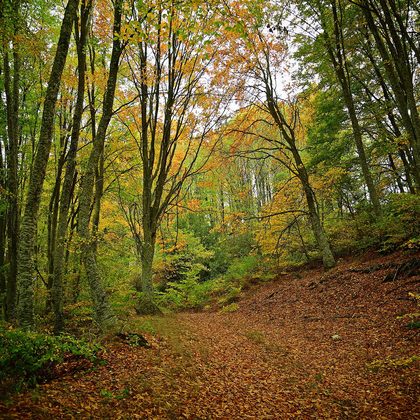
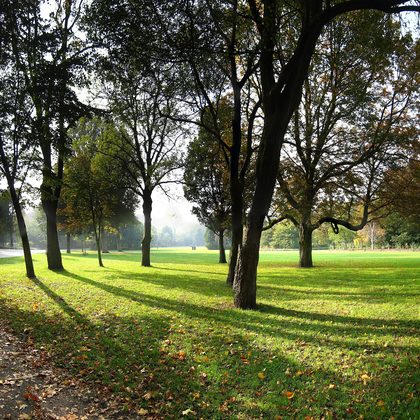
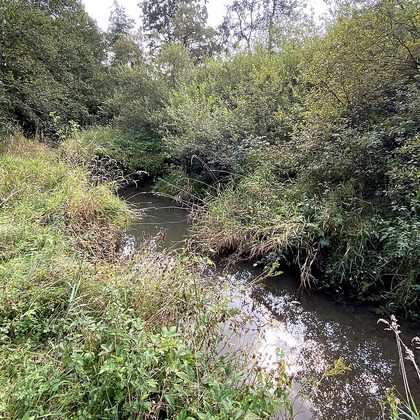
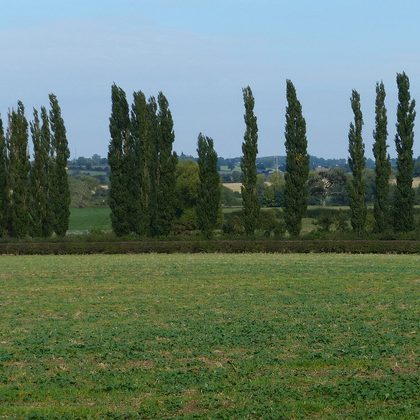
Half-open tree country in dry regions, always where there is water: poplar, willow and tamarisk woodland along rivers and wadis, date plantations, pistachio and almond orchards, village gardens and farmyard trees. It needs cavities in old trees, walls or rock, and hunts from a low perch for large insects, spiders, lizards and the occasional mouse. Closed forest plays no part in its world, and treeless desert is avoided.
Where the bird is most at home, classified with EUNIS — the European standard for habitats.
Range and movements
From Turkey and the Levant east through Iran and central Asia to north-west India. Within the region covered here it is a bird of Israel and Jordan: small numbers winter in the Jordan valley, the Arava and around the Dead Sea, and in recent years a handful of pairs have bred in the Rift. The classic site for European birders lies just beyond the eastern edge of the map, at Birecik on the Euphrates in south-east Turkey, where the species breeds in gardens and pistachio orchards. It has never been recorded in Britain or the Low Countries.
- Resident
- Breeding (summer)
- Winter
- Migration direction
- dark = core range, pale = thinly spread
Where and when to look
In December or January find a date garden or a line of old poplars in the Jordan valley or the Arava and stand still for half an hour after dark. The call is so low that traffic or wind swallows it, so pick a still evening and a spot away from the road. Wintering birds are usually silent, so work the trunks and heavy side branches with binoculars: the owl perches low and pressed against the wood. Use no playback and no bright lamp — a brief, weak red beam is enough.
Conservation status
Not globally threatened; the range is vast and the species is locally common in Iran and central Asia. At the western edge, in Turkey and the Levant, it is scarce and vulnerable, because there it depends on a narrow ribbon of old trees along water. The main threats are the clearing of riverside poplar and tamarisk, water abstraction that dries those ribbons out, insecticides that remove the large insects it lives on, and road casualties along orchard roads. At the few known breeding sites, disturbance by photographers and the use of playback are a real problem.