All species › Kingfishers, bee-eaters and rollers › Kingfishers › Pied kingfisher
Pied kingfisher | Ceryle rudis
Bonte ijsvogel | Martín pescador pío
The only black-and-white kingfisher in the world, and the only one that can hang on the wing for minutes over open water far from any perch. Over the fish ponds of Israel and along the Nile it hovers like a big pied tern before dropping vertically.

Voice
Noisy and conspicuous: a sharp chattering chirruk chirruk in flight, and a busy high twittering at the colony or on a favourite post. Heard all year, loudest in spring and wherever several birds fish one pool together; the sound arrives before the sighting.
No freely licensed recording is available for this species yet.
Identification
Large and heavily built, with a big head and short shaggy crest, a long black dagger of a bill and dark legs. The whole plumage is black and white: black upperparts speckled and blotched with white, a white supercilium over a black eye-stripe, and white underparts. The male carries two black breast bands, a broad one with a narrow one below it; the female a single band broken in the middle. Juveniles show a dusky, mottled band. In flight white panels flash in the primaries.
Confusion species
Nothing else in the region is a pied kingfisher. Common kingfisher is far smaller, cobalt and orange, and hovers only briefly and close to the bank. Belted kingfisher — an extreme vagrant from North America to the Atlantic seaboard — is blue-grey with a white collar and shows nothing pied at all. The real trap is a hovering bird at long range: a common or little tern over the same water hangs still too, but has narrow pointed wings, a forked tail and a light dancing flight, where the pied kingfisher stands heavily in the air with its head straight down.
Habitat
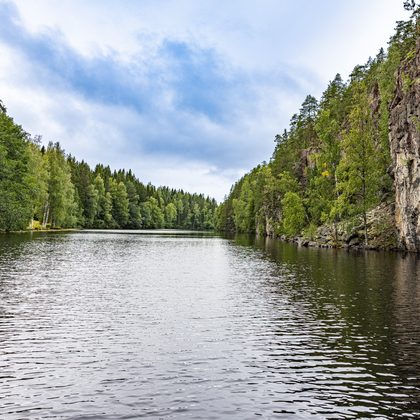
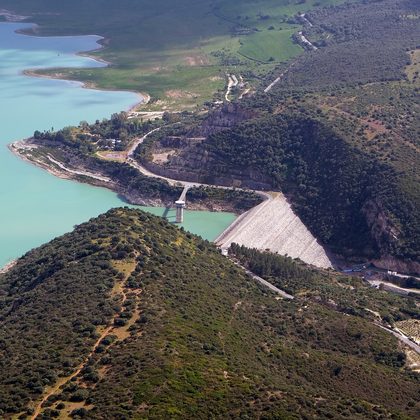
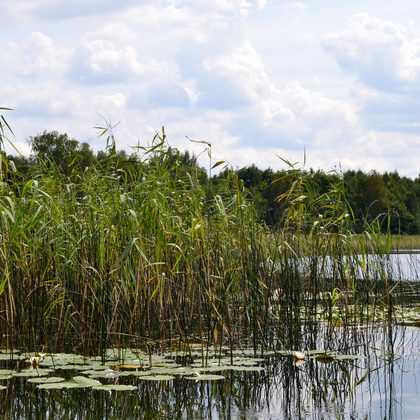
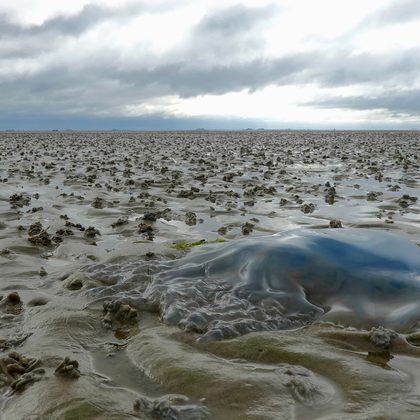
Open fresh and brackish water with clear shallows: lakes, reservoirs, slow rivers, irrigation canals, fish ponds, sewage works and salt pans, and on the coast lagoons and river mouths as well. For nesting it needs a steep sand or loam face where dozens of pairs can tunnel side by side; in such a colony unpaired young males often help to feed another pair's brood, which is unusual among birds. It hunts over open water even where no branch or post is within reach, and swallows small fish in flight — which lets it fish further out than any other kingfisher.
Where the bird is most at home, classified with EUNIS — the European standard for habitats.

Range and movements
Within the area of this guide it breeds along the Nile in Egypt, through the Levant from the Jordan valley to the Israeli coastal plain, and in southern Turkey along the Seyhan, the Ceyhan and the Euphrates, reaching its northern limit around Birecik and the Göksu delta. Beyond that it is spread across Africa and southern Asia. Resident, though young birds wander, which accounts for occasional records on Cyprus and in Greece. There is no record from Britain, Ireland or the Netherlands.
- Resident
- Winter
- Passage
- Migration direction
- dark = core range, pale = thinly spread
Where and when to look
In Israel the Hula valley is the easiest place: watch out over the water from the hide until a bird stops in mid-air. The fish ponds at Ma'agan Michael and the Sea of Galilee are equally reliable. In Egypt a walk along the Nile bank at Luxor or Aswan will do it. Look for hovering silhouettes over open water rather than for a bird sitting on a branch.
Conservation status
Not threatened and numerous throughout its range; in Israel and Turkey it has gained from fish ponds and reservoirs. It is persecuted or trapped locally at fish farms, and river training and hard bank revetment take away the faces it nests in. Pollution and silt hit it sooner than other fish-eaters, because it must see its prey from high above the surface.