All species › Passerines › Shrikes › Red-tailed shrike
Red-tailed shrike | Lanius phoenicuroides
Turkestaanse klauwier | Alcaudón colirrojo
The Red-tailed Shrike breeds in the dry foothills and valleys of Central Asia, from north-east Iran to western China, and winters in East Africa. Its breeding range begins just beyond the edge of the area covered by these maps, but its migration route runs right through it: in March and April, and again in September and October, it passes in numbers through Iran and the Gulf states. In north-west Europe it is the rarest of the three eastern shrikes, and the only one that also turns up here in spring.

Voice
Almost always silent in Europe. On the breeding grounds it gives a hard, rattling chek-chek in alarm and a harsher chair when disturbed. The song is a soft, sustained chatter with many imitations, delivered from a bush top and usually audible only at close range.
No freely licensed recording is available for this species yet.
Identification
A slim shrike, slightly smaller than a Red-backed Shrike. The male is the most strongly marked of the three: the crown is warm rufous and stands out clearly against a grey-brown to grey mantle, and below it runs a broad, deep black mask that continues across the lores to the base of the bill. Above that lies a crisp, clean white supercilium. The underparts are white to creamy and often strikingly clean; rump and the long, narrow tail are rusty red. The wing usually shows a small white patch at the base of the primaries. Females are duller, with a browner mask, a less sharply drawn supercilium and fine dark vermiculation on the white flanks. Six or seven primary tips show on the closed wing, more than in Brown Shrike but fewer than in Red-backed. In the west of the breeding range birds of the karelini type occur, with a greyer crown and correspondingly less contrast; their status is unresolved.
Confusion species
The rusty red rump and tail separate this bird at once from Red-backed Shrike, which has a black-and-white tail and a chestnut back. The real task is Daurian Shrike, with which this species was treated as one until this century and from which it has been kept separate on the British List since 2018. On an adult male the difference is clear: Red-tailed is a bird of contrasts — rufous crown against a greyer mantle, a broad mask running across the base of the bill, a sharply drawn white supercilium — while Daurian is pale sandy with almost no difference between crown and mantle, a narrower mask and a diffuse supercilium. On females and first-year birds that difference largely disappears, and many birds cannot be named with certainty in the field; such records are accepted simply as Red-tailed or Daurian Shrike. Brown Shrike is warm brown with a dull brown tail, a much heavier bill and a strikingly short hand showing some four primary tips. Two things make it harder still. Birds of the karelini type, which breed mainly along the western edge of the range, recall Daurian Shrike because of their greyer crown — both Dutch birds, in 2000 and 2002, belonged to that type. And it is this species in particular that hybridises with Red-backed Shrike where their ranges meet; the most reliable sign is a tail in which rufous and dark markings run together. Better to leave a bird unnamed than to name it on a single character.
Habitat
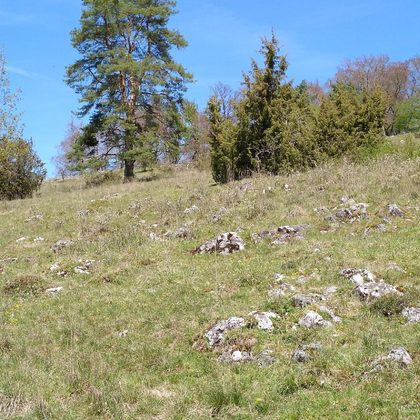
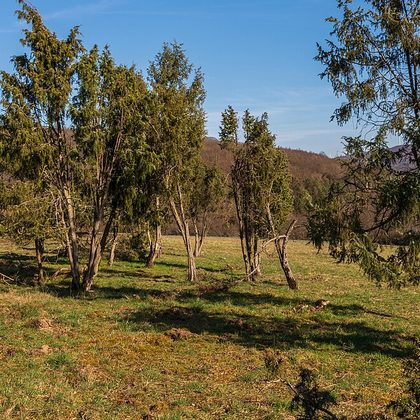
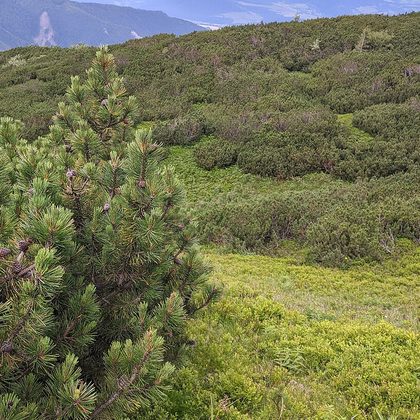
Dry, open country at the foot of the Central Asian mountains and far up into them: juniper scrub on mountain slopes, tamarisk along river valleys, thorn scrub in steppe, reed fringes along watercourses and the edges of fields and orchards. It occurs from the plains up to well over three thousand metres, higher than the other shrikes of this group. Everywhere the requirement is bushes with open ground between them: the nest sits low in a thorn bush, hunting is done from a projecting branch, and prey is impaled on thorns and barbed wire.
Where the bird is most at home, classified with EUNIS — the European standard for habitats.

Range and movements
The breeding range runs from the Kopet Dag and north-east Iran through Turkmenistan, Uzbekistan, Kyrgyzstan and southern Kazakhstan to western Xinjiang, and south to Afghanistan and Pakistan. Its western limit falls just outside the area of these maps: the Iranian breeders sit in the mountains east of fifty-three degrees east, and everything further west involves migrants only. That migration, however, is fully within view: in March and April and again in September and October the species is a familiar bird in Kuwait, eastern Saudi Arabia, Qatar, Bahrain and western Iran, moving to and from the winter quarters in East Africa. In north-west Europe each country has only a handful of records. The Netherlands has six, all this century: five between 13 August and 25 November, and one in spring, at Bergen on 14 May 2022. Britain has more than ten since the first in Norfolk in 1995; the best known stayed for a month at Bempton Cliffs in Yorkshire in the summer of 2022. Iberia has only a few records, among them a much-watched bird at the Tagus estuary in Portugal in July 2018.
- Passage
- dark = core range, pale = thinly spread
Where and when to look
In north-west Europe: August to late November on the coast, with a slim chance in May. Search dune scrub, rough field margins and barbed wire for a shrike hunting from a low perch. Look at the tail first — rusty red, not black-and-white — then at the head: contrast between a rufous crown and a greyer back, and a mask that carries across the base of the bill, both point to this species. Do not judge the bird into the light, because crown colour changes drastically then; walk round if you have to.
Conservation status
Not globally threatened (IUCN: Least Concern). The species is numerous across much of Central Asia and locally benefits from scrub along fields and irrigation channels. For Europe it is a visitor with no conservation status of its own. Exactly how many records there are is hard to say: because this species and Daurian Shrike were long treated as one, a proportion of the older observations can no longer be assigned to either, and in practice the usable series only begins around the turn of the century.