All species › Passerines › Shrikes › Northern shrike
Northern shrike | Lanius borealis
Noordelijke klapekster | Alcaudón boreal
The Northern Shrike is the grey shrike of the taiga and the tundra edge, from central Siberia through Alaska to Canada. In north-west Europe it counts as a winter bird only in the sense that the very few claims all fall between October and March: there are no more than a handful of accepted European records, several of them settled by DNA. For a British observer it is the possibility raised by any unusually large, pale, heavily barred grey shrike. Like its relatives it impales mice and small birds on thorns.

Voice
As Great Grey Shrike: a harsh rattling chek-chek in alarm and a hard, nasal waaid. The song is a soft, drawn-out warble with many imitations of other birds, given from a high perch and heard outside the breeding season too. Voice is no help in separating the species: the differences are too slight and too variable to work from in the field.
No freely licensed recording is available for this species yet.
Identification
A large grey shrike, on average slightly bigger and heavier than Great Grey Shrike. The upperparts are a light, pale ash grey and the underparts white; adults often keep fine vermiculation on the breast, and in first-winter birds that vermiculation covers the whole underside as dense, fine barring, over a brownish wash. The black mask is comparatively narrow and barely crosses the base of the bill in front of the eye, leaving a pale wedge between bill and mask, with a thin white line above it. The bill is the best pointer: longer and deeper than in Great Grey Shrike, with a stronger hook and usually an obviously pale base to the lower mandible. The wing is black with a white primary patch, the tail long and black with white outer feathers. In posture and hunting style it cannot be told from Great Grey Shrike: upright on an exposed top, tail swinging, a low undulating flight.
Confusion species
Great Grey Shrike is the yardstick and the real difficulty. It averages smaller, with a shorter and shallower bill and a weaker hook, a broader mask that reaches further across the base of the bill in front of the eye, and adults show cleaner, less vermiculated underparts. None of those characters settles a bird on its own: some individuals fall between, and the Finnish rarities committee therefore accepts European records only with DNA. Iberian Grey Shrike points the other way: darker grey, a pink wash across the breast, a broader white brow and less white in the wing. Lesser Grey Shrike is more compact, with black running right across the forehead, a shorter bill and longer wing points, and it is a summer bird here, so confusion in the winter half of the year is all but impossible. In short: in the field concentrate on the bill and the barring, and accept that the bird may not be identifiable.
Habitat
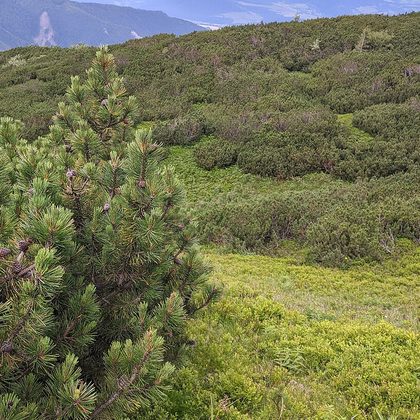
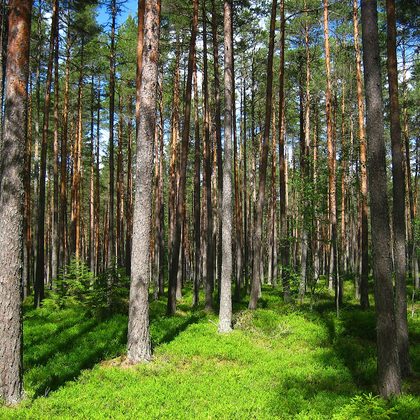
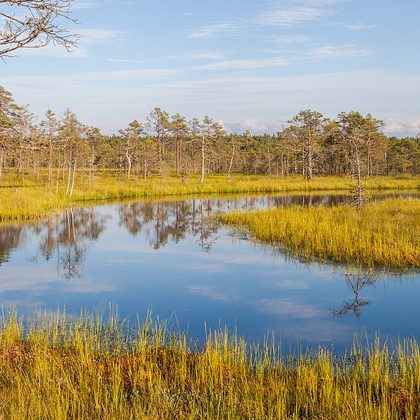
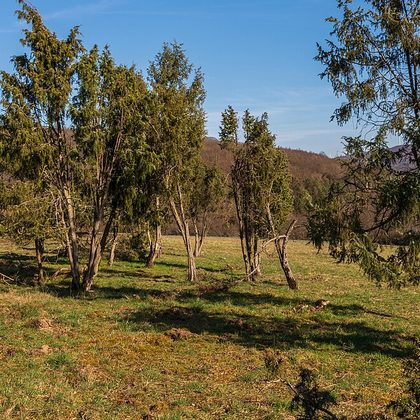
On the breeding grounds the transition from forest to tundra: open larch and spruce taiga with plenty of clearings, willow and dwarf birch scrub along streams, and the margins of peat bogs — everywhere with free lookouts above low, vole-rich vegetation. In winter it drops south into open country with scattered bushes and trees: grassland, steppe and field margins. The stray birds in Europe turn up in the same sort of ground as Great Grey Shrike.
Where the bird is most at home, classified with EUNIS — the European standard for habitats.
Range and movements
Breeds from central and eastern Siberia east to Kamchatka, and on the far side of the Bering Sea through Alaska and northern Canada to Labrador; it winters well to the south, into the northern United States. The entire range therefore lies outside the map area of this guide. In Europe it is an extreme vagrant, with only a handful of accepted records, some of them supported by DNA. The single Dutch record is a bird collected at Nuenen in November 1909, which lay in the Naturalis collection and was recognised as Lanius borealis sibiricus only after 2020.
Where and when to look
Realistically you do not find this bird; you stumble on it. Anyone looking at grey shrikes in winter would do well to photograph the head profile and the side of the breast of every one: bill length, the shape of the mask in front of the eye and the extent of the vermiculation are what the case turns on afterwards, and they are easier to judge at home on a sharp image than through a telescope. If a bird looks promising, collect droppings or a dropped feather as well; without DNA the identification stays open in Europe.
Conservation status
Not globally threatened (IUCN: Least Concern): the range is vast and lies largely in thinly settled taiga, although North American winter counts have shown a slow decline. For Europe the species is mainly a taxonomic matter. Lanius borealis was long regarded as the northern form of Great Grey Shrike and has been treated as a separate species since 2017, after genetic work showed the Siberian and North American birds to stand closer to one another than to the European ones. Old museum skins have been re-examined ever since — and in the Netherlands that immediately produced a new species.