All species › Passerines › Wagtails and pipits › Red-throated pipit
Red-throated pipit | Anthus cervinus
Roodkeelpieper | Bisbita gorgirrojo
The only pipit with a colour. From May the males stand out on the tundra of Finnmark, Lapland and the Kola Peninsula with a brick-red throat, face and upper breast — a pattern nothing else in Europe comes near — singing from a dwarf birch or in a low flight over the bog. Outside those few weeks it is a heavily streaked, high-contrast small pipit that turns up on migration in wet grassland, rice fields and stubble, and that you find above all by its long, sighing call. It breeds inside the area of this guide, but in western Europe it is a scarce autumn migrant, most reliably found on an island in late September.

Voice
The call is the best character the species has away from the breeding grounds, and it is unmistakable once known: a long, high, reedy, slightly hoarse pseeeeh that sags away at the end and dies out like air escaping. It is far more drawn out than the short notes of meadow or tree pipit and sounds plaintive rather than sharp; migrants call almost continuously as they pass, and over the fields of Israel and Cyprus in October it is one of the standard sounds of the sky. A short hard chup is sometimes given on flushing. The song, heard only in the far north, is an oddly monotonous buzzing and rattling phrase with an insect-like humming middle section and a closing trill, delivered in a low song flight over the bog or from a dwarf birch, and it suggests a grasshopper more than a songbird.
No freely licensed recording is available for this species yet.
Identification
Small and compact at 14–15 cm, short-tailed, and boldly streaked. The summer male is unmistakable: throat, cheeks, forehead and upper breast are brick-red to pink-orange and unstreaked, the colour wrapping round the head like a hood, and below it the breast turns white with heavy black streaks. The female shows less red, sometimes only a pink wash on the throat, and juveniles and winter birds show none at all. For those birds — which is most of what you will see — two characters always work. The first is the rump: clearly dark-streaked in this species, plain in meadow, tree and olive-backed pipits. On a bird flying away that is often all you get, and it settles the matter. The second is the back and flanks: two broad creamy braces run down the mantle, and the flanks carry heavy, broad, jet-black streaks on white — blacker and broader than on any other small pipit. The legs are pale flesh and the hindclaw is long. The overall impression is short-tailed, dumpy and very contrasty, and the bird keeps low.
Confusion species
In summer plumage there is nothing to confuse. In autumn plumage, meadow pipit is the first to eliminate: duller and browner, plain-rumped, with narrower and less black flank streaks, much vaguer mantle braces and a completely different stuttering call. Tree pipit has fine flank streaks and a plain rump. Pechora pipit, described later in this book, is the genuine identification problem: also heavily streaked and pale-braced, but shorter-tailed, much stouter-billed, with a longer primary projection and a hard, short call — where red-throated calls long and plaintive. On migration in southern Europe olive-backed pipit is the third option, but its mantle is green and unstreaked. Faced with a heavily streaked small pipit, flush it and spend that one second on the rump; everything after that is confirmation.
Habitat
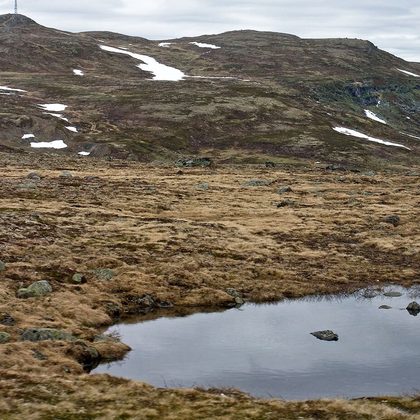
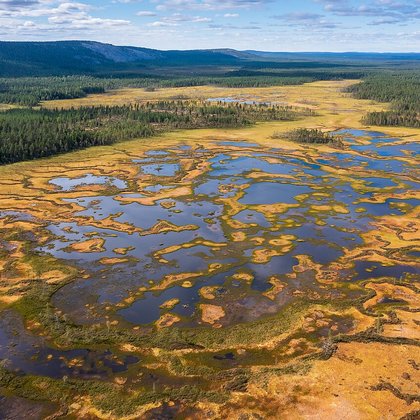
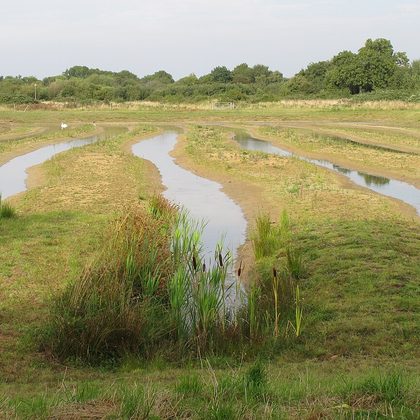
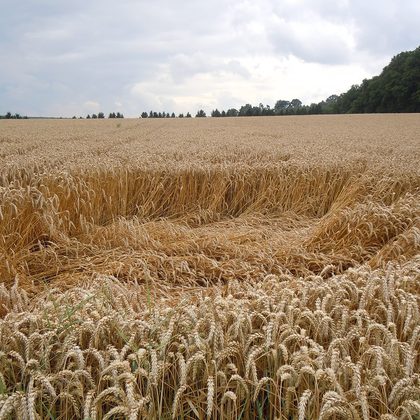
In the breeding season, wet low-lying tundra and the marshy birch zone: sedge flats and sphagnum with pools, dwarf birch and willow scrub along streams, palsa mires and the damp margins of tundra lakes, from sea level up into low mountain tundra. Always near water and always with some low scrub. On migration and in winter the picture is quite different: damp, short-grazed pasture, rice fields, irrigation channels, wet stubble, marsh edges and freshly cut or grazed fields, often in the company of yellow wagtails. It avoids dry, bare ground.
Where the bird is most at home, classified with EUNIS — the European standard for habitats.
Range and movements
Breeds from northern Norway, Swedish and Finnish Lapland and the Kola Peninsula east across arctic Russia to Alaska. The Scandinavian and Kola part of that range lies within the area of this guide, which makes red-throated pipit a genuine, if northern and thinly spread, European breeding bird; in Finnmark, Troms and Finnish Lapland it is locally the commonest pipit of the wet tundra. The whole population winters in East Africa, southern Asia and south-east Asia. The main migration route runs south-east, so the big numbers cross the eastern Mediterranean: it is a common migrant and locally a common wintering bird in Israel, Cyprus, Egypt and Turkey. That is precisely why it is scarce in western Europe. In Britain it is a rare but annual migrant, with most records in late September and October on Shetland, the Northern Isles and the Scilly and south-west coasts, and a smaller spring passage in May.
- Breeding (summer)
- Winter
- Passage
- Migration direction
- dark = core range, pale = thinly spread
Where and when to look
For full summer plumage there is one address and one moment: the first half of June on the tundra of Varanger or Finnish Lapland. Drive the roads across the dwarf birch flats with their pools, stop at every singing bird and check the posts and the tops of the scrub; the males sing in the open and allow close approach, and the colour really is as bright as the plate. In Britain the window is the last ten days of September and the first week of October, on short turf, an airfield or a cattle field on an island. Walk with the wind and listen: nine out of ten are found on the call before they are ever seen.
Conservation status
Not globally threatened (LC): the range covers most of the arctic belt from Norway to Alaska and the population runs to millions. Within Europe the species is confined to the far north and numbers swing widely from year to year, which is normal in tundra birds and tracks June weather and the rodent cycle that governs how hard skuas and raptors hunt. The longer-term concerns are real enough: the wet tundra on which the species depends entirely is changing fast as the north warms, with scrub advancing, flats drying out and thaw altering the whole water regime. Its wintering grounds in East Africa and south-east Asia lie in marshes and wet rice cultivation that are themselves under pressure. For now, no decline has been demonstrated.
Scientific name
Anthus cervinus (Pallas, 1811)
Pallas described the species in 1811 as Motacilla cervina; because it was later moved to another genus, the author and year stand in brackets. The genus Anthus was introduced in 1805 by Bechstein. Anthus is the Latin name Pliny the Elder gave to a small bird of grasslands. cervinus is Latin for 'stag-coloured', from cervus 'stag', after the rusty red throat of the breeding bird. The specimen the first description was based on came from the Kolyma River, Siberia.