All species › Passerines › Starlings › Rosy starling
Rosy starling | Pastor roseus
Roze spreeuw | Estornino rosado
The rosy starling is the locust bird of the steppe: a starling in shape and manner, but pink with a black hood and a drooping crest. It breeds in huge, unpredictable colonies that hold thousands of pairs one year and stand empty the next, and in locust years it spills far to the west.

Voice
Starling-like, but harder and more grating. The song is a hurried medley of squeaks, rattles and dry clicks, with far fewer sliding whistles than common starling, delivered with violently quivering wings. An occupied colony produces a continuous, loud chatter audible from a long way off. The call is a nasal, chattering chik-chik and, in flight, a hoarse cherr.
No freely licensed recording is available for this species yet.
Identification
Exactly the build of a common starling: compact, short-tailed, sharp-winged, walking briskly. The adult is unmistakable — dirty pink body and back, glossy blue-black head, wings and tail, with a clean line between black and pink. The bill is pink with a dark base, shorter and blunter than a common starling's; the legs are flesh-coloured. In the breeding season the male carries a long, loosely drooping nape crest. In autumn the black is dull and the pink feathers are darkly scaled. Juveniles are very pale sandy, with a distinctly paler rump and undertail, a dark lore, and a short yellowish bill; the wing feathers have broad pale edges.
Confusion species
An adult rosy starling can be mistaken for nothing, but the bird that turns up in western Europe is usually a juvenile, and it sits among juvenile common starlings. Juvenile common starling is uniform mouse-brown, darker and colder in tone, with a dark bill and no contrast between back and rump. Juvenile rosy starling is strikingly paler and sandier, with a pale rump and undertail coverts that flash as it flies off, broad pale edges to the wing coverts, and a short, blunt, yellowish bill with a dark tip. The dark lore also stands out, giving the head a gentler, faintly masked look. If an adult appears in a garden, look hard at the legs: captive starlings and mynas are widely kept, and a closed ring settles the matter.
Habitat
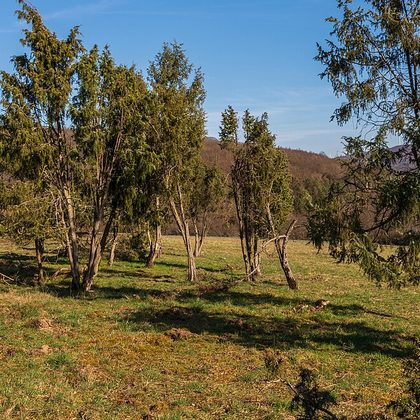
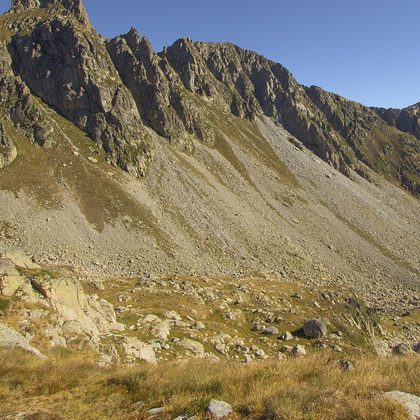
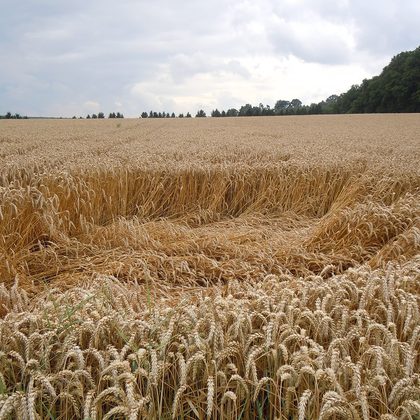
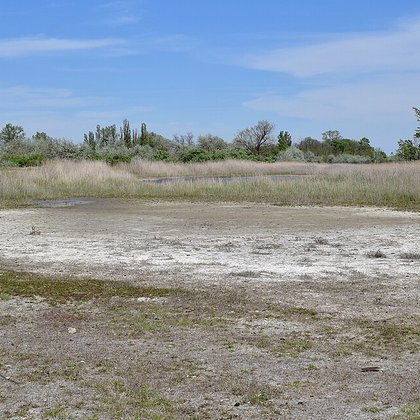
Dry steppe, salt steppe and semi-desert, with cereal fields, vineyards and mulberry trees interspersed. It breeds in dense colonies in stone piles, scree slopes, crevices in cliffs and sea cliffs, in field walls, under railway sleepers and increasingly in stone quarries. It feeds by walking on open steppe and arable land, taking mainly grasshoppers and crickets, and after the breeding season switches to mulberries, cherries and grapes. Nest site and feeding ground lie close together and belong to the same landscape.
Where the bird is most at home, classified with EUNIS — the European standard for habitats.
Range and movements
Breeds in south-eastern Europe, Turkey, the Caucasus and the Caspian steppes, east to Kazakhstan, Xinjiang and western Mongolia. Bulgaria was credited with between zero and seven thousand breeding pairs for 2013–2020: colonies on the Black Sea coast near Burgas and Cape Kaliakra, in the Karnobat field and along the Tundzha are used for five or six years running and then skipped for years. It winters on the Indian subcontinent and in Sri Lanka. In locust years flocks push far west, reaching Italy, France, Britain and the Low Countries; the Netherlands then records a few to a few dozen birds a year, mostly juveniles in July and August.
- Resident
- Breeding (summer)
- Winter
- Passage
- Migration direction
- dark = core range, pale = thinly spread
Where and when to look
In July, August and September work through starling flocks on ploughed fields and in cherry orchards, looking for the bird two shades paler than the rest; the pale rump shows the moment the flock lifts. To see the species on its own ground, go to a stone quarry or a stone pile on the Bulgarian or Turkish steppe in mid-June: an occupied colony is heard before it is seen, and the birds shuttle in and out all day with bills full of grasshoppers.
Conservation status
Not threatened (IUCN: Least Concern); the world population is large but swings wildly, because colonies follow the locusts and shift from year to year. That mobility is exactly what makes the species vulnerable on the ground: clearing stone piles, finishing off a quarry or spraying a locust outbreak can render a colony worthless in a single season. Bulgaria and Turkey therefore fence off known colony sites during the breeding season.