All species › Passerines › Starlings › Tristram's starling
Tristram's starling | Onychognathus tristramii
Tristrams spreeuw | Estornino de Tristram
Stand on Masada, or walk into the gorge at Ein Gedi, and you hear it before you see it: a long, pure whistle bouncing from one rock wall to the other and dying away. Tristram's starling is the black bird of the desert cliffs of the Dead Sea, the Negev and the Arava, with an orange wing patch that only catches fire when it takes off. It is also entirely shameless: on every terrace, car park and viewpoint in that country there is one walking between visitors' feet.

Voice
The hallmark, and surprisingly beautiful for a starling. The song is built from long, clear, wistful whistles that slide slowly up or down — tsuuuu-weee, hweee-oooo — separated by silences, and returning as echoes off a gorge wall; on a still morning a single note carries more than a kilometre. Between them come rattling and grating notes of a far more starling-like character. The alarm is a hard, hoarse chrek. Heard all year, most in the first hour after sunrise and around the nest site from February to May.
No freely licensed recording is available for this species yet.
Identification
Large and slim for a starling, with a long tail that broadens towards the tip and a fine, slightly decurved bill. The male is glossy blue-black throughout, with a purple sheen on head and mantle. The decisive feature is in the wing: the primaries are orange-cinnamon with black tips, which on a perched bird usually shows only as a narrow orange wedge at the bend of the wing, but sets the whole hand alight as the bird lifts. The female has an ash-grey head, throat and upper breast, finely streaked darker, against an otherwise black body; young birds resemble the female but duller and browner. Bill and legs are black, the eye dark.
Confusion species
Fan-tailed raven shares the same gorges and is the classic mistake at range: far larger and heavier, with a short wedge-shaped tail that barely projects beyond the wing tips, a massive bill and a slow, soaring flight — and no orange in the wing. Tristram's starling is narrow, long-tailed and fast, on hurried shallow beats. White-crowned wheatear is half the size and shows a white crown, a white rump and white tail sides. Common starling reaches Israel in winter but is shorter-tailed, spangled and yellow-billed, and works fields and lawns rather than cliffs. In short, nowhere in this region is there a second black songbird with an orange primary panel.
Habitat
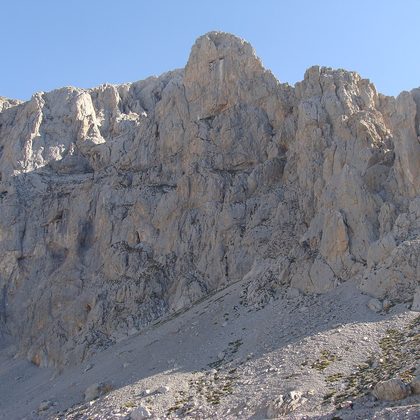
Rock faces, cliffs, gorges and canyons in desert and semi-desert, from the Dead Sea shore to well above a thousand metres in the mountains of Edom and Sinai. The nest goes in a crevice or cavity in the rock, usually above a steep slope. Feeding happens largely elsewhere: on bare ground and stony slopes, in the acacias and tamarisks of the wadis, in date palms, and abundantly in the human landscape pressed up against the cliffs — kibbutz lawns, hotel terraces, car parks, refuse bins and the gardens of the Dead Sea resorts. Water binds it all together: the birds come daily to springs and oases to drink.
Where the bird is most at home, classified with EUNIS — the European standard for habitats.



Range and movements
The Levantine and Arabian desert belt. Within this region: the Judean desert and the whole western shore of the Dead Sea, the Negev, the Arava down to Eilat, and across the rift in Jordan at Petra, Dana and Wadi Rum, plus Sinai. Beyond the region the range continues down the western edge of the Arabian peninsula to Yemen and southern Oman. It is resident, but outside the breeding season flocks of tens of birds wander and drop into the valleys and the settlements. As villages, hotels and irrigated gardens spread through the Negev and the Arava during the twentieth century, the species increased markedly in both numbers and range.
- Resident
- Passage
- dark = core range, pale = thinly spread
Where and when to look
Masada at sunrise, or the lower part of Nahal David at Ein Gedi. On Masada they walk along the ruined walls and the edge of the plateau and allow an approach to a few metres; wait until one takes off and the orange hand opens, because that image is what makes the species. Ein Gedi is better for the sound: stand in the gorge where the walls close in and listen to the whistles coming back from both sides. At the Dead Sea hotels and the car park at Wadi Rum you can simply watch them from a bench.
Conservation status
Not globally threatened (IUCN: Least Concern). This is one of the few desert birds that profits from human presence: irrigation, lawns, refuse and permanent drinking water raised its numbers in Israel and Jordan through the second half of the twentieth century, and it has occupied villages and tourist sites it did not previously use. Its nest sites are sheer rock faces, which are hard to spoil; the only local pressure comes from quarrying and road building in the gorges. Where it lives off café tables it has become tame enough to be treated as a nuisance, but no control is carried out.