All species › Gamebirds › Pheasants and partridges › Sand partridge
Sand partridge | Ammoperdix heyi
Arabische woestijnpatrijs | Perdiz desértica
The smallest gamebird in the region and the best hidden. Barely bigger than a quail and exactly the colour of the gravel it walks on. You are standing in a wadi in the Judean desert or the Negev at sunrise, watching a bare boulder-strewn slope on which nothing moves, and then a piece of the slope shifts: a covey walking down to water.

Voice
A clear, faintly plaintive kew-kew-kew that quickens as it goes and bounces from wall to wall in a quiet canyon, so that you look for the bird on the wrong side. Also a sharp quip of alarm and a hurried wuit-wuit-wuit as a covey scatters. Males call from a boulder or a ledge, chiefly in the first hour of light and again towards dusk, from February to May.
No freely licensed recording is available for this species yet.
Identification
A round, short-tailed sandy bird, plain and finely marbled above, with a set of broad wavy bars in chestnut, black and white running across the flanks like fingerprints. The male has a grey head with an orange bill, a white spot in front of the eye and a white ear patch, and white droplets down the side of the neck. The female has none of it: uniform sand, finely vermiculated, with a duller yellowish bill and pink rather than white marks on the neck sides. Legs buff-yellow. Flushed birds go off in a short whirring glide, angling downhill, showing rufous outer tail feathers.
Confusion species
Nothing else of this size lives on bare desert slopes here. Chukar shares the ground but is nearly twice the size, with a white bib inside a black line and a red bill and red legs, and it prefers higher, greener hillsides. Quail is smaller still, streaked rather than barred, and belongs in grass and crops, not on gravel. Further east, see-see partridge Ammoperdix griseogularis just touches the region in the far south-east of Turkey: that male has a grey throat and a black band across forehead and lores, and lacks the white cheek patch. Females of the two are barely separable in the field — let locality settle it.
Habitat
Bare stony desert with relief: boulder-strewn slopes, scree fans below the cliffs, terraces and ledges in the rock face, and the sand and gravel beds of wadis. The vegetation is widely spaced dwarf shrubs; large flat sand deserts are avoided. From two thousand metres in the hills down to four hundred metres below sea level along the Dead Sea. Drinking water within walking distance is the condition: springs, seeps and stock troughs are visited on foot morning and evening.
Where the bird is most at home, classified with EUNIS — the European standard for habitats.
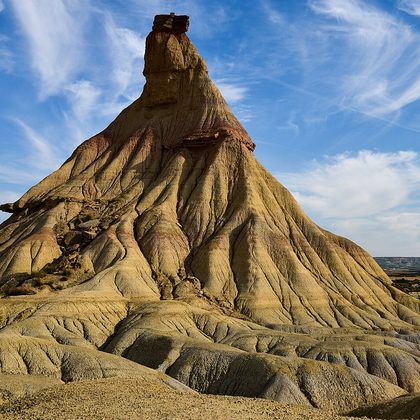
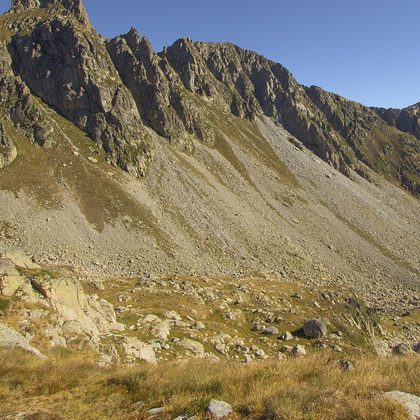
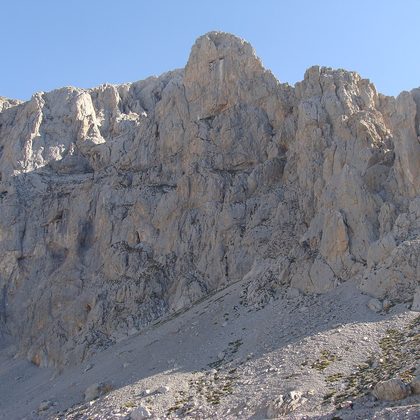
Range and movements
Within the guide's window this is the dry half of the Levant: the Judean desert, the eastern Negev, the Arava, the Eilat mountains, the flanks of the Jordan rift and Sinai. East and south of the map it carries on into Arabia and the Egyptian eastern desert. Four races divide that range; birds of the rift and the Negev are the darkest, those of the sand deserts the palest.
- Resident
- Breeding (summer)
- Passage
- dark = core range, pale = thinly spread
Where and when to look
Be at a spring or a stock trough at first light and sit down. Ein Gedi, Ein Avdat, the Sde Boker area and the wadis around Timna are all reliable. Look for movement, not for a bird shape: on a hundred-metre slope a walking covey registers only while it walks. If they flush, mark where they land and wait — they nearly always walk back to the same place. In the middle of the day they sit out the heat under a boulder and there is nothing to be had.
Conservation status
Not globally threatened and still widespread across its desert range. Israel likewise assesses it as of least concern nationally, yet the comparison of the 1980-1990 and 2010-2020 atlas periods shows a retreat: fewer occupied squares and steep declines in part of the range. The cause has not been pinned down. Disturbance at drinking places, changes in water management and the growing traffic through the wadis are the obvious suspects.