All species › Passerines › Starlings › Spotless starling
Spotless starling | Sturnus unicolor
Zwarte spreeuw | Estornino negro
The spotless starling is the starling of Spain and Portugal: the same shape and the same brisk walk, but all black and with a shaggy beard under the chin. Stand on any Iberian village square and this, not the common starling, is the bird on the roof tiles.

Voice
The song resembles common starling's but is louder, slower and more whistled, with less rattling. The typical phrase is a long descending tsheeeoo, repeated from a roof tile or aerial with quivering wings, between clicks and gurgles. It mimics chickens, house sparrows, Kestrel and doorbells. In flight and at the roost it gives a short, hoarse tcherr. Song runs mainly from February to June, and many males start again in autumn.
Recording: Joost van Bruggen — CC BY-SA 4.0 · xeno-canto
Identification
Compact and short-tailed, with pointed wings and a long straight bill. The plumage is dull, oily black, purple-glossed on head and breast and greener on the back; it never shows the metallic two-tone shimmer of common starling. In spring the bill is yellow with a blue-grey base in males and a pink base in females, and the legs are bright pink. The throat feathers are long and lance-shaped and fan out into a shaggy beard when the bird sings — the single best mark for the species. From October to February very fine white spots appear, almost confined to the belly and undertail, while the mantle stays plain and the bill darkens. Juveniles are dark sooty brown with a dark throat.
Confusion species
Everything turns on common starling — see its own species page, where the same pair is set out from the other side. In May there is no problem at all, but from October to March millions of northern common starlings pour into the peninsula and both species share one flock on the same lawn. Five things settle nearly every bird. The mantle: Common starling carries big white drops right across the back, Spotless is almost plain. The closed wing: Common starling has rusty-buff feather edges that build a warm, scaly wing, Spotless has grey edges and so a dark, uniform wing. The throat: long and ragged in Spotless, short and smooth in Common. The bill: longer and straighter in Spotless. And the build: Spotless is slightly bigger, broader-winged and heavier in flight. Take care in July and August, when a badly worn adult common starling can look almost unspotted — then read the wing and the throat, never the spotting. The young separate well too: sooty brown with a dark throat in Spotless, mouse-brown with a pale throat in Common.
Habitat
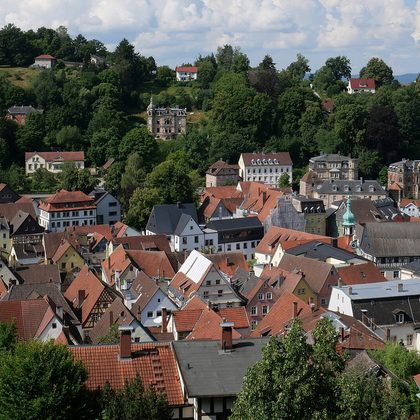
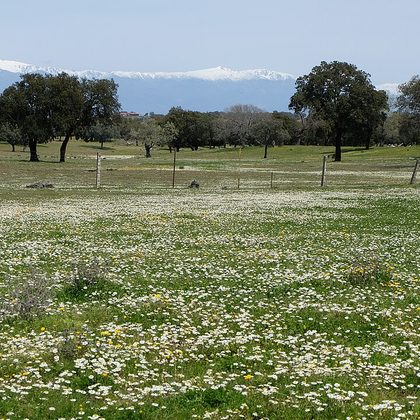
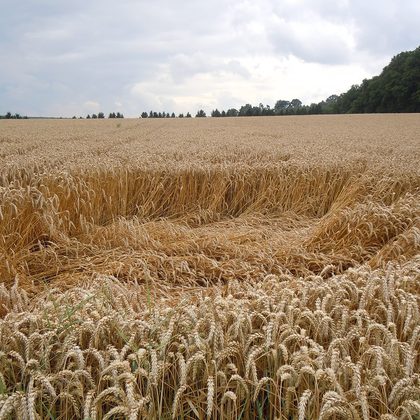
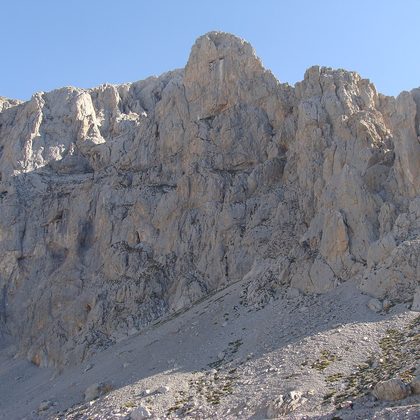
Villages, farmsteads, churches and bell towers, roof tiles and holes in walls; also oak dehesa, olive groves, market gardens and stubble, and cliffs, quarries and rocky gorges. It nests in cavities — under tiles, in wall holes, in nest boxes, in old holm oaks and in rock crevices — often in loose colonies of a few pairs. It feeds by walking and probing on lawns, waste ground and freshly ploughed arable, and in winter moves to olive groves, orchards and tips. It roosts communally in town trees, reedbeds and farm sheds.
Where the bird is most at home, classified with EUNIS — the European standard for habitats.
Range and movements
The whole Iberian Peninsula except the highest and wettest parts of the Cantabrian coast and the Pyrenees, plus the Maghreb (Morocco, Algeria, Tunisia and coastal Libya), Corsica, Sardinia, Sicily and the far south of France, where it has been pushing north steadily since the 1970s. It is resident and usually spends its life within a few kilometres of the village where it hatched. Its entire world range fits inside this guide's map area.
- Resident
- Breeding (summer)
- Winter
- Passage
- dark = core range, pale = thinly spread
Where and when to look
In Spain or Portugal, stand under the plane trees on a village square half an hour before sunset and wait for the roost to gather. In March a singing male on a roof ridge gives the best view of all: against the light the raised throat beard and the yellow bill settle the bird at once. In January, work slowly through a mixed flock in an olive grove or on a football pitch and separate the two starlings on mantle and wing — the finest field exercise the peninsula has to offer.
Conservation status
Not threatened (IUCN: Least Concern). It is one of the commonest birds in Iberia and is still spreading into northern France and along the Cantabrian coast, helped by villages, irrigated farmland and olive growing. Problems are local: damage to cherries, figs and table grapes, and the nuisance of urban roosts, which is sometimes answered by felling the trees. Sealing wall cavities during roof renovation costs it nest sites in old town centres.