All species › Waders, gulls and terns › Plovers and lapwings › Spur-winged lapwing
Spur-winged lapwing
Vanellus spinosus | Sporenkievit | Avefría espolonada
The one lapwing in this group with a settled European breeding population, in the Greek deltas, along the Turkish coast and, since recently, on Cyprus. A loud, pied and sand-coloured bird that starts scolding a visitor long before the visitor has seen it.

Voice
The most obtrusive voice of any European lapwing. The territorial call is a hard, metallic and endlessly repeated tik-tik-tik or pit-pit-pit, breaking into a rhythmic, far-carrying ti-ti-ter-el, usually written as did-he-do-it. Birds call at night as well. Beside a Greek saltpan you will always hear one before you see it.
Recording: A.R. Gregory / The British Library — CC BY 4.0 · Wikimedia Commons
Identification
Smaller and more compact than Northern Lapwing, with long black legs and a short black bill. Crown, forehead and throat are deep black and continue as a hood onto the breast and the centre of the belly; against it stands a clean white cheek that runs down the side of the neck as a broad band. Mantle and wing coverts are sandy to greyish brown, flanks and undertail coverts white. The iris is dark wine-red. A short black spur sits at the carpal joint and disappears under the feathers on a standing bird. In flight the pattern is striking: brown forewing, broad white band, black flight feathers, white rump and a white tail with a broad black terminal band. Juveniles have a dull brown hood with pale feather fringes rather than solid black.
Confusion species
Within its European range the likeliest confusion is with Northern Lapwing, which is larger, crested and glossed green and purple at close range, where Spur-winged is crestless and crisply pied about the head. White-tailed Lapwing, a vagrant to the same Greek and Turkish marshes, has a plain buff head with no black, yellow legs and an entirely white tail. Red-wattled Lapwing, in south-east Turkey, gives itself away with the red wattle before the eye, the red bill and the yellow legs. On juvenile Spur-winged, check the extent of the hood: it always reaches well onto the belly.
Habitat
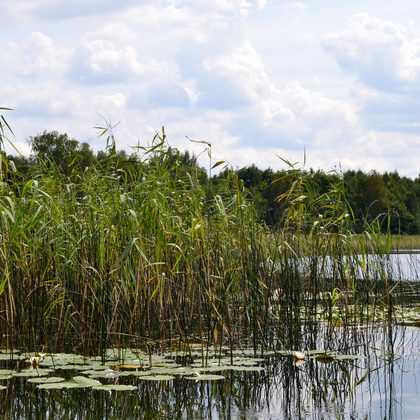
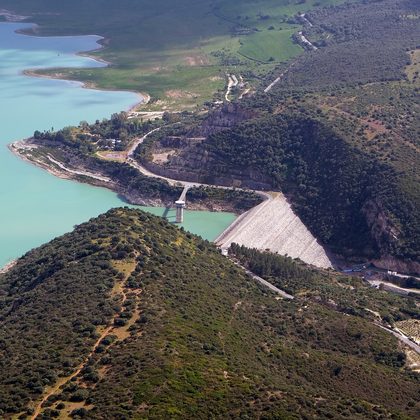
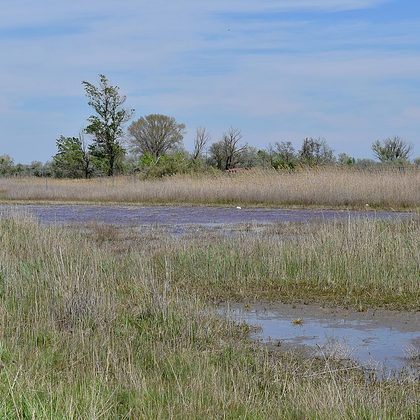
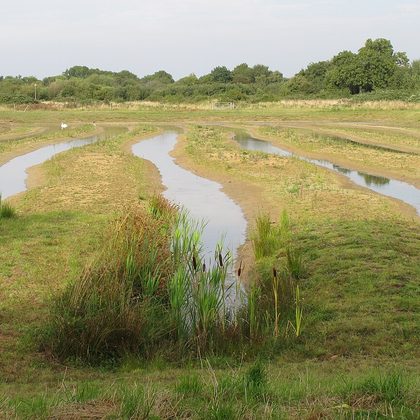
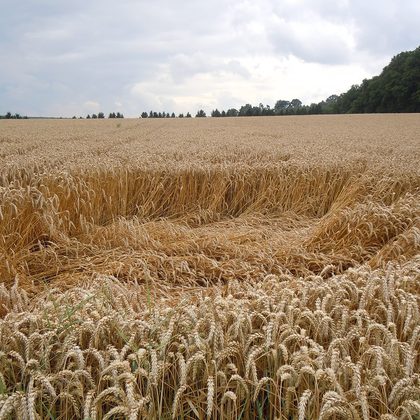
Bare wet ground: mud fringes of river mouths and lagoons, the bunds and channels of saltpans, drying mud, gravel bars in river beds and the edges of irrigated land. It breeds on open, bare terrain close to water and defends it fiercely; the nest is usually on a shingle bar or a bare bund where there is nothing to hide behind.
Where the bird is most at home, classified with EUNIS — the European standard for habitats.
Range and movements
In Europe the species breeds in north-east Greece and Macedonia, with the Evros delta, the Nestos delta, the Axios and Aliakmonas mouths and Lake Kerkini as the core areas, plus Lesvos and a few other islands. Across the Evros the range continues without a break into European and Asian Turkey, where it is far more numerous, and it has colonised Cyprus over recent decades. Greek and Turkish birds are summer visitors, returning in late March and leaving in August and September for the Middle East and north-east Africa; further south, in Israel and Egypt, the species is present year-round.
- Resident
- Breeding (summer)
- Passage
- Migration direction
- dark = core range, pale = thinly spread
Where and when to look
Go to the Kalloni saltpans on Lesvos or to the Evros delta in April, May or June and drive the bunds slowly. Wind the window down: the insistent tik-tik-tik points you at the territory, and any approach to a breeding pair is met head-on and noisily. Early morning finds them out on the bare pan margins; later in the day they withdraw into the shade of the bunds.
Conservation status
Least Concern globally, and in the Mediterranean expanding rather than retreating: it has colonised Cyprus and is increasing in Israel and Turkey. The European breeding population is nonetheless small and concentrated in a handful of deltas. Drainage and river regulation, the loss of open shingle bars and disturbance of nests on bunds and beaches are the real threats, and the abandonment of small-scale salt working removes nesting ground as well.