All species › Passerines › Larks › Temminck's lark
Temminck's lark | Eremophila bilopha
Temmincks strandleeuwerik | Alondra sahariana
The desert version of the horned lark, and one of the finest birds of the bare gravel plain. Everything that is yellow on a horned lark is white here: white forehead, white supercilium and white throat, cut across by a black mask, with two small black feather horns and a black breast band. Above it all, a warm cinnamon back that matches the gravel exactly.

Voice
The song is short, thin and lightly tinkling: a hurried tsee-tsee-tseedle-di lasting a couple of seconds, given from a stone, a low ridge, or in a short dancing song flight ten metres up. Over the bare plain it carries surprisingly far. The call is a short dry tseep or tseeh, usually from a bird that flies a few seconds and drops straight back down. In winter the parties are quieter than in spring.
No freely licensed recording is available for this species yet.
Identification
A compact, short-tailed lark with a small dark bill and black legs. The head settles it: white forehead and supercilium, a broad black mask running from the base of the bill through the eye and down over the cheek, a black band across the forecrown drawn out on each side into two short pointed horns, and a black band across the upper breast. Throat and cheek are white — nowhere a trace of yellow, in any plumage and any season. The upperparts are warm sandy cinnamon, unstreaked or at most faintly mottled; the underparts white with a creamy flank. The female wears the same pattern more softly, the black veiled with brown and the horns barely there. In flight, a dark tail with pale outer edges and a plain sandy wing.
Confusion species
The comparison that counts is with horned lark, which winters as far south as Israel and Jordan, so the two can stand on the same plain. Four things separate them. First the face: forehead, supercilium and throat are white here and yellow on horned lark — washed out in winter, but always yellow. Second the back: warm cinnamon to rusty sand here, greyer and duller brown there, with a pinkish cast on the nape. Third size and shape: Temminck's lark is smaller, shorter-tailed and rounder, and next to a horned lark it looks half a size down. Fourth the place: this bird stands on flat desert gravel and rarely comes near the sea or mountain grassland, while horned lark breeds in those and is only a visitor to the desert. The call is shorter and drier than the thin two-note note of horned lark. Beyond that, nothing in the desert has a black-and-white face mask; at long range a desert lark can mislead, but it is plain and carries no head pattern at all.
Habitat
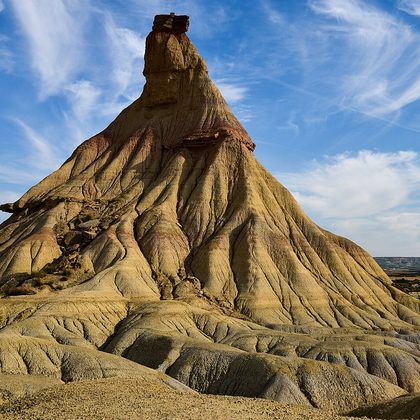
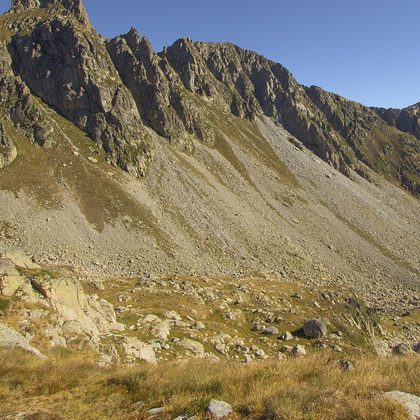
Flat, open desert of gravel or hard-packed sand with the odd low bush: reg, the margins of the hamada, the plains around salt pans and the wide level floors between the mountains. It wants the ground genuinely flat and genuinely bare; it avoids dunes and leaves the rocky slopes to desert lark. The nest is a scrape out in the open, set on the north side of a tussock or stone so that it lies in shade, with a low rim of pebbles and soil crumbs.
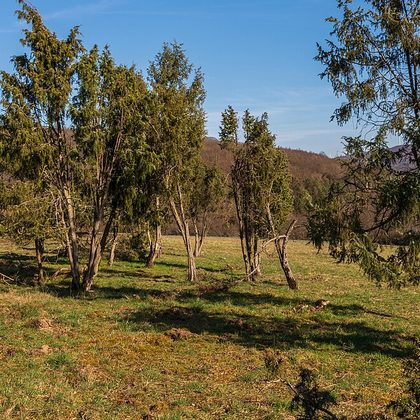
Where the bird is most at home, classified with EUNIS — the European standard for habitats.
Range and movements
The whole Saharo-Arabian belt: from southern Morocco and the Western Sahara through Algeria, Tunisia, Libya and Egypt to Sinai, Israel, Jordan, Syria and northern Arabia. Within the map it occupies the plains of Morocco south of the High Atlas — the Tagdilt plain near Boumalne Dadès is the best known site of all — southern Tunisia, and the gravel of the Negev and the eastern desert in Israel and Jordan. Resident, though in dry years parties wander long distances after seed. It does not occur in Europe.
- Resident
- Winter
- Passage
- dark = core range, pale = thinly spread
Where and when to look
The Tagdilt plain near Boumalne Dadès, shortly after sunrise. Drive the tracks at walking pace and look for movement: small birds that run a few metres, stop, and run again. If they do fly, they seldom go far. Stay in the car, which works as a hide and lets you get close. In Israel the plains of the central Negev around Nizzana and Sde Boker are the equivalent. In winter look for parties of five to twenty, often in company with other desert larks.
Conservation status
Not threatened (LC): the range covers the whole Sahara and northern Arabia, and locally the bird is numerous. What is going wrong is small and very local. The Tagdilt plain, for years the most famous site in Morocco, has been damaged by rubbish tipping, spreading building and off-track driving, and numbers of desert birds there are noticeably lower than twenty years ago. For the range as a whole that is a pinprick, but for anyone hoping to see the species in Morocco it is the ground that changes first. Overgrazing and the spread of irrigated farming along the desert edge do the same elsewhere; nobody is measuring it.