All species › Passerines › Bulbuls › White-spectacled bulbul
White-spectacled bulbul | Pycnonotus xanthopygos
Arabische buulbuul | Bulbul árabe
Open a window in Israel, Lebanon or Jordan and you hear it: the bulbul is the bird of the garden, the balcony and the pavement there, as ordinary as a blackbird is further north. It perches high and in the open, calls all day, and gives itself away as it flies off by a patch of bright yellow under the tail.

Voice
Noisy and audible all day. The song is a short, full and very clear whistled phrase of four to seven notes, with a conspicuous upward jump halfway, delivered from a roof, an aerial or the top of a cypress and repeated every few seconds. Besides that a sharp penetrating kweet as a contact note, a rapid chatter whenever two birds meet, and, at a cat or an owl, a rasping sustained chrr-chrr that brings the whole neighbourhood in. From half an hour before sunrise it is the first bird to start in an Israeli garden.
No freely licensed recording is available for this species yet.
Identification
A solid, long-tailed songbird, bigger than a starling. The head is sooty black, from the base of the bill over crown, cheek and throat to a fairly sharp border on the upper breast, and set into that black is a narrow but strikingly white ring around the eye — the 'spectacles' of the English and scientific names. The rest of the bird is soberer: mantle, wings and tail grey-brown, underparts pale greyish buff, a little lighter towards the belly. Under the tail sits a patch of clear warm yellow that shows at once as the bird takes off or fans its tail. The bill is short, black and gently decurved, with stiff bristles at the base; legs dark. Sexes alike. Juveniles have a browner hood, a duller eye-ring and paler yellow beneath the tail. There is no crest, though the crown feathers are briefly raised in excitement.
Confusion species
In the Levant it is the only bulbul, which settles most questions. Confusion comes rather from other dark-headed garden birds: a female blackbird is bulkier, plain brown without a black hood, has a pale bill and works the ground rather than the shrub, and has no yellow under the tail. When in doubt, always check two things together: the white eye-ring set in black, and the yellow vent. A bulbul turning up in Israel or Jordan without an eye-ring but with a large white cheek patch is an escaped white-eared bulbul; one with a tall black crest and a red cheek spot is an escaped red-whiskered bulbul. At the western edge of the range, in Sinai and the Nile valley, common bulbul comes into play: it has no white eye-ring and white rather than yellow undertail coverts.
Habitat
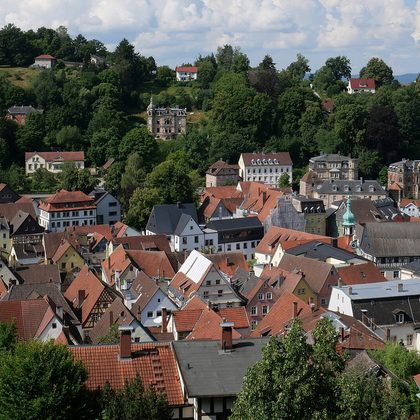
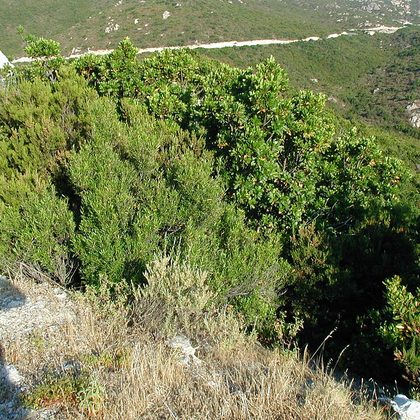
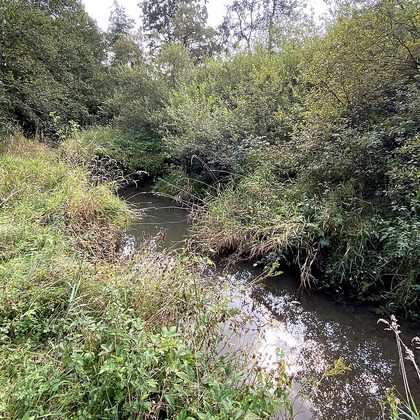
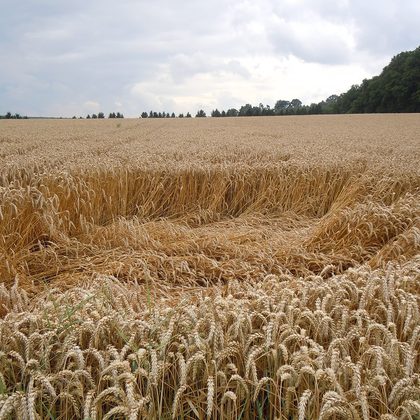
Anywhere shrubs, trees and water come together. Town gardens, parks, hotel grounds, street planting and cemeteries, then orange, pomegranate, date and olive groves, vineyards, the maquis and garrigue of the Mediterranean hills, and the oleander, tamarisk and Christ's-thorn thickets of the wadis, out to the oases of the Arava and the Dead Sea. Closed forest and bare desert are avoided. The diet is largely vegetable: fruit, berries, flower buds and nectar — it hangs on flowering aloes and loquat trees — with insects added, especially in the breeding season. The nest is a loose cup of twigs, grass stems, leaves and moss, lined with hair and fine roots, in a shrub or low tree one to three metres up, often right beside a terrace.
Where the bird is most at home, classified with EUNIS — the European standard for habitats.

Range and movements
The Levant and the adjoining Middle East. Within the map area it breeds along the southern coast of Turkey, from the neighbourhood of Kaş eastwards through Antalya, Mersin, Adana and Hatay to the Syrian border, and on through western Syria, Lebanon, Israel and the Palestinian territories, western Jordan and Sinai. Beyond the map area the range continues across western and southern Arabia to Yemen and Oman. It is resident and moves at most within a district, from higher gardens down into the valleys. In Turkey it has spread noticeably westwards along the coast in recent decades.
- Resident
- Passage
- dark = core range, pale = thinly spread
Where and when to look
No searching required: in Jerusalem, Tel Aviv, Amman or Adana simply sit outside somewhere a hose or a drip line is running. In the heat of the day the birds come to drink and bathe, and then the white eye-ring and the yellow vent appear in a single view. For the song the first half hour after sunrise is best; look for the bird on the highest point around, since it prefers an aerial or a bare branch. In an orchard with ripe figs or dates, dozens gather together in autumn.
Conservation status
Not globally threatened and common to very common over almost all its range; in Israel it is one of the most numerous birds in the country. The species profits strongly from gardens, irrigation, urban greenery and orchards, and is expanding — visibly westwards along the Turkish coast. In fruit-growing districts it is locally regarded as a nuisance for helping itself to ripe figs, dates, grapes and loquats; scaring measures have no measurable effect on numbers. There are no threats of consequence.