All species › Birds of prey › Hawks, eagles and kites › White-tailed eagle
White-tailed eagle
Haliaeetus albicilla | Zeearend | Pigargo europeo
The White-tailed Eagle is Europe's largest raptor and the most spectacular Dutch comeback of this century: from no breeding pairs in 2005 to a steadily growing population in the big marshes. Watch one sail over the Oostvaardersplassen and the Dutch nickname flying barn door explains itself.

Voice
Usually silent away from the nest. Around the eyrie and along the territory boundary it gives a barking, far-carrying series of klee-klee-klee-klee notes, high and almost gull-like for so large a bird, often in duet with the head tilted up. Loudest from February to April, when pairs display over the nest tree and sometimes tumble down with locked talons.
No freely licensed recording is available for this species yet.
Identification
The silhouette does the work. Huge, broad, rectangular wings with a straight leading edge and six long, deeply fingered primaries, held in a flat horizontal plane — no V, no bulge. The body is heavy, the neck long, and the head with its massive yellow bill projects far forward, about as far as the tail projects behind. The tail is short and, in adults, wedge-shaped and pure white. Adult: dark earth-brown body, a pale sandy head and neck, an all-yellow bill and that white wedge of a tail. Immature: much darker and more mottled, with a dark bill, a dark head and a dark tail with white feather shafts and a marbled inner web; the white tail is only complete after four or five years, filling in from the inside out. Young birds also have longer secondaries and tail feathers, so the trailing edge of the wing looks wavy rather than straight.
Confusion species
With a decent view confusion is barely possible, but at range it can go wrong. A Golden Eagle is slimmer, holds its wings in a shallow V, has a smaller head that projects clearly less than the longer tail, and a wing pinched at the base; its tail is long and rounded, never wedge-shaped. A Griffon Vulture has even broader wings but a tiny withdrawn head and a short, rounded tail. A distant immature White-tailed Eagle, flat-winged and broad, can suggest a Black Stork or a vulture, but the projecting head and the heavy short wedge of a tail settle it. A Buzzard alongside gives the best yardstick: the size difference is grotesque.
Habitat
Large, fish-rich, undisturbed waters: peat marshes, border lakes, big rivers and reservoirs, and on the coast sea inlets, fjords and skerries. It builds an enormous stick eyrie high in an old tree, often reusing it for years. It eats mainly fish and waterbirds, but is an unashamed scavenger too — in winter a regular at dead geese and stranded fish, and often sharing a carcass with ravens, crows and buzzards.
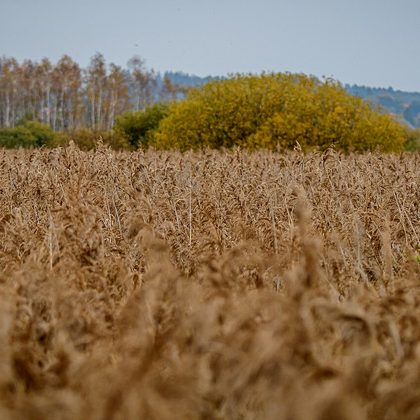
Where the bird is most at home, classified with EUNIS — the European standard for habitats.




Range and movements
From Iceland and Norway through the Baltic and central Europe to Russia and Central Asia; the European population has been growing for decades. It has bred in the Netherlands since 2006, in the Oostvaardersplassen, the Biesbosch, the Lauwersmeer, the south-western Delta, the border lakes and along the great rivers, with northern birds added in winter. In Spain it does not breed and is very rare, at most a vagrant in the north.
- Resident
- Breeding (summer)
- Winter
- Passage
- dark = core range, pale = thinly spread
Where and when to look
In winter head for a large marsh or border lake — Oostvaardersplassen, Lauwersmeer, Biesbosch — and first scan the horizon for a dark, blocky shape on a post or out on the ice; the perched silhouette is as distinctive as the flying one. A wave of panic through thousands of geese or wigeon often betrays a passing eagle before you pick it up yourself. Around nest sites, keep your distance and stay on the paths from February to July.
Conservation status
Not globally threatened (IUCN: Least Concern) and one of European conservation's great successes. After the ban on DDT and mercury seed dressings, the reduction of persecution and targeted nest protection, numbers grew from a few hundred pairs in the 1960s to many thousands today, with the colonisation of the Netherlands, Denmark, Czechia and France. Lead poisoning from shot in carrion, collisions with wind turbines and power lines, and disturbance at nests are the remaining problems.