All species › Birds of prey › Hawks, eagles and kites › Black kite
Black kite
Milvus migrans | Zwarte wouw | Milano negro
In Spain the Black Kite is one of the commonest raptors: in spring, dozens circle over every river, rubbish tip and village edge. In the Netherlands it is a scarce migrant with a handful of breeding records — the same bird, two entirely different experiences.

Voice
Usually silent away from the breeding site, but noisy at colonies and food sources. The call is a sustained, quavering, almost whinnying peeeeh-i-i-i-i-i, opening with a high rising whistle and running into a rapid rattle — quite unlike the plaintive, buzzard-like mewing of the Red Kite. Heard most at spring colonies and over tips and fishing spots where dozens of birds gather.
Recording: Joost van Bruggen — CC BY-SA 4.0 · Wikimedia Commons
Identification
A medium-sized, long-winged raptor with a loose, rocking, endlessly manoeuvring flight. The wings are long and narrow and are held slightly kinked downwards in a glide, with a flat or drooping hand; it constantly corrects with the tail. That tail is the mark: brown, fairly long and shallowly forked — but the fork vanishes the moment the tail is spread, when it looks square or even slightly rounded. The plumage is dark chocolate-brown, browner below with a vague paler base to the primaries and fine dark streaking, without sharp contrasts. The head is a little paler greyish-brown, the bill base yellow, the eye dark. Juveniles show pale fringes on the coverts and a paler, more streaked breast.
Confusion species
The Red Kite is the main confusion species, and the contrast is stark once you know where to look: Red Kite is bigger and longer-winged, with a deeply forked rusty-red tail that stays notched even when spread, a large white patch under the primaries, a rufous body and a pale grey head. Black Kite is more compact, darker and plainer, with a shallow fork and at most a vague pale panel in the hand. A Marsh Harrier flies with its wings in a clear V and has a narrower, unforked tail and a much lighter, more floating hunting action. A dark Buzzard has far broader wings, a short fanned tail and soars on stiff wings, where the Black Kite manoeuvres continuously and looks looser in the arm. When in doubt, watch the tail as the bird turns — the shallow fork always shows through at some point.
Habitat
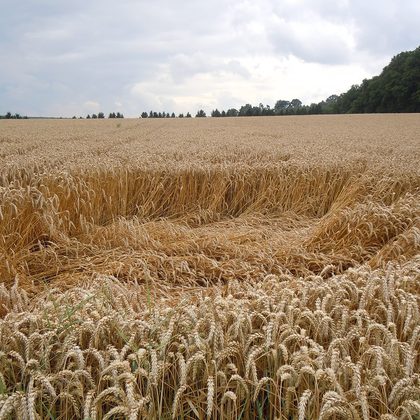
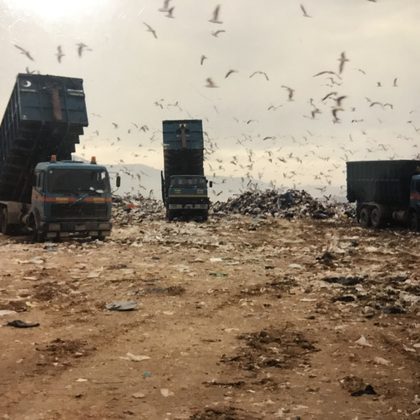
Tied to water and to easy food: rivers with gallery woodland, reservoirs, rice fields, marshes and deltas, plus rubbish tips, fish farms, abattoir waste and roadsides with traffic casualties. It nests in trees, often in loose colonies and sometimes among herons or storks. It fishes and scavenges from the water surface, takes dead fish and young waterbirds, and follows mowers and fires for flushed prey.
Where the bird is most at home, classified with EUNIS — the European standard for habitats.



Range and movements
Breeds across almost all of continental Europe, at the highest densities in Spain, France, Germany and eastern Europe, and winters in sub-Saharan Africa. In Spain it is abundant: tens of thousands of pairs along the Tagus and the Guadalquivir and through the dehesas, and in spring visible over any village or reservoir. In the Netherlands it is genuinely scarce — a few dozen migrants a year, mainly in April and May along the rivers and over the Veluwe, and only occasionally a breeding pair. That north-south contrast is this species' story.
- Breeding (summer)
- Winter
- Passage
- Migration direction
- dark = core range, pale = thinly spread
Where and when to look
In Spain it takes no effort: drive through the dehesas of Extremadura or along a large reservoir in April or May and count the kites over the road. In the Netherlands it takes intent: pick a fine day in the second half of April or in May, stand at a migration watchpoint or on an ice-pushed ridge where raptor passage funnels through, and scan between the Buzzards for a slim dark bird with a forked tail and a loose, rocking flight.
Conservation status
Not globally threatened (IUCN: Least Concern) and stable to slightly increasing in Europe as a whole, after recoveries in France and Germany. The closure of open landfills has locally reduced Spanish numbers, while poisoning by illegally laid baits, lead shot, collisions with power lines and wind turbines and the loss of riverside woodland remain the main threats. West European populations are also sensitive to drought in the Sahel, where the birds spend the winter.