All species › Pelicans, herons and ibises › Herons and bitterns › Yellow-crowned night-heron
Yellow-crowned night-heron
Nyctanassa violacea | Geelkruinkwak | Martinete coronado
The Yellow-crowned Night Heron is a heavy-billed, long-legged American night heron that lives largely on crabs. It stands taller and looks more top-heavy than the Night Heron, with a big head and a bill built for cracking shells. In our area it is a recent addition, known almost entirely from the Azores and Madeira.

Voice
A single, hard, barking quawk, higher and shorter than the deeper kwok of a Night Heron, given in flight and often at night. At colonies birds add a yelping yup-yup and a flat huh in display, and the young beg with a soft, repeated chu-chu-chu. A stray in our area is nearly always silent, so the voice is of little practical use here.
No freely licensed recording is available for this species yet.
Identification
The adult is a smooth blue-grey bird with a strikingly banded head: glossy black, with a broad white cheek patch and a cream to pale yellow crown, so that the face reads as black and white in alternating bars. Two or three long white plumes trail from the nape in the breeding season. The scapulars are grey with black centres and pale edges, giving a scaled back. The bill is short, very thick and wholly black, the eye large and orange-red, the legs yellow and long enough that the feet and part of the leg project beyond the tail in flight. Juveniles are grey-brown, finely and evenly spotted buff above, streaked below, with a dull yellow eye.
Confusion species
The Night Heron is the bird to eliminate, and with juveniles that takes real care. A young Yellow-crowned is greyer and colder brown, with small, neat, even spots on the upperparts, while a young Night Heron is warmer brown with large, obvious white droplets. The bill decides it: thick and wholly dark on a Yellow-crowned, more slender and with a pale yellowish base and lower mandible on a Night Heron. In flight a Yellow-crowned trails the whole foot and a stretch of leg beyond the tail, a Night Heron only the toes. The Yellow-crowned also stands taller and looks longer legged and thicker necked. Adults are unmistakable: no other heron in our area has a black-and-white head with a pale crown.
Habitat
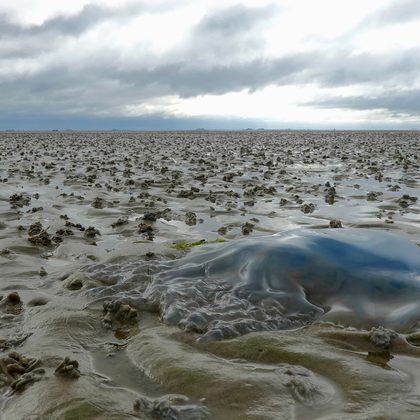
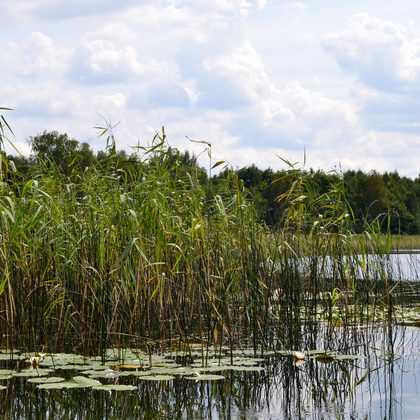
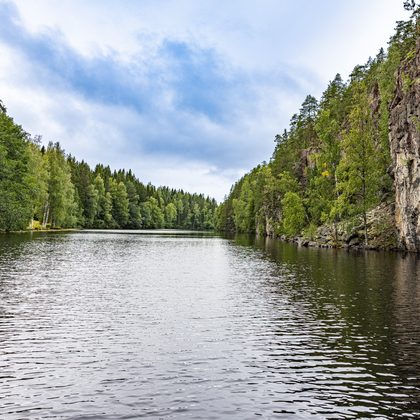
Coastal above all: tidal creeks and mudflats, mangrove, saltmarsh, rocky shores and boulder beaches, harbour walls and slipways, and stream mouths. Inland it uses wooded pond and river margins. It feeds mainly on crabs and crayfish, taken slowly and deliberately, and it works whatever hours the tide dictates rather than strictly at night. By day it roosts in waterside trees and bushes.
Where the bird is most at home, classified with EUNIS — the European standard for habitats.


Range and movements
The species breeds in the warmer Americas, from the eastern and southern United States through Central America and the Caribbean to the coasts of northern South America, with northern birds moving south in autumn. In our area it was only added to the list in the last two decades, on the strength of a run of records in the Azores and on Madeira between 2009 and 2014: birds on Terceira, Pico, Santa Maria and Corvo and one in Funchal harbour. Most were first-winter birds, most stayed for weeks or months, and the dates are spread through the year rather than piled into autumn. Away from the Atlantic islands the species remains exceptional.
Where and when to look
In the Azores and on Madeira this is a bird of harbours and rocky coast rather than of marshes: check boulder shores, slipways and stream mouths on a falling tide, and look for a heron standing tall and motionless on wet rock. Because these birds tend to settle, a report is usually still worth following up days or weeks later. Anywhere else, check the bill and the leg projection on every odd-looking juvenile night heron before anything else.
Conservation status
Not globally threatened (IUCN: Least Concern). The population is large and has spread north in the United States over the last century, although several states list the species as threatened or endangered within their own borders. Its fortunes follow the crabs it feeds on: the loss of saltmarsh and mangrove and the hardening of tidal shorelines are the main pressures. None of that plays out in our area, where the bird appears only as a stray.