All species › Passerines › Swallows › Barn Swallow
Barn Swallow | Hirundo rustica
Boerenzwaluw | Golondrina común
The Barn Swallow is the only swallow in North America with long, wire-thin outer tail feathers and a deeply forked tail. It builds a cup of mud pellets against a beam in a barn, under a bridge or beneath an eave, and so breeds almost anywhere that buildings and open land meet.
Voice
The song is a long, continuous twitter of clear and scratchy notes, closed by a dry mechanical rattle that suggests a wind-up spring. Both sexes sing, the male most elaborately. The contact call is a sharp witt or witt-witt. There are two alarm calls: a sharp, high signal for ground predators such as cats, and another for birds of prey, at which the whole group takes to the air.
Recording: Jonathon Jongsma — CC BY-SA 4.0 · Blue Bell Campground, Custer State Park, South Dakota, United States · xeno-canto
Identification
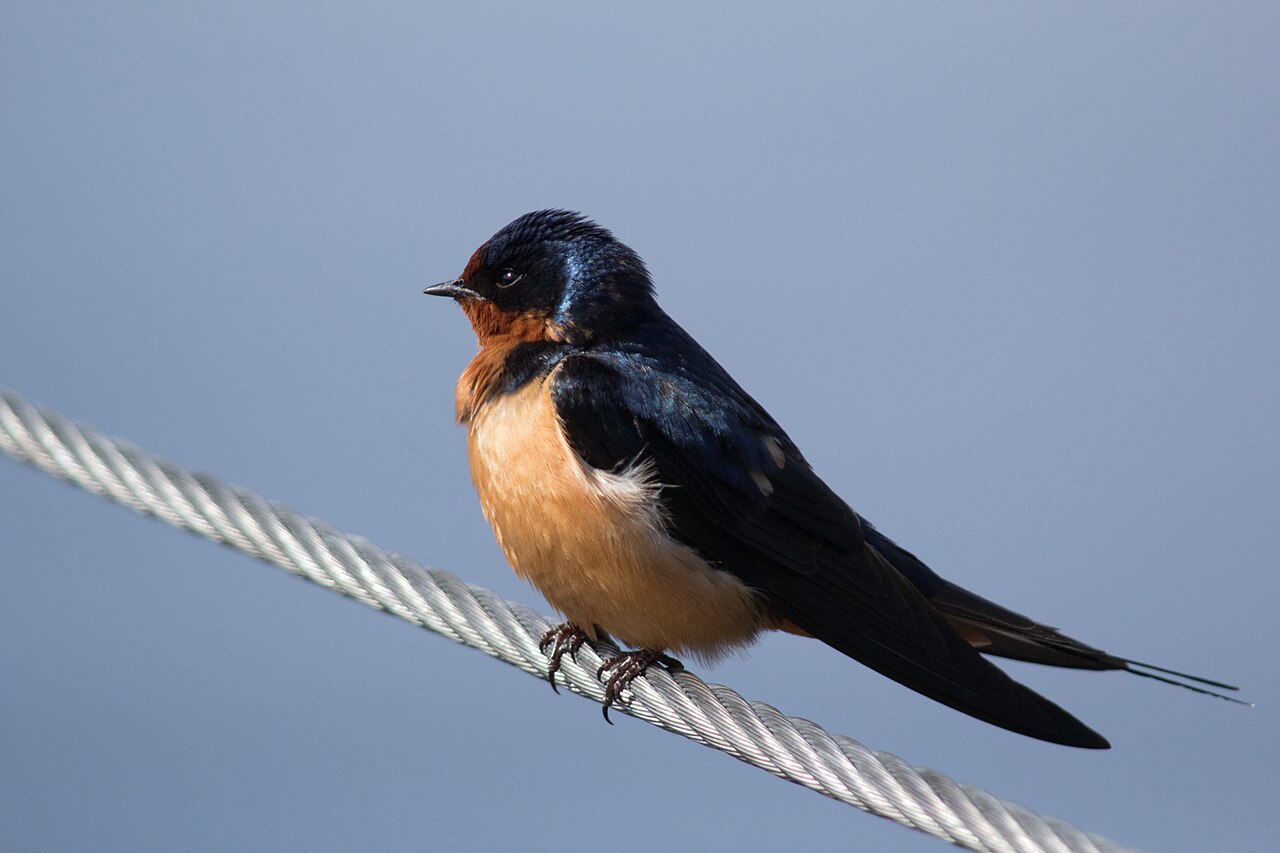
Upperparts steel blue, forehead and throat rufous, with a blue breast band that in the North American subspecies erythrogaster is narrow and often broken. The underparts of that subspecies are not off-white but warm cinnamon to rufous. The tail is deeply forked with long outer feathers and a line of white spots visible only when the tail is spread. Females have shorter streamers, less gloss and paler underparts; juveniles are browner, with a paler rufous face, and lack the elongated streamers.
Confusion species
No other North American swallow combines a rufous throat with a deeply forked, streamered tail. Juvenile Barn Swallows without streamers can be confused with Cliff Swallow, but that species has a square tail, a pale rump and a pale forehead. Tree and Violet-green Swallows are white below with a short, shallowly notched tail. Bank and Northern Rough-winged Swallows are brown above, much smaller and short-tailed.
Habitat
Open land with short vegetation and buildings: pasture and livestock farms, cropland with farmyards, villages, parks, bridges and wharves, preferably with water nearby both for insects and for the mud the nest is built from. Hunting is low, often just above grass or a water surface, taking individual fairly large insects rather than swarms. From sea level to about 3000 metres.
Where the bird is most often found, arranged by the USNVC — the vegetation classification of the United States and Canada — and CMECS for sea and coast.




Range and movements
It breeds from Alaska and southern Canada through the whole of the United States into northern Mexico, and locally further south in the Mexican highlands. The winter range lies mainly in South America; through Mexico, Central America and the Caribbean it passes in large numbers, with smaller numbers staying the winter. In southern Florida it is both a breeder and a winter visitor. Since about 1980 a small and growing population has bred in Argentina, on a reversed annual cycle.
- Resident
- Breeding (summer)
- Winter
- Passage
- dark = core range, pale = thinly spread
Where and when to look
The best chance is a livestock farm or a bridge over a creek between May and August: walk past the open barn or look under the deck and find the mud cups on the beams. Over a mown field the species can be told at a distance by the low, fluid flight with sharp turns and by the forked-tail silhouette.
Conservation
Partners in Flight puts the global population at about 190 million birds and the species is rated of low conservation concern. The Breeding Bird Survey nevertheless shows a North American decline of roughly 0.6 percent a year, some 25 percent between 1966 and 2019. The species earlier gained from forest clearance and from the building of barns and bridges; the present decline is linked to farm consolidation, to closed modern livestock buildings with no access opening, and to the fall in flying insect numbers.
Scientific name
Hirundo rustica | Linnaeus, 1758
Linnaeus described the species in 1758 as Hirundo rustica; the genus has not changed since, so author and year stand without parentheses. Hirundo is the Latin word for swallow and rusticus means 'of the countryside'. The specimen described came from Europe, with Sweden as the restricted type locality. The North American subspecies is erythrogaster, from Greek eruthros 'red' and gaster 'belly', after the rufous underparts.