All species › Owls › Owls › Barred Owl
Barred Owl | Strix varia
Gestreepte bosuil | Búho Barrado
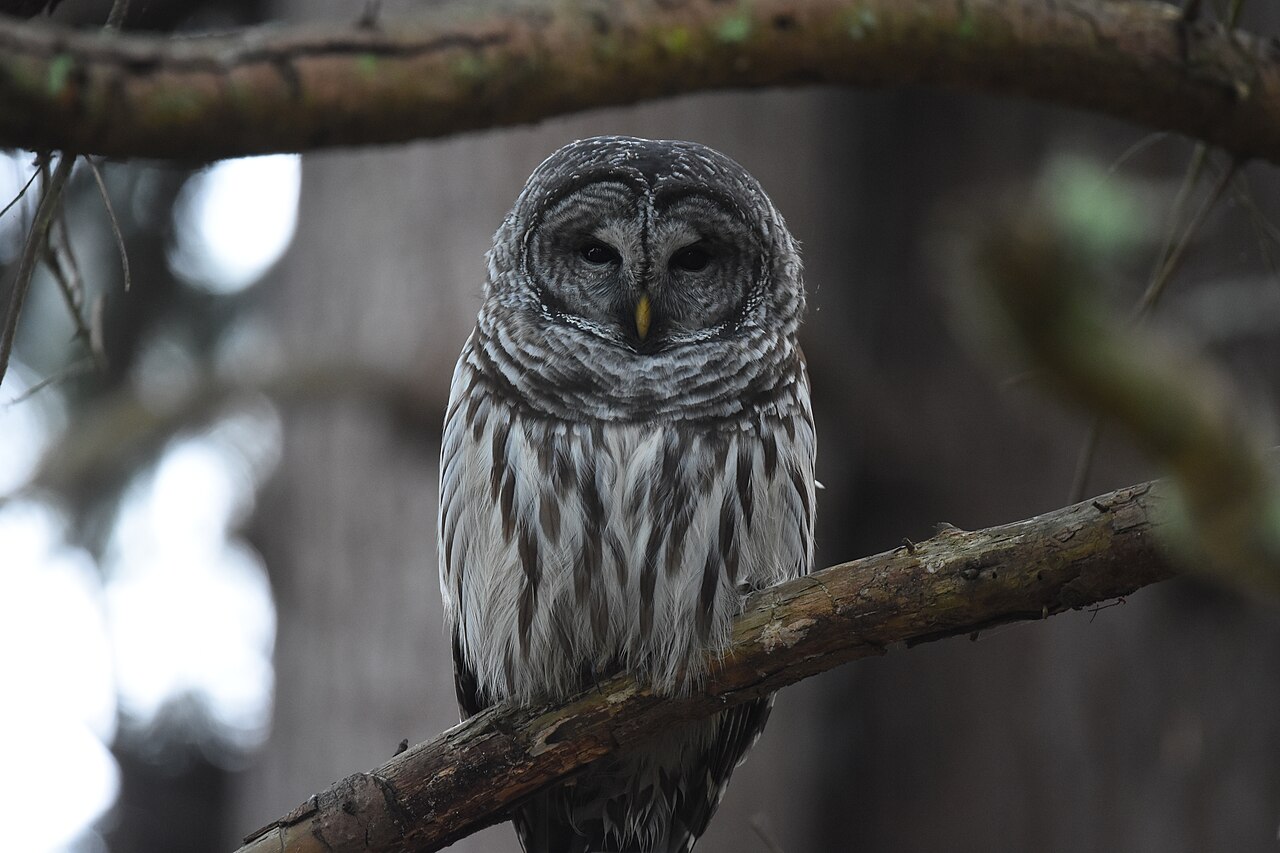
The Barred Owl is the most often heard woodland owl of eastern North America: stocky and grey-brown, with a round head, black eyes and a loud call of eight or nine syllables. During the twentieth century it extended its range to the Pacific, where it now lives alongside the Spotted Owl.
Voice
The call is one of the most recognisable bird sounds on the continent: eight or nine hollow notes, rendered as who cooks for you, who cooks for you-all, with the last syllable sliding downward. At night pairs answer each other in a raucous duet of cackles, barks, gurgles and screams. There is also a rising hoo-aaah and, during squabbles, the snapping of the bill. It is loudest in late winter but calls year round, sometimes in daylight.
Recording: Kayla Brown — CC BY-NC-SA 4.0 · Tobe Rock 2023C, Lane County, Oregon, United States · xeno-canto
Identification
Grey-brown, with a round head lacking ear tufts and a pale facial disc marked by fine dark rings. The pattern below settles it: horizontal barring across the throat and upper breast, vertical streaking down the belly and flanks. The eyes are dark brown to almost black, the bill yellow; wings and tail are barred brown and white. The sexes are alike, the female larger. In flight the heavy, flat-faced head is obvious, which rules out a hawk even at a distance.
Confusion species
Spotted Owl is smaller and darker and carries round white spots over the whole underside instead of bars and streaks; where the two overlap in the west, hybrids occur, mixing both patterns. Great Horned Owl is bigger, with ear tufts and bright yellow eyes. Great Grey Owl is much larger and greyer, with yellow eyes and a white patch under the bill. Any tufted silhouette is ruled out at once by the round, tuftless head.
Habitat
Extensive, unfragmented forest of some age, preferably mixed and damp: swamp forest, stream valleys, riverbanks and old deciduous woods with thick trunks. It needs tree cavities to nest in and hunts from low perches in the understorey. Open farmland and young plantations are avoided, but in older suburbs with big trees it settles close to houses. In the west it has also taken over conifer forest that only Spotted Owls once held.
Where the bird is most often found, arranged by the USNVC — the vegetation classification of the United States and Canada — and CMECS for sea and coast.





Range and movements
Resident from southeastern Alaska and southern Canada through the eastern United States to Florida and east Texas. Around 1900 the range stopped at the Great Plains; tree planting, fire suppression and the loss of bison and beaver created a wooded belt along which the owl moved west. It reached British Columbia in 1943, Washington about 1965, Oregon in 1972 and northern California in 1976, and is now in the Sierra Nevada. It does not migrate: ringed birds stay in the same wood for life.
- Resident
- Breeding (summer)
- Winter
- Passage
- dark = core range, pale = thinly spread
Where and when to look
Go to damp deciduous woodland near water an hour after sunset in February or March and listen; this is the owl most likely to call unprompted, and its mate usually answers within a minute. By day it is given away by jays and crows mobbing one tree. In the American northwest it is worth logging calling birds: their spread there is tracked closely.
Conservation
Least Concern (LC) on the Red List; Partners in Flight puts the population near 3.5 million birds, rising by a little over one per cent a year since 1966. Logging of mature forest hurts it locally and the Great Horned Owl is its chief predator, but the stock as a whole is growing. Where it has pushed into the range of the Spotted Owl the picture is reversed: in 2024 the American government decided to have up to some fifteen thousand Barred Owls shot each year in the west, under half a per cent of the North American total.
Scientific name
Strix varia | Barton, 1799
Benjamin Smith Barton described the species in 1799 as Strix varius, and since it has never changed genus, author and year stand without parentheses. The ending was later adjusted to agree with the feminine genus name, so the name now reads Strix varia. Strix is Latin for a bird of the night, taken from Greek strinx, and was introduced by Linnaeus in 1758. varia means 'variegated' or 'mottled', after the barred and streaked plumage. The specimen described came from Pennsylvania.