All species › Owls › Owls › Spotted Owl
Spotted Owl | Strix occidentalis
Gevlekte bosuil | Búho Moteado
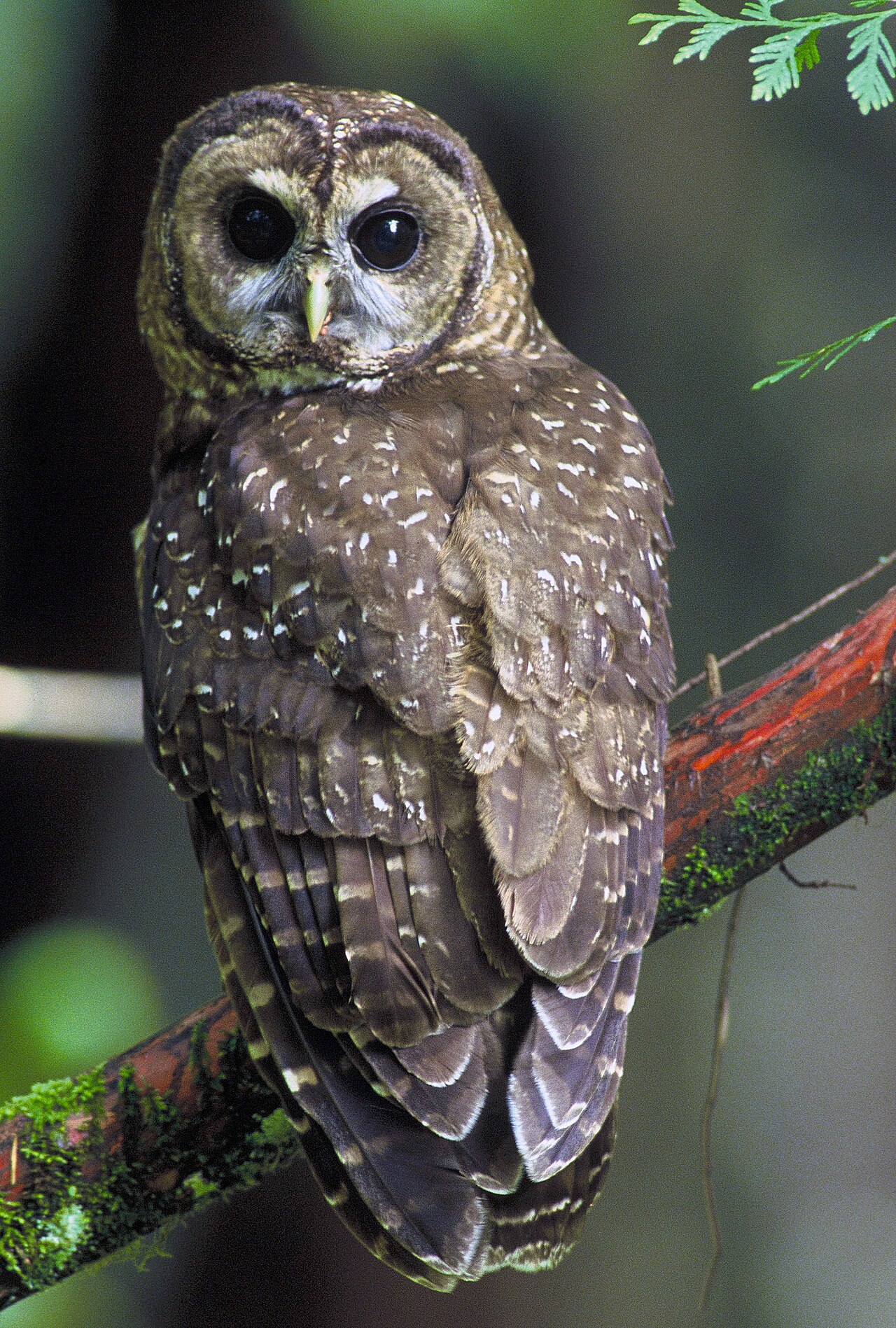
The Spotted Owl is a dark brown, white-spotted owl with black eyes, tied to old forest in western North America. It hunts flying squirrels and woodrats at night from a perch. It is the bird for whose sake logging in the Pacific Northwest was curtailed in the 1990s.
Click a thumbnail to switch the photo above.
Subspecies
Voice
The signature sound is a series of four hollow notes with the middle two close together — hoo — hoo-hoo — hooo — deep and pure, the female's voice higher than the male's. Pairs keep contact with a hollow whistle that rises at the end, and fledged young beg with a shriller version of it. Birds often answer only after a long silence, and where Barred Owls have settled some territories stay silent altogether.
No freely licensed recording has been found for this species yet; what to listen for is described below.
Identification
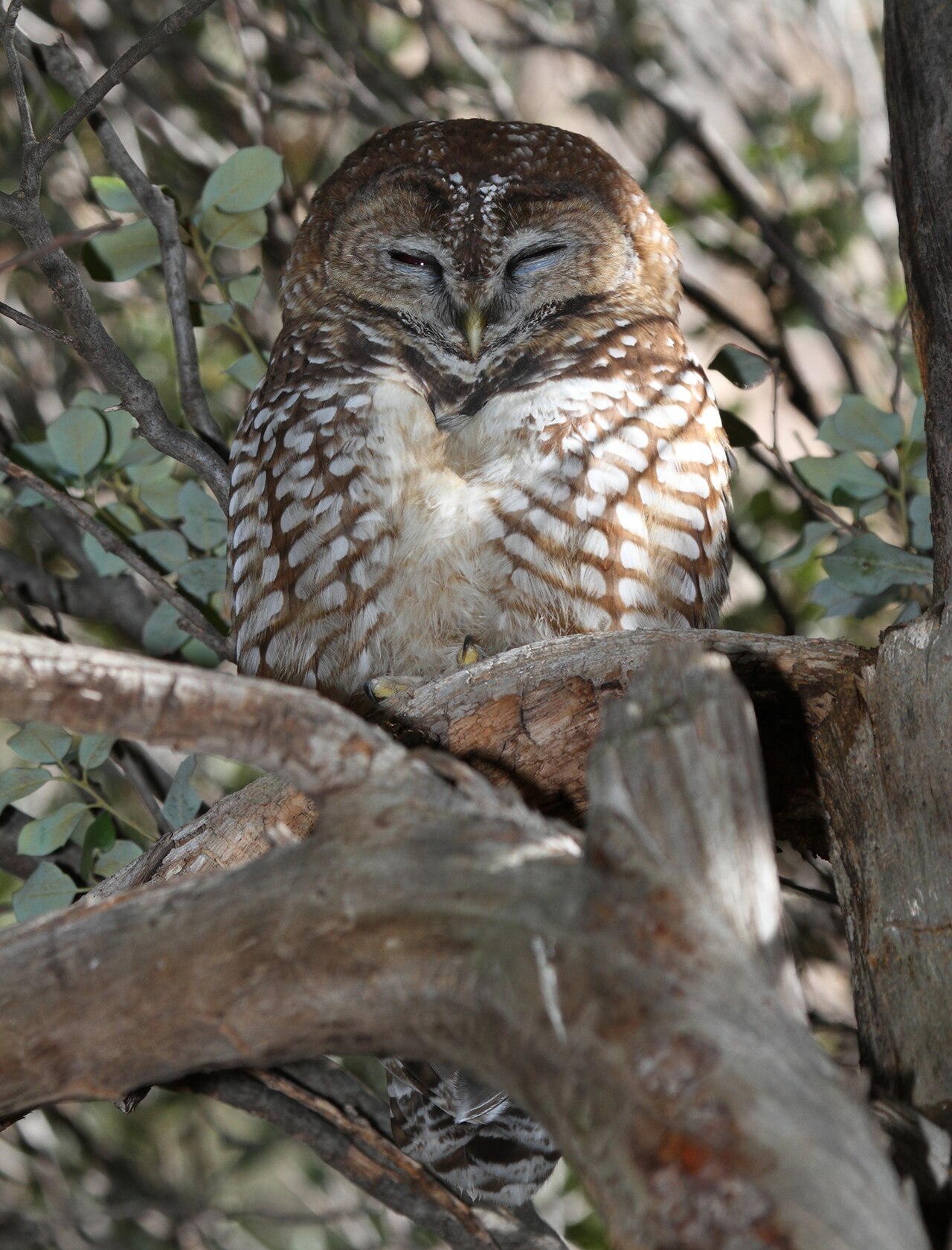
Dark brown, covered with round and oval white spots on crown, mantle, breast and belly — spots, not bars or streaks. The head is round and lacks ear tufts; the brown facial disc carries a pale X between the eyes. The eyes are dark brown to black, the bill yellowish green. The sexes look alike, but the female is larger and higher-voiced. Flight is silent and agile, on broad rounded wings, threading between the trunks.
Confusion species
Barred Owl is larger and greyer, barred horizontally across the upper breast and streaked vertically down the belly, where Spotted Owl is spotted throughout. The two have lived side by side in the American northwest for some decades and interbreed there; hybrids carry both spots and bars and cannot always be named with certainty. Great Horned Owl has ear tufts and yellow eyes. In Mexico the subspecies lucida is much paler and more coarsely spotted.
Habitat
Old, closed conifer and mixed forest with tall thick trees and a layered canopy: unlogged Douglas-fir in the northwest, mixed conifer in the Sierra Nevada, pine-oak in cool canyons in the southwest and Mexico. Clearcuts and young even-aged plantations are avoided; the owl needs shade, old cavities and an understorey that holds woodrats. A single territory covers hundreds to more than a thousand hectares.
Where the bird is most often found, arranged by the USNVC — the vegetation classification of the United States and Canada — and CMECS for sea and coast.



Range and movements
Resident from southwestern British Columbia through western Washington and Oregon to Marin County in California, along the Sierra Nevada to Tulare County, and on into northern Baja California. A second, disjunct range lies in the mountains of Utah, Colorado, Arizona, New Mexico and western Texas and continues down the Mexican Sierra Madre to Michoacán. It does not migrate; young birds wander only in their first autumn. The outline of the range has hardly shrunk, but inside it the owl has gone from many forests.
- Breeding (summer)
- Passage
- dark = core range, pale = thinly spread
Where and when to look
Look for it by day: it roosts low in the shade of a dense tree, often on the same branch for weeks, and gives itself away by white droppings and pellets below. To hear it, take the first hour after sunset in a stand of uncut old forest. Playing recordings is prohibited across most of its range: it drains territorial birds and draws Barred Owls in.
Conservation
Assessed as Near Threatened; Partners in Flight puts the world population near 15,000 breeding birds, and the species has lost more than half its numbers in fifty years. Two causes act together: the loss of old-growth forest to logging, and the advancing Barred Owl. The northern subspecies has been federally protected since 1990; in Canada the wild population has all but disappeared and captive-bred birds have been released since 2022. In 2024 the American government decided to have Barred Owls shot across parts of the western range.
Scientific name
Strix occidentalis | (Xántus, 1860)
János Xántus described the species in 1860 as Syrnium occidentale; because it was later moved to Strix, author and year stand in parentheses. Strix is the Latin word for a bird of the night, taken from Greek strinx, and was introduced as a genus name by Linnaeus in 1758. occidentalis means 'western', for the western side of North America where the bird lives. The specimen described came from Fort Tejon, California.