All species › Owls › Owls › Eastern Screech-Owl
Eastern Screech-Owl | Megascops asio
Oostelijke schreeuwuil | Tecolote del Este
The Eastern Screech-Owl is the small owl of eastern North America: stocky, short-tailed, with a big head and sharp ear tufts. It does not screech, in spite of the name — it whinnies, in a descending tremolo that suggests a small horse. Of all American owls it copes best with towns: suburbs and city parks often hold more pairs per square kilometre than the farmland around them.
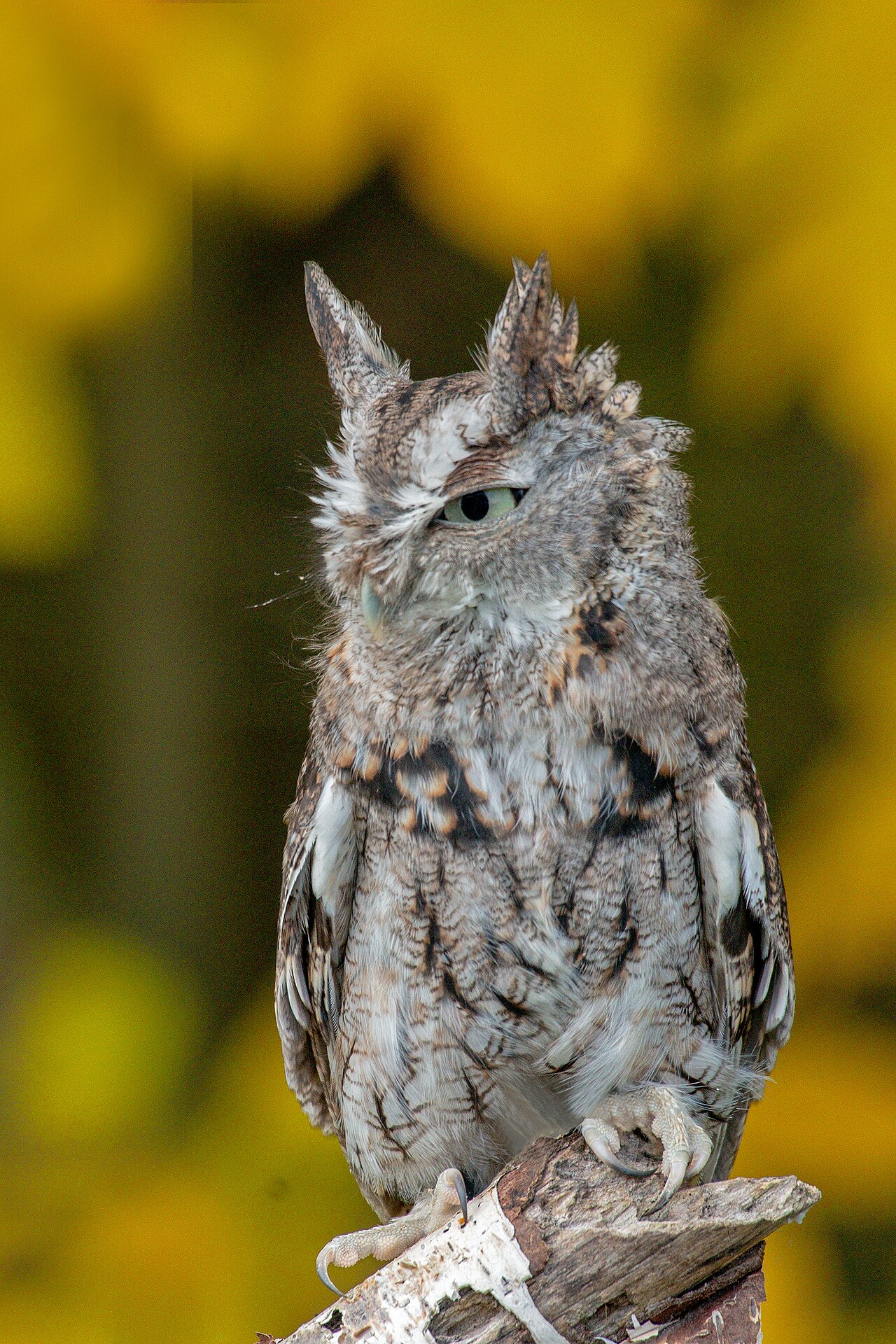
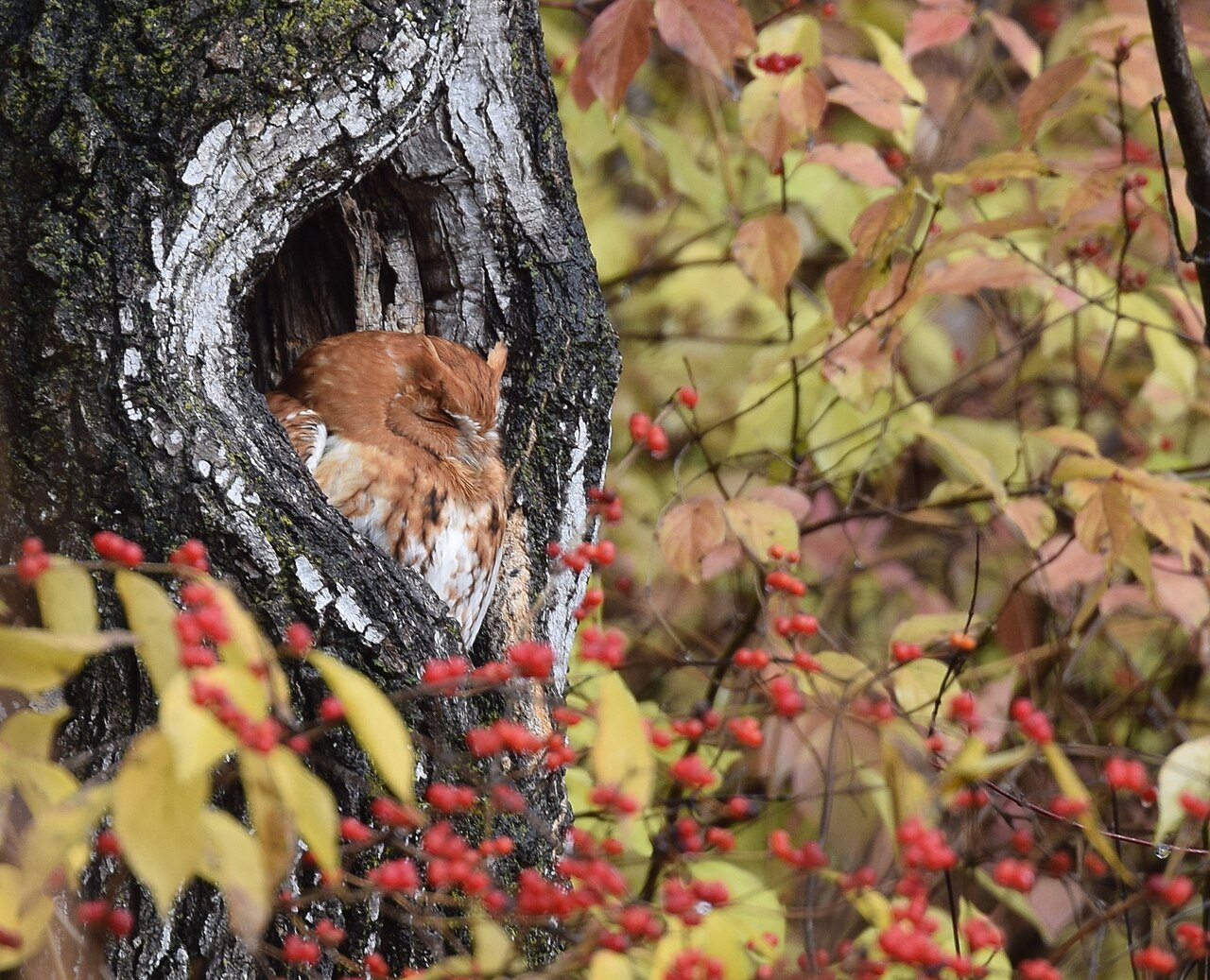
Colour forms
Voice
Two songs, neither of them a screech. The better known is the whinny: a tremolo that falls and wavers in pitch over a little more than a second, exactly the sound of a small horse at a distance. The second is a flat, purring trill on one pitch lasting three to five seconds, used between members of a pair and around the nest. The male is the smaller bird but has the deeper voice, so the two owls of a pair can be told apart by pitch alone. Barks, a high wail and bill-snapping are added when an intruder comes close.
Recording: Noah Khanti Steinberg — CC BY-NC-SA 4.0 · Kissimmee, Osceola County, Florida, United States · xeno-canto
Identification
A small, solidly built owl with a large broad head, almost no neck and a short square tail; the ear tufts are often held straight up, but can be laid completely flat. The plumage comes in two set colour morphs, grey and rufous, with brown intermediates alongside them. About a third of birds are red — more in the southeast, under fifteen per cent at the western edge of the range — and both morphs turn up in one brood. The eyes are yellow, the bill pale greenish-yellow, and the underparts carry heavy black lengthwise streaks crossed by fine bars. Male and female look alike, the female being the heavier; flight is straight and silent on short, rounded wings.
Confusion species
Western Screech-Owl (Megascops kennicottii) is all but identical in build and pattern; the two ranges meet only in a narrow belt along the Rio Grande in west Texas and on the eastern plains of Colorado. Two things decide it: Eastern has a pale greenish-yellow bill and a rufous morph, Western a dark grey to blackish bill and no red birds at all. The safest difference is the voice — whinny and purring trill against an accelerating series of short whistles, sounds with nothing in common. Great Horned Owl (Bubo virginianus) has the same shape but five times the weight, and Long-eared Owl is far slimmer and longer-winged, with a rusty face marked by a white X.
Habitat
Deciduous and mixed woodland with an open understorey, but above all the half-open tree layer of suburbs, city parks, cemeteries, orchards and farmyards. On the Great Plains it follows the wooded creek and river bottoms far out into the grassland. What it needs is a cavity — an old woodpecker hole, a rotted limb, a nest box — with trees around it; bare arable land without standing timber goes unused. It avoids ground where Great Horned Owls are settled, since those eat it.
Where the bird is most often found, arranged by the USNVC — the vegetation classification of the United States and Canada — and CMECS for sea and coast.





Range and movements
Resident throughout eastern North America, from southern Ontario, Quebec and Manitoba south to Florida and the Gulf Coast, and west to the eastern plains of Montana, Colorado and New Mexico and on into northeastern Mexico. It does not migrate; young birds wander in their first autumn, but adults hold one territory for life. On the prairies it moved west during the twentieth century as shelterbelts and town trees were planted, and in the northeast it follows the suburbs. Long, heavy snow winters open gaps at the northern edge of the range that take several years to fill again.
- Resident
- Breeding (summer)
- Winter
- Passage
- dark = core range, pale = thinly spread
Where and when to look
Walk a park edge or an old cemetery with heavy trees half an hour after sunset in March or April and listen for the descending whinny; it does not carry far, so get close to the trees. By day it can be found by watching the entrance of a nest box or a cavity: the bird often sits in the opening sunning itself, tufts flat and eyes narrowed to slits. Where Blue Jays, chickadees and nuthatches suddenly gang up and scold in one tree, a screech-owl is usually sitting exactly there.
Conservation
The species is listed as Least Concern (LC); Partners in Flight puts the population at around 560,000 birds and rates conservation concern as low, but the North American Breeding Bird Survey shows a loss of close to one per cent a year between 1966 and 2019, more than a third in total. It is a generalist that survives both alongside people and in woodland, and suburban pairs on average raise more young than rural ones. The pressures are the loss of hollow and dead trees, collisions along roads it hunts low across, and predation by Great Horned Owls. Nest boxes fitted with a predator guard are taken up quickly and reliably.
Scientific name
Megascops asio | (Linnaeus, 1758)
Linnaeus described the species in 1758 as Strix Asio; because it was later placed in another genus, author and year stand in parentheses. The genus Megascops was introduced by Kaup in 1848 and is built from Greek megas, 'large', and skōps, 'little owl' — large by comparison with the scops owls of the Old World. asio is the Latin word Pliny used for an owl with ear tufts; the same word serves as the genus name of the Long-eared Owl. Linnaeus worked from Catesby's plate; the described specimen came from America, with South Carolina as the type locality.