All species › Tubenoses › Petrels, shearwaters and diving petrels › Bermuda Petrel
Bermuda Petrel | Pterodroma cahow
Bermudastormvogel | Petrel cahow
Bermuda Petrel is one of the rarest seabirds in the world: it breeds only on a handful of tiny islets off Bermuda and was believed extinct from the seventeenth century until the middle of the twentieth. Since the rediscovery of eighteen breeding pairs in 1951, decades of intensive management have slowly brought the species back from the edge of extinction.
Voice
On the breeding islets off Bermuda, Bermuda Petrel is heard at night with a hoarse, wailing call, rendered by early English settlers as cahow, which gave the species its other name. By day, and over the Gulf Stream off the American coast where it is seen outside the breeding season, it is silent like most petrels. From the birds reported on pelagic trips off North Carolina, accordingly, nothing more than the sound of wings on take-off has ever been noted.
Recording: Robert L. Flood — CC BY-NC-SA 4.0 · St.George's, St. George's Parish, United Kingdom · xeno-canto
Identification
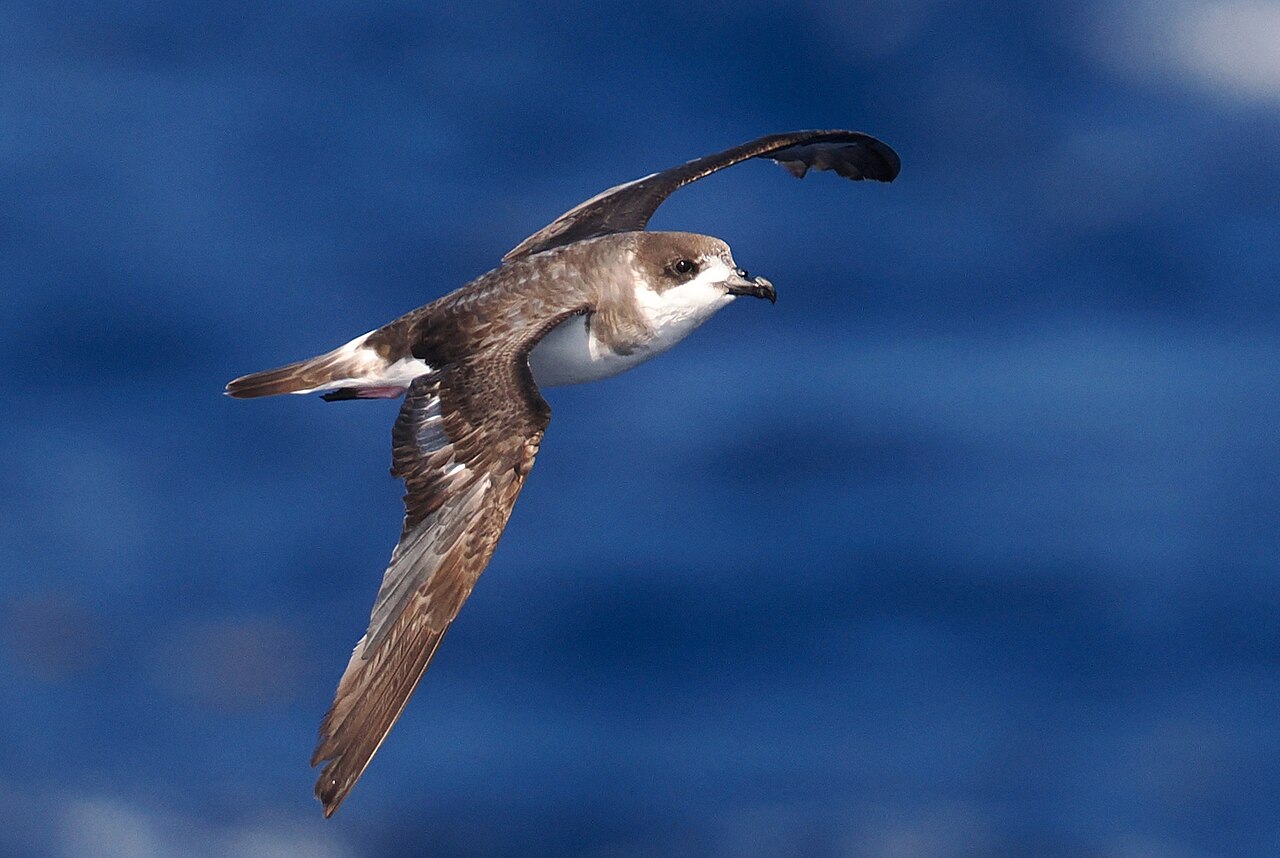
A medium-sized petrel with a dark, greyish-black cap that blends smoothly into the neck and back, without a sharp edge or pale collar. The upperwings and tail are dark grey, the rump is a narrow, inconspicuous white, and the entire underside, including the underwing edge, is white with a narrow dark trailing edge. The bill is small and slender for a petrel of this size. Male and female do not differ in appearance.
Confusion species
Black-capped Petrel (Pterodroma hasitata), with which Bermuda Petrel is most often confused, is larger and more heavily built, with a distinctly heavier bill and usually a sharply defined white rump and pale collar that are absent or at most faintly visible on Bermuda Petrel. Desertas Petrel (P. deserta) is paler overall with a greyer chest band and lacks the almost entirely dark cap. On the Gulf Stream, where it is rarer than either of the other two, a Bermuda Petrel sighting always calls for careful documentation.
Habitat
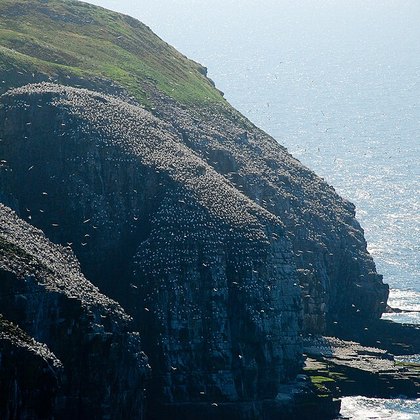
Outside the breeding season Bermuda Petrel lives entirely on open ocean water, concentrated in and around the Gulf Stream between Bermuda, Nova Scotia and North Carolina. For breeding it uses a few small, rocky islets with a thin soil layer, digging a burrow or using a natural rock crevice; to counter the collapse of the soft limestone soil, artificial concrete nest burrows have now been built on the main island. The species uses no land beyond the breeding islets.
Where the bird is most often found, arranged by the USNVC — the vegetation classification of the United States and Canada — and CMECS for sea and coast.

Range and movements
The entire world population breeds on Nonsuch Island and a few neighbouring islets in Castle Harbour, Bermuda; the historical breeding range of more small islands in the same bay has largely been lost to erosion and disturbance. After fledging in May and June the birds disperse northwest across the Gulf Stream, with regular sightings off Cape Hatteras, North Carolina, mainly from late May to September. Before 1996 the species was virtually unknown to living observers outside Bermuda; since then, thanks to targeted pelagic boat trips, it has become a rare but regular sight off the American coast.
- Resident
- Breeding (summer)
- Winter
- Passage
- dark = core range, pale = thinly spread
Where and when to look
The best chance of Bermuda Petrel within this area is a pelagic boat trip in the Gulf Stream off Cape Hatteras between late May and early June, well beyond the edge of the continental shelf. Compare every candidate carefully with the more numerous Black-capped Petrel: the smaller bill and the smoothly blended, not sharply defined, cap of Bermuda Petrel are easier to judge from photographs than in the field.
Conservation
From the eighteen breeding pairs rediscovered in 1951, the population has grown steadily, via one hundred and thirty-two pairs in 2019, to a few hundred birds in total — one of the best-known seabird recovery stories. Competition for nest burrows with the larger White-tailed Tropicbird, loss of breeding habitat to hurricanes, and continued dependence on a handful of tiny islets nonetheless leave the species vulnerable.
Scientific name
Pterodroma cahow | (Nichols; Mowbray, 1916)
John Treadwell Nichols and Louis L. Mowbray described the species in 1916 as Aestrelata cahow, with the southeastern side of Castle Island, Bermuda, as the type locality; because it has since been placed in the genus Pterodroma — erected by Bonaparte in 1856 — author and year stand in parentheses. The species name cahow is a Latinized form of the English spelling of the bird's call, the same sound by which the species is also known in everyday speech. Bermuda Petrel and cahow are, in practice, two names for exactly the same bird.