All species › Tubenoses › Petrels, shearwaters and diving petrels › Black-capped Petrel
Black-capped Petrel | Pterodroma hasitata
Zwartkapstormvogel | Petrel antillano
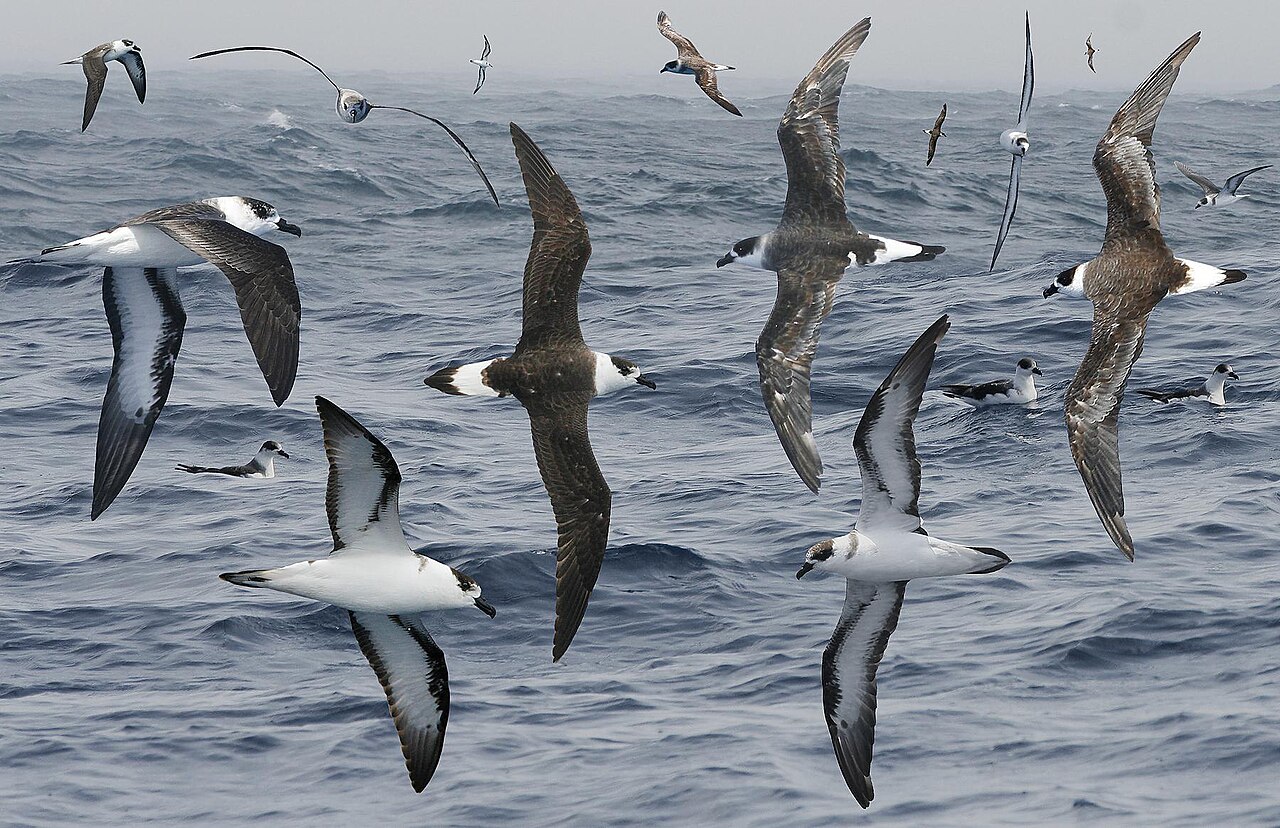
Black-capped Petrel is the gadfly petrel that regulars on pelagic boat trips off Cape Hatteras can expect year-round: a medium-sized, black-and-white petrel that breeds only in the mountains of Hispaniola and Dominica, yet disperses widely into the Gulf Stream off the Atlantic coast of the United States outside the breeding season. Early Haitian settlers named it diablotin, after the ghostly call that rang out of the mountains at night.
Voice
At the mountain colonies on Hispaniola, Black-capped Petrel is noisy at night: a wailing, almost howling call among the rocks earned the species the nickname diablotin, little devil, among early inhabitants. Over the Gulf Stream, far from the colonies, it is silent by day like most of its relatives. From the birds seen here, then, rarely more is heard than the soft beat of wings as a group lifts off after fish offal is thrown.
No freely licensed recording has been found for this species yet; what to listen for is described below.
Identification
A sturdily built, medium-sized petrel, black above and white below, with a black cap, a white rump and a fast, arcing flight on high, sharp glides. The species occurs in two forms: the 'white-faced' form has a smaller cap with a pale collar and a pale line above the eye, while the 'dark-faced' form carries a larger cap around the eye with a brownish collar and a dark chest spot; intermediates also occur. Male and female do not differ in appearance. The heavy, strongly hooked bill and broad wings set the species apart in silhouette from smaller petrels.
Confusion species
Bermuda Petrel (Pterodroma cahow) is smaller, with a smaller bill and a dark cap that blends smoothly into the back, lacking the clear pale collar and sharply defined white rump of Black-capped Petrel. Great Shearwater (Ardenna gravis) is larger and heavier, with less contrast between head and body and a straighter flight without the high, arcing glides. Sooty Shearwater (A. grisea) is entirely dark and lacks the white underparts altogether. In the Gulf Stream, Black-capped Petrel is usually the most numerous of these dark-and-white petrels, which complicates picking out the rarer species among them.
Habitat
Within this area Black-capped Petrel is a bird of warm, open ocean water along the western edge of the Gulf Stream, where converging currents concentrate food that the birds pick from the surface at night and in the early morning. It does not breed in North America; its colonies lie in steep, forested mountains on Hispaniola, between roughly sixteen hundred and twenty-two hundred metres elevation, and probably also on Dominica. Along the coast itself it is essentially never seen.
Where the bird is most often found, arranged by the USNVC — the vegetation classification of the United States and Canada — and CMECS for sea and coast.

Range and movements
Black-capped Petrel breeds in the mountains of Hispaniola, split between the Dominican Republic and Haiti, and on Dominica; breeding is suspected but unconfirmed on Cuba and Jamaica, and the species is extinct as a breeder on Guadeloupe. Outside the breeding season it can be found year-round over the Gulf Stream off Cape Hatteras, North Carolina, with smaller numbers north to Virginia and south through the rest of the Caribbean. The world population has shrunk sharply over the past half-century, chiefly through the loss of montane forest on the breeding islands.
- Breeding (summer)
- Winter
- Passage
- dark = core range, pale = thinly spread
Where and when to look
The Gulf Stream off Cape Hatteras, reachable on a day trip from Hatteras Village, is the most reliable place in the world to see Black-capped Petrel, in almost any month of the year. Watch for the combination of black cap, white rump and the high, arcing flight: that alone separates it, even at a distance, from the smaller, darker petrels sharing the same waters.
Conservation
Partners in Flight estimates the world population at fewer than fifteen hundred breeding birds, after a decline of more than half over the past fifty years; in 2024 the species accordingly gained protection as an endangered species under the US Endangered Species Act. Loss of montane forest to agriculture, predation by introduced cats and mongooses on the breeding islands, and the rise of offshore wind energy over the Gulf Stream stand out as the main threats.
Scientific name
Pterodroma hasitata | (Kuhl, 1820)
Heinrich Kuhl described the species in 1820 as Procellaria hasitata, without a recorded locality; because it has since been placed in the genus Pterodroma — erected by Bonaparte in 1856 — author and year stand in parentheses. The species name hasitata is Latin for 'hesitated' or 'uncertain', possibly reflecting Kuhl's own hesitation over where to place the species. Because the origin of the type material was never recorded, an official type locality remains lacking to this day.