All species › Tubenoses › Petrels, shearwaters and diving petrels › Newell's Shearwater
Newell's Shearwater | Puffinus newelli
Newells pijlstormvogel | Pardela de Newell
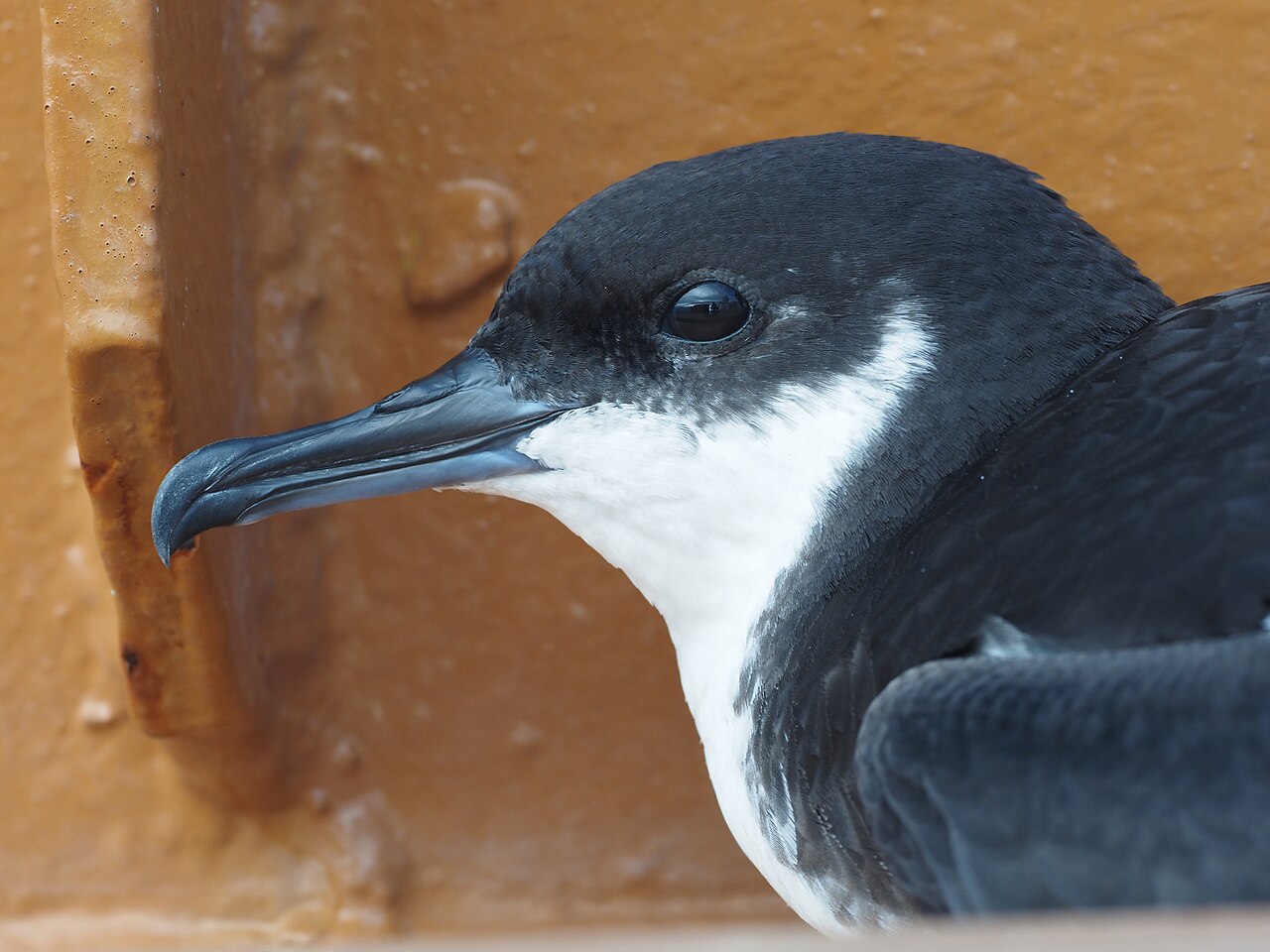
Newell's Shearwater is a small, black-and-white shearwater that breeds only in the Hawaiian Islands, and there almost exclusively high in the forested mountains of Kauaʻi, far from the coast where most of its relatives nest. Known by its Hawaiian name 'a'o, after its barking call, it has been in freefall since the 1990s and is now listed as Critically Endangered (CR).
Voice
Only at night, when birds fly in from the sea to their mountain burrows, is Newell's Shearwater heard: a harsh, hoarse barking, often likened to the braying of a donkey, rings out over Kauaʻi and gave the species its Hawaiian name 'a'o. By day, at sea, it is silent. Because the flight to the colony happens at night, young birds especially lose their way in the artificial light of towns and roads — it is this lost, braying call under streetlights, rather than a call heard in the wild, by which most people come to know the species.
Recording: Tim Holland — CC BY-NC-SA 4.0 · Pu'u O Kila Lookout (past lookout along ridge), Kauai County, Hawaii, United States · xeno-canto
Identification
A small shearwater, black above and white below, with a sharp line between the two colours and a white patch on the flank that projects behind the wing like a 'saddlebag'. The bill is thin and dark, the tail long for a shearwater. Male, female and juvenile do not differ in plumage. In flight the wingbeat is quicker and more hurried than in the larger shearwaters, with shorter glides.
Confusion species
Wedge-tailed Shearwater (Ardenna pacifica), with which it often forms mixed flocks near the colonies, is considerably larger, with a long, tapering tail and a slower, more buoyant flight; the pale morph of that species is also dingy brown rather than sharply black above. Hawaiian Petrel (Pterodroma sandwichensis) is likewise larger and heavier, with a thicker bill and an entirely different flight, soaring high above the water. On the ground, where lost fledglings crash-land at night, Newell's Shearwater is most often confused with young storm-petrels, which are much smaller and have a forked tail.
Habitat
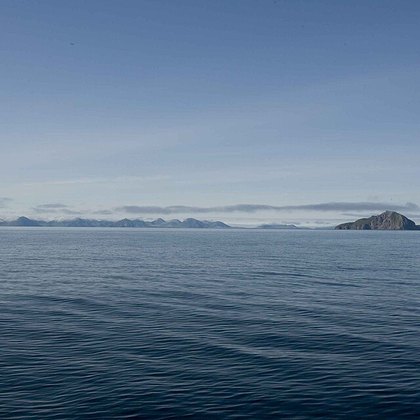
At sea Newell's Shearwater is a bird of warm, open water in the tropical and subtropical Pacific, diving in flocks by day for fish and squid. For breeding it departs sharply from most shearwaters: it does not burrow near the coast but deep in the mountains, on densely vegetated, damp slopes above a thousand metres, sometimes tens of kilometres from the sea. It scarcely uses the low, open coastal ground where many other shearwaters breed.
Where the bird is most often found, arranged by the USNVC — the vegetation classification of the United States and Canada — and CMECS for sea and coast.

Range and movements
The main colonies lie on Kauaʻi, around the Alakaʻi Plateau and the mountains near Mokoleʻa; smaller numbers breed on Molokaʻi and Hawaiʻi, and possibly still on Maui, Oʻahu and Lanaʻi. Outside the breeding season the species disperses across the tropical Pacific, south to waters off Japan and the Mariana Islands and to the southwestern Pacific near New Caledonia, the Solomon Islands and Vanuatu. Between 1993 and 2013 the population, measured by radar over the flight paths to the colonies, collapsed by roughly ninety-four per cent — among the steepest declines known for a North American seabird.
- Breeding (summer)
Where and when to look
Within this area Newell's Shearwater is seen at sea almost only on a specialised boat trip off Kauaʻi; in addition, in late summer and autumn weakened fledglings sometimes crash-land, disoriented after their first night flight, on streets or in gardens on Kauaʻi. If you find such a bird, take it to a local drop-off point of the shearwater rescue programme — with a little help it can still reach the sea.
Conservation
In the mid-1990s the species was still among the most numerous seabirds on Kauaʻi, with an estimated eighty-four thousand birds, but it has since declined severely and is now listed as Critically Endangered (CR). Artificial light from towns and roads draws fledging birds in, which then die colliding with buildings and power lines; introduced rats, cats, pigs and American Barn Owls further threaten eggs and chicks in the mountain burrows. An annual rescue effort for grounded fledglings and growing predator control around the colonies have somewhat slowed the decline.
Scientific name
Puffinus newelli | Henshaw, 1900
Henry W. Henshaw described the species in 1900 as Puffinus newelli, named for Brother Matthias Newell, who obtained the type specimen on Maui; the genus Puffinus, erected by Brisson in 1760, has remained unchanged since, so no parentheses stand around author and year. The type locality lies in Waihe'e Valley on Maui. For a long time Newell's Shearwater was treated as a subspecies of Townsend's Shearwater; since being recognized as a full species, it carries its own name alongside that of its Mexican relative.