All species › Passerines › Tits, chickadees and titmice › Black-crested Titmouse
Black-crested Titmouse | Baeolophus atricristatus
Zwartkruinmees | Herrerillo crestinegro
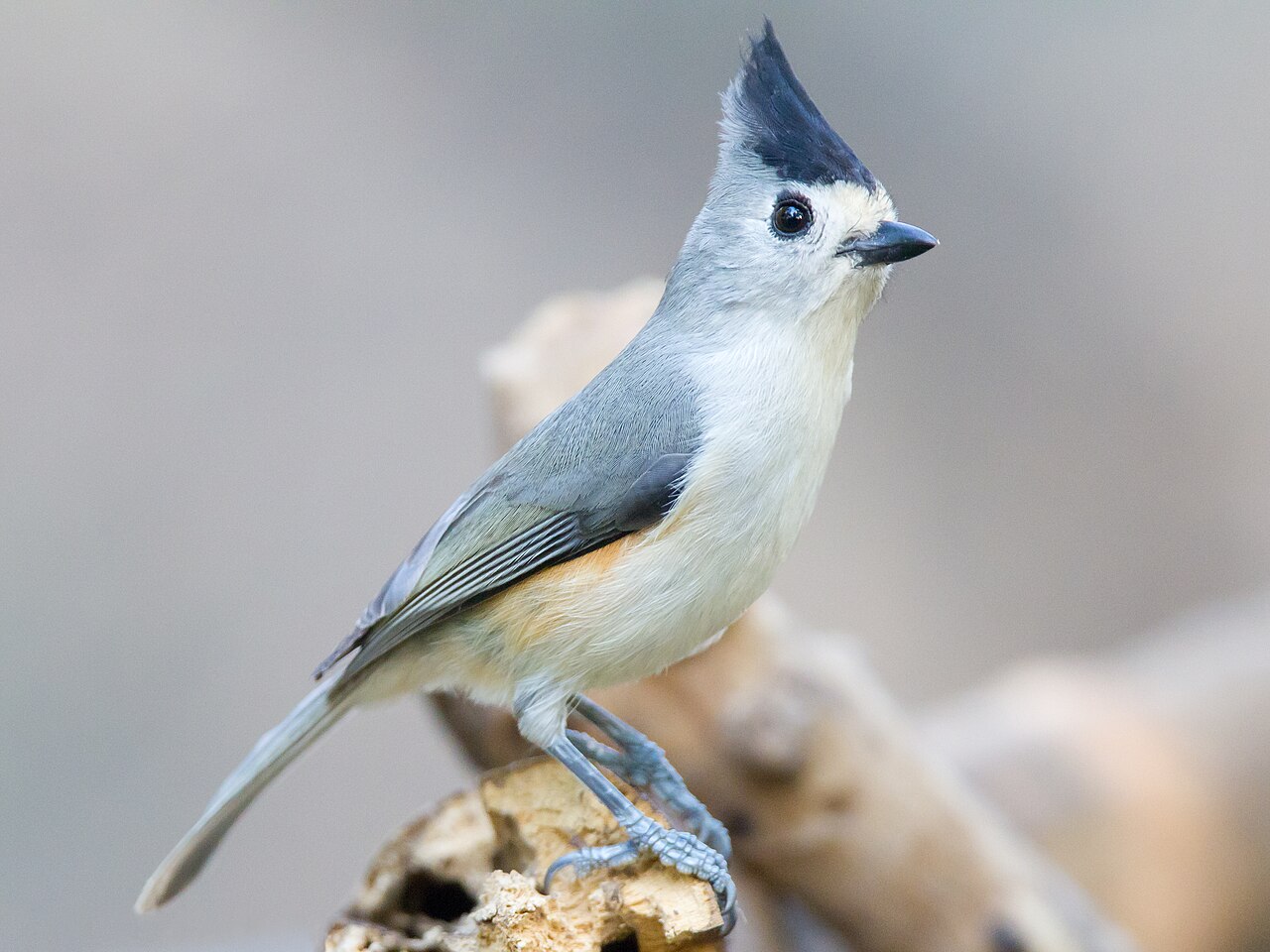
The Black-crested Titmouse is the titmouse of Texas and northeastern Mexico: grey, with a black crest above a white forehead. It replaces the Tufted Titmouse west and south of a narrow hybrid zone through central Texas.
Voice
The song consists of five to seven rapidly delivered, downslurred phrases, roughly peew peew peew peew peew. It resembles that of the Tufted Titmouse but averages higher and faster. Alongside it come several versions of a raspy chick-a-dee, high thin contact notes, and a swelling scolding chorus with which a small party surrounds an owl or a snake.
Recording: Phoenix Birder — CC BY-NC-SA 4.0 · Brackettville, Kinney County, Texas, United States · xeno-canto
Identification
About 15 cm, medium grey above and pale below, with greyish flanks and no clear rusty tone. The crest is black in the male of the nominate form, dark grey in the female, and short and grey in juveniles. The forehead is buffy white and contrasts sharply with the crest; the lores are white and there is a white eye-ring with a black spot above it. The bill is short and stout.
Confusion species
Tufted Titmouse has the reverse head pattern: grey crest above a black forehead. In the narrow hybrid zone in central Texas and southwestern Oklahoma, intermediates occur with a dull, half-black crest and a dingy forehead; they cannot be assigned to either species. Female Black-cresteds with a dark grey crest are also awkward there. Bridled Titmouse of Arizona and New Mexico is smaller and has a black-and-white patterned face with a black throat patch and a black border to the crest. Carolina Chickadee is smaller, uncrested and has a black cap and bib.
Habitat
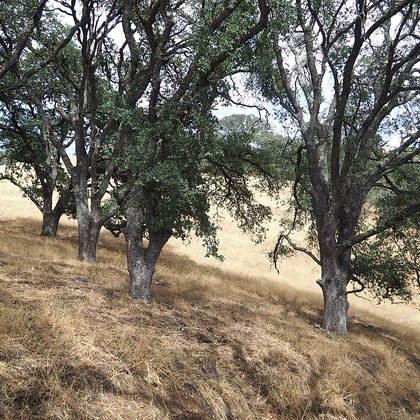
Woodland and scrub from the lowlands to about 2300 metres: oak woodland, mesquite (a thorny pod-bearing shrub of the Southwest that forms dense thickets) bosque, Rio Grande thorn scrub, streamside woodland, and montane conifer forest in West Texas and northeastern Mexico. It also occupies gardens, city parks and yards with tall trees, and comes to feeders there. The nest is in a tree cavity, old woodpecker hole or nest box. The food is largely insects, with nuts, seeds, berries and corn added; food storing has not been established for this species, unlike several of its relatives in the family.
Where the bird is most often found, arranged by the USNVC — the vegetation classification of the United States and Canada — and CMECS for sea and coast.






Range and movements
Resident in central and southern Texas, the Texas Panhandle and southwestern Oklahoma, west to the Davis Mountains, and from there south through northeastern Mexico: northeastern Coahuila, Nuevo León, Tamaulipas, San Luis Potosí and on along the eastern flank of the Sierra Madre Oriental through Querétaro and Hidalgo to southern Veracruz. Outside the breeding season small parties range through the territory and join mixed foraging flocks with chickadees, nuthatches and warblers; it does not migrate over any distance.
- Resident
- Breeding (summer)
- dark = core range, pale = thinly spread
Where and when to look
In the Texas Hill Country it can be seen at almost any feeder with sunflower seed. When in doubt look at the forehead rather than the crest: a white forehead belongs to this species, a black forehead to Tufted Titmouse, and a dingy grey forehead points to a bird from the hybrid zone.
Conservation
The IUCN rates the species as Least Concern (LC), with an estimated 1.2 million mature birds and an increasing trend. It adapts to built-up land and uses nest boxes, so it remains present in suburbs and small towns. Where thorn scrub and mesquite along the Rio Grande are cleared for cropland the cavity trees disappear, and that is the main constraint there.
Scientific name
Baeolophus atricristatus | (Cassin, 1850)
Cassin described the species in 1850 as Parus atricristatus; because it was later moved to another genus, author and year stand in parentheses. The species name is from Latin ater 'black' and cristatus 'crested'. The genus Baeolophus is from Greek baios 'small' and lophos 'crest'. The specimen described came from the Rio Grande in Texas, later restricted to the stretch between Brownsville and Rio Grande City. Because of the hybrid zone the bird was long treated as a subspecies of the Tufted Titmouse; since 2002 it has counted as a separate species again.