All species › Waders, gulls and terns › Skimmers, noddies, terns and gulls › Black-legged Kittiwake
Black-legged Kittiwake | Rissa tridactyla
Drieteenmeeuw | Gaviota tridáctila
The Black-legged Kittiwake is the gull that lives furthest from land: after breeding it spends months at a stretch on the open sea without coming ashore. Its English name comes from its call, and its Dutch and scientific names from its hind toe, reduced to a stump. There are millions of them, and yet the species has been listed as Vulnerable since 2017.
Voice
The call that gave the bird its name is a shrill, nasal kittee-waaake, kittee-waaake, which at a colony comes off the cliff from thousands of throats at once and hangs over the water. At the nest there is also a soft crooning greeting between partners, and a high squeaking begging note from the female during courtship. When a predator approaches, the colony switches to a short repeated oh-oh-oh-oh and the birds lift off together. At sea it is almost always silent; anyone who hears one there is usually hearing a squabble over a fish.
Recording: Stanislas Wroza — CC BY-NC-SA 4.0 · Ekkeroy, Finland · xeno-canto
Identification
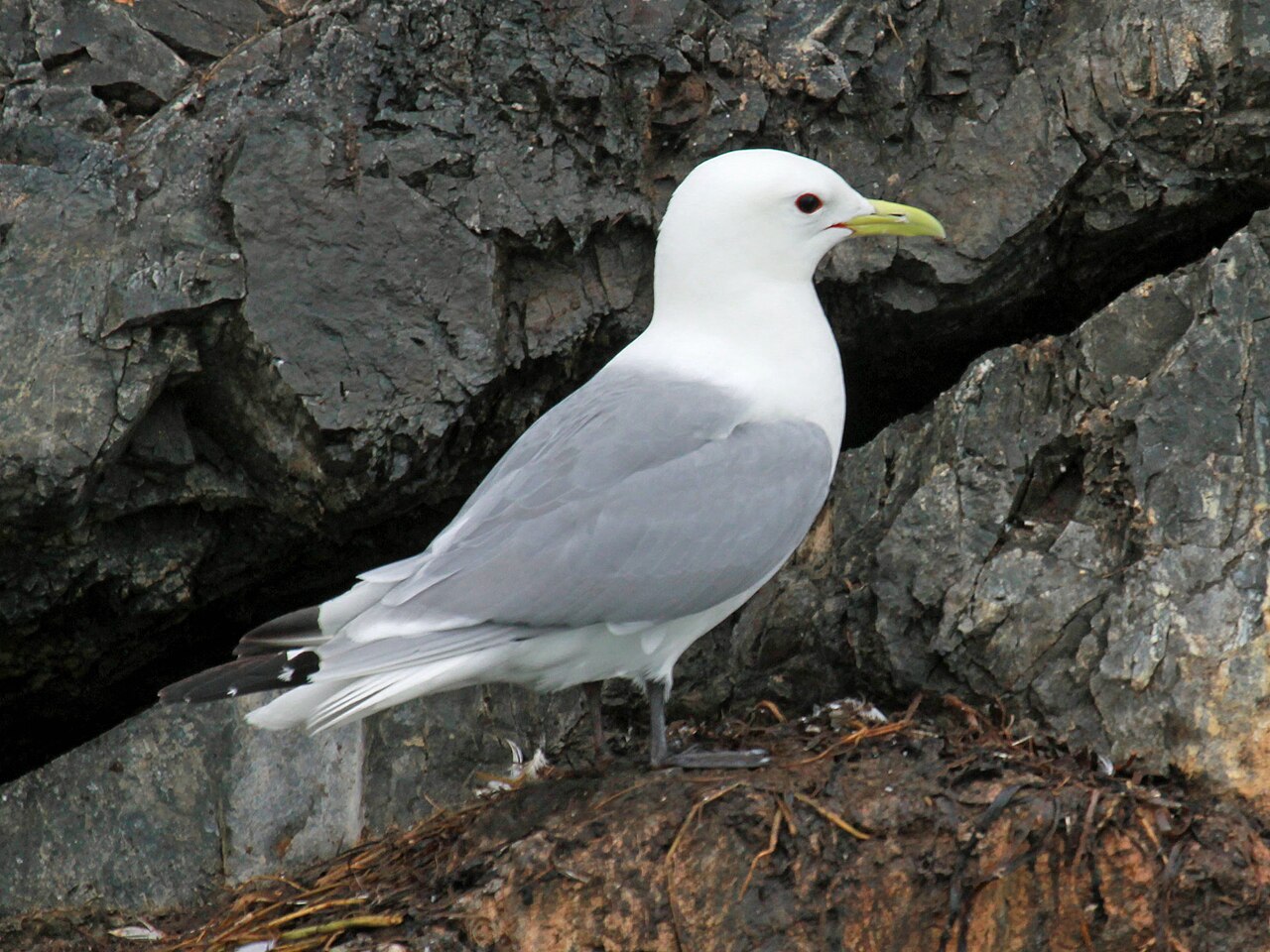
A medium-sized, slender gull with a pale grey mantle, white head and underparts, a plain yellow bill without a red spot, and short, jet-black legs. The wingtip looks dipped in ink: the black is sharply cut off, covers the outer three primaries, and carries no white mirrors. Male and female look alike; in winter plumage a grey smudge appears behind the ear and across the nape. In juveniles a black M runs across the spread upperwings, a black collar crosses the neck, the bill is black and the slightly forked tail has a black terminal band. The flight is light and springy, with stiff quick beats, and over the sea it skims low through the troughs of the waves.
Confusion species
Red-legged Kittiwake (Rissa brevirostris) of the Bering Sea is the closest relative and the most similar species: smaller, darker grey, with short red legs, a shorter bill and — decisively — a grey rather than white underwing. Short-billed Gull (Larus brachyrhynchus) is about the same size and also has a plain yellow bill, but yellow legs, clear white mirrors in the black wingtip, and a softer, rounder face. Young kittiwakes are confused with young Sabine's Gull (Xema sabini) and Little Gull (Hydrocoloeus minutus), which carry the same black M across the wings; the kittiwake is larger, has black legs, a black collar and a tail band across the full width. When in doubt, look at the leg: jet black on a kittiwake, red or flesh-coloured on the others.
Compare gulls: legs, head, bill and wing tip side by side
Habitat
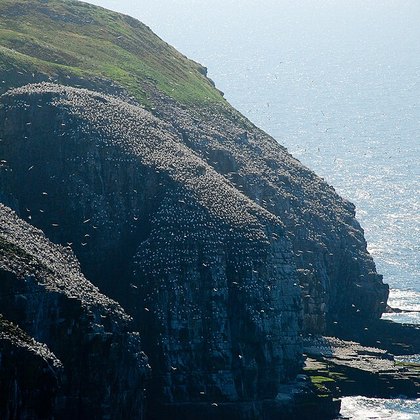
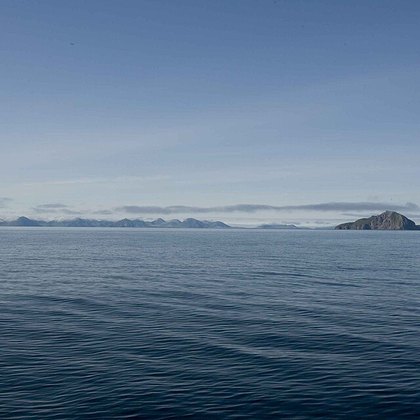
It breeds on narrow ledges of sheer sea cliffs, out of reach of fox and rat; it almost never nests on flat ground, and where it settles on buildings it picks window ledges and sills that imitate a cliff. Outside the breeding season it lives entirely on the open sea, favouring cold water over the shelf edge, over banks and seamounts and along current fronts, where food gathers. Unlike most gulls it does not come to rubbish dumps, and it makes little use of harbours. While breeding it forages up to a day's sailing from the colony, dipping low over the water or making a short plunge.
Where the bird is most often found, arranged by the USNVC — the vegetation classification of the United States and Canada — and CMECS for sea and coast.


Range and movements
It breeds right around the northern hemisphere: in North America from the Aleutians and the Bering Sea along the Gulf of Alaska, in the Canadian high Arctic, in Greenland, and in large colonies on Newfoundland, Labrador and in the Gulf of St. Lawrence. Outside the breeding season it spreads over the open ocean: in the west to off California and northwestern Mexico, in the east to off North Carolina and in smaller numbers further south. The two sides of the continent have moved in opposite directions over the past half-century — several eastern Canadian colonies grew strongly while those in the Bering Sea fell away. In autumn the odd young bird crosses the interior, and after a heavy gale dozens can end up on the Great Lakes.
- Resident
- Breeding (summer)
- Winter
- Passage
- dark = core range, pale = thinly spread
Where and when to look
Visit a cliff colony in June or July — Cape St. Mary's in Newfoundland, the Pribilof Islands — and notice how narrow the ledges are that hold a nest. To see it in winter, seawatch from a headland during an onshore gale between November and March, when the birds come within reach of the coast. In flight, look at the wingtip: pure black with no white, as if dipped in ink, is the best mark at long range.
Conservation
The world population comes to nearly fifteen million birds, but it has fallen by about forty per cent since the 1970s, and that moved the species from Least Concern to Vulnerable (VU) in 2017. The cause lies in the food: warmer sea water shifts the plankton and with it the small fish the bird lives on — sandeel in the east, capelin and herring in the Bering Sea — and in a bad year a whole colony fails at once. Birds are also drowned in fishing gear. Because it lays its nests open and visible on the cliff, it is one of the best-counted seabirds in the world, which is why the decline shows up so plainly.
Scientific name
Rissa tridactyla | (Linnaeus, 1758)
Linnaeus described the species in 1758 as Larus tridactylus; because it was later placed in a genus of its own, author and year stand in parentheses. The genus Rissa was introduced by Stephens in 1826 and is taken from the Icelandic rita, the name for this bird. tridactyla is Greek for three-toed, after the hind toe, which in this gull is reduced to a clawless stump. Linnaeus gave northern Europe as the type locality; it was later restricted to Great Britain.