All species › Waders, gulls and terns › Skimmers, noddies, terns and gulls › Sabine's Gull
Sabine's Gull | Xema sabini
Vorkstaartmeeuw | Gaviota de Sabine
Sabine's Gull is the only gull with a clearly forked tail and with an upperwing divided into three sharp triangles: grey, black and white. It breeds on wet tundra along the Arctic coast and then makes the longest migration of any gull, to the upwelling zones off Peru and Namibia. Anyone who sees it in North America usually sees it far offshore, in autumn, from a boat.

Voice
Its voice does not suit a gull: high, shrill and squeaking, with a harsh grating edge that suggests a tern. At the tundra colony it is noisy, especially when a jaeger or a fox passes and the birds — often together with the Arctic Terns among which it nests — dive at it in a cloud. Outside the breeding season it is almost entirely silent. At sea it is therefore a quiet presence, and sound is rarely of any use to the observer.
No freely licensed recording has been found for this species yet; what to listen for is described below.
Identification
In breeding plumage the adult has a slate-grey hood cut off at the rear by a narrow black collar, a red eyering and a black bill with a yellow tip. The best mark is in the upperwing: the inner wing is grey, the primaries black and the secondaries pure white, so that three large triangles lie side by side in flight. The tail is white and clearly forked, which no other gull in the region shows. In winter plumage the hood is lost, leaving a grey nape and a dusky smudge around the eye. Juveniles have a scaly grey-brown inner wing instead of grey, a black tail band and an all-black bill, but carry the same triangular pattern.
Confusion species
Young Little Gull (Hydrocoloeus minutus) and young Black-legged Kittiwake (Rissa tridactyla) also carry a dark M across the upperwings, but on those it runs as a zigzag through the whole wing, while Sabine's Gull has three cleanly bounded triangles and a forked tail. Ross's Gull (Rhodostethia rosea) is smaller and has a wedge-shaped tail with an elongated central feather rather than a fork. Adults with their grey hood are seldom confused, but at a distance the light, dancing flight can suggest a tern; the broad white tail and the three-part wing settle it at once. Aleutian Tern (Onychoprion aleuticus) does share a grey, white and black pattern, but has a straight pointed bill and a far deeper tail fork.
Habitat
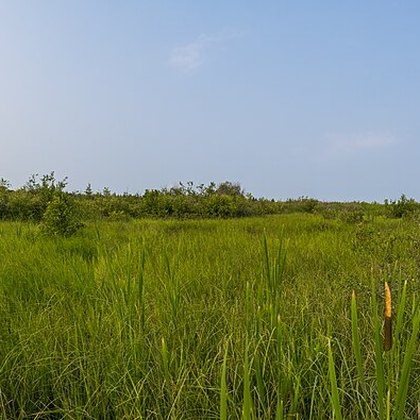
It breeds on low-lying, wet coastal tundra with pools and small lakes, among sedge and on muddy shores, usually within a few hundred metres of fresh water and often in small groups inside colonies of Arctic Terns, which help defend the chicks. There it feeds like a wader: walking and picking among the vegetation and along the water's edge for midge larvae, beetles and flies. As soon as the young can fly it leaves the land and becomes a bird of the open ocean, with a strong preference for cold upwelling zones along the shelf edge. It skips inland water and the ordinary coastal places — harbours, beaches, rubbish dumps.
Where the bird is most often found, arranged by the USNVC — the vegetation classification of the United States and Canada — and CMECS for sea and coast.




Range and movements
It breeds in a broken band around the pole: on the west and north coasts of Alaska, in northern Canada from Yukon to Nunavut, along Hudson Bay, in Greenland and from Svalbard eastward through Siberia. Its migration is the longest of any gull, well over thirty thousand kilometres a year: western birds follow the Pacific to the upwelling off Peru and northern Chile, eastern birds cross by way of western Europe and northwest Africa to the waters off Namibia and South Africa. Along the North American Pacific coast it passes in flocks from August to October, almost always out of sight of land, and then southward past the west coast of Mexico. On the Atlantic side it is scarce, and inland it turns up almost only after an autumn storm has driven it off course.
- Breeding (summer)
- Winter
- Passage
- dark = core range, pale = thinly spread
Where and when to look
The surest way to see one is a pelagic trip off Oregon, California or British Columbia in September, when passage is under way; from the beach it usually stays a distant speck. Then watch the wing, not the head: the crisp triangular pattern is recognisable at a range where nothing else can be made out. On the tundra, for instance near Utqiaġvik in Alaska, it simply sits at the edge of a pool in June and allows a close look.
Conservation
The species is listed as of least concern, with an estimated breeding population of some three hundred and forty thousand birds spread across country almost nobody visits. Reliable trends are therefore lacking: colonies are small, scattered and shift between years. The main worry is climate change, which is altering both the wet tundra where it breeds and the upwelling zones where it winters. As a bird of the open sea it is also exposed to oil and to poisons that build up in the food chain.
Scientific name
Xema sabini | (Sabine, 1819)
Joseph Sabine described the species in 1819 as Larus Sabini and named it for his brother Edward Sabine, who collected the first specimen in 1818 on the west coast of Greenland during Ross's search for the Northwest Passage; because the species was afterwards placed in a genus of its own, author and year stand in parentheses. That genus, Xema, was introduced in the same year, 1819, by Leach, and is an invented word without meaning — Leach liked to coin names that refer to nothing. The type locality is the Sabine Islands off Melville Bay, on the west coast of Greenland. The Dutch name points to the feature that separates it from every other gull: the forked tail.