All species › Waders, gulls and terns › Skimmers, noddies, terns and gulls › Black-tailed Gull
Black-tailed Gull | Larus crassirostris
Japanse meeuw | Gaviota japonesa
The Black-tailed Gull is an East Asian coastal gull, the only adult gull in the region with a full black tail band. In Japan it is called umineko, sea cat, after its mewing call. To North America it is a vagrant: a few dozen records, most of them from Alaska and British Columbia, spread over a century and a half.

Voice
The call is nasal and plaintive and sounds like a cat's mewing — hence the Japanese name umineko, sea cat. Work at the colonies distinguishes more than ten sounds: alarm calls, threat calls, contact calls and a long call given with the head thrown up. Over a colony of tens of thousands, as at Kabushima in northern Honshu, these merge into a continuous wailing that carries for kilometres. In North America it is almost never heard: the birds that turn up there are silent singletons in a large flock of gulls.
Recording: Bo Shunqi 薄顺奇 — CC BY-NC-SA 4.0 · 兴庄河口, Lianyungang, Jiangsu, China · xeno-canto
Identification
A medium-large, slender gull with long wings and a heavy, straight bill. The adult has a dark slate-grey mantle, yellow legs, a pale yellow eye with a red orbital ring, and a yellow bill with a black band and a red tip beyond it. The mark that matters is the tail: a broad, complete black band across an otherwise white tail, shown by no other adult gull in North America. In winter plumage the head and neck are finely streaked brown. Young birds are at first a uniform dark brown with a pale face and a pink bill with a sharply cut black tip; four years are needed to reach adult plumage.
Confusion species
California Gull (Larus californicus) comes closest: also a dark grey mantle, also a yellow bill with black and red, but with an all-white tail, yellow-green legs and a dark eye instead of a pale yellow one. Lesser Black-backed Gull (Larus fuscus) is darker still on the mantle, has a yellow eye and lacks the tail band. Ring-billed Gull (Larus delawarensis) is smaller and far paler grey, with only a black ring round the bill and a pale eye. Young Black-tailed Gulls are so dark that they suggest a young Western Gull (Larus occidentalis) instead; look then at the pale face and the sharply two-toned bill.
Compare gulls: legs, head, bill and wing tip side by side
Habitat
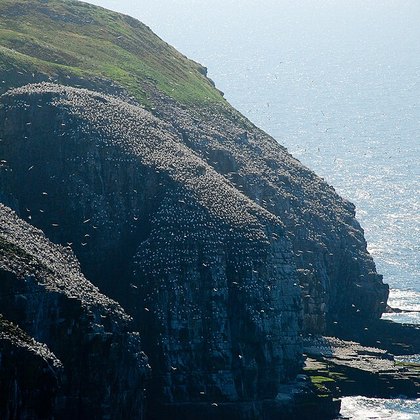
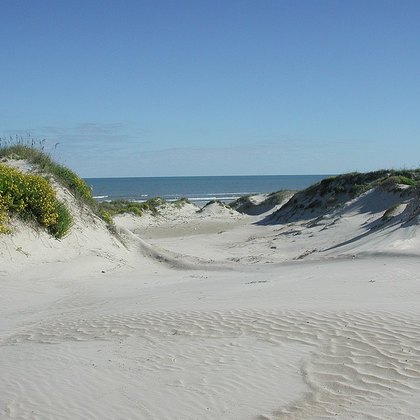
In its breeding range a bird of rocky islets, cliffs and steep coastal rims, where it nests on the ground in dense colonies. Away from those it belongs to fishing harbours, piers, river mouths and sandy beaches, and follows fishing boats well offshore. It feeds mainly on small fish and on what the fishery leaves behind, and also visits landfills. The birds that reach North America are almost always found in a harbour or at a river mouth, among other gulls.
Where the bird is most often found, arranged by the USNVC — the vegetation classification of the United States and Canada — and CMECS for sea and coast.



Range and movements
Breeds along the coasts and on the islets of eastern Siberia and the Kuril Islands, on Hokkaido and Honshu, along the Korean peninsula and the east coast of China, and on Matsu off Taiwan. In winter the birds shift southward, some reaching southern Vietnam and the Philippines. In North America it is a vagrant: most records come from western and southern Alaska and from British Columbia, but there are scattered occurrences from coast to coast, as far inland as Illinois and as far east as Vermont. Some of those distant birds are suspected of having ridden part of the way on a ship.
Where and when to look
Every North American chance lies in a flock of gulls in a harbour or at a river mouth on the Pacific coast, from late spring into late summer. Look at the tail rather than the head: one broad black band across a white tail, on a bird with a dark mantle and yellow legs, is enough. Take a photograph — a vagrant claim without an image is rarely accepted in North America.
Conservation
The species is listed as Least Concern (LC) and is locally numerous in East Asia; the colony on Kabushima holds well over forty thousand birds and is protected in Japan as a natural monument. Colonies are nonetheless vulnerable to oil spills, disturbance and introduced rats, because the great bulk of the population breeds on few islands. For North America the species has no conservation significance: none breed there.
Scientific name
Larus crassirostris | Vieillot, 1818
Vieillot described the species in 1818 as Larus crassirostris, and because it has stayed in that same genus ever since, author and year stand without parentheses. crassirostris is Latin for thick-billed, from crassus for thick and rostrum for bill — a fair observation here, for the bill is heavy for the size of the bird. The type locality is Nagasaki, Japan. Vieillot based his account not on a skin but on plate 57 of the narrative of Krusenstern's voyage around the world.