All species › Waders, gulls and terns › Skimmers, noddies, terns and gulls › Franklin's Gull
Franklin's Gull | Leucophaeus pipixcan
Franklins meeuw | Gaviota de Franklin
Franklin's Gull is the gull of the prairie: it nests on floating rafts in inland marshes and winters on the Pacific coast of Peru and Chile. Of all gulls it makes the longest annual journey, straight over the Rocky Mountains. It is also the only gull that moults completely twice a year, and so is almost always in fresh feather.
Voice
The commonest call is a short, sharp kek, given while feeding, in flight and at the roost. Disturbed, it becomes a rapid series of kek-kek-kek that runs through a colony like a wave. The male's long call begins and ends with a short kah and holds up to eight drawn-out, high keeeah notes in between — the sound by which a marsh full of Franklin's Gulls is known from a distance. Over a ploughed field full of gulls the whole becomes a steady, high-pitched creaking.
Recording: Dante Buzzetti — CC BY-NC-SA 4.0 · Puerto Montt city, Llanquihue, Los Lagos, Chile · xeno-canto
Identification
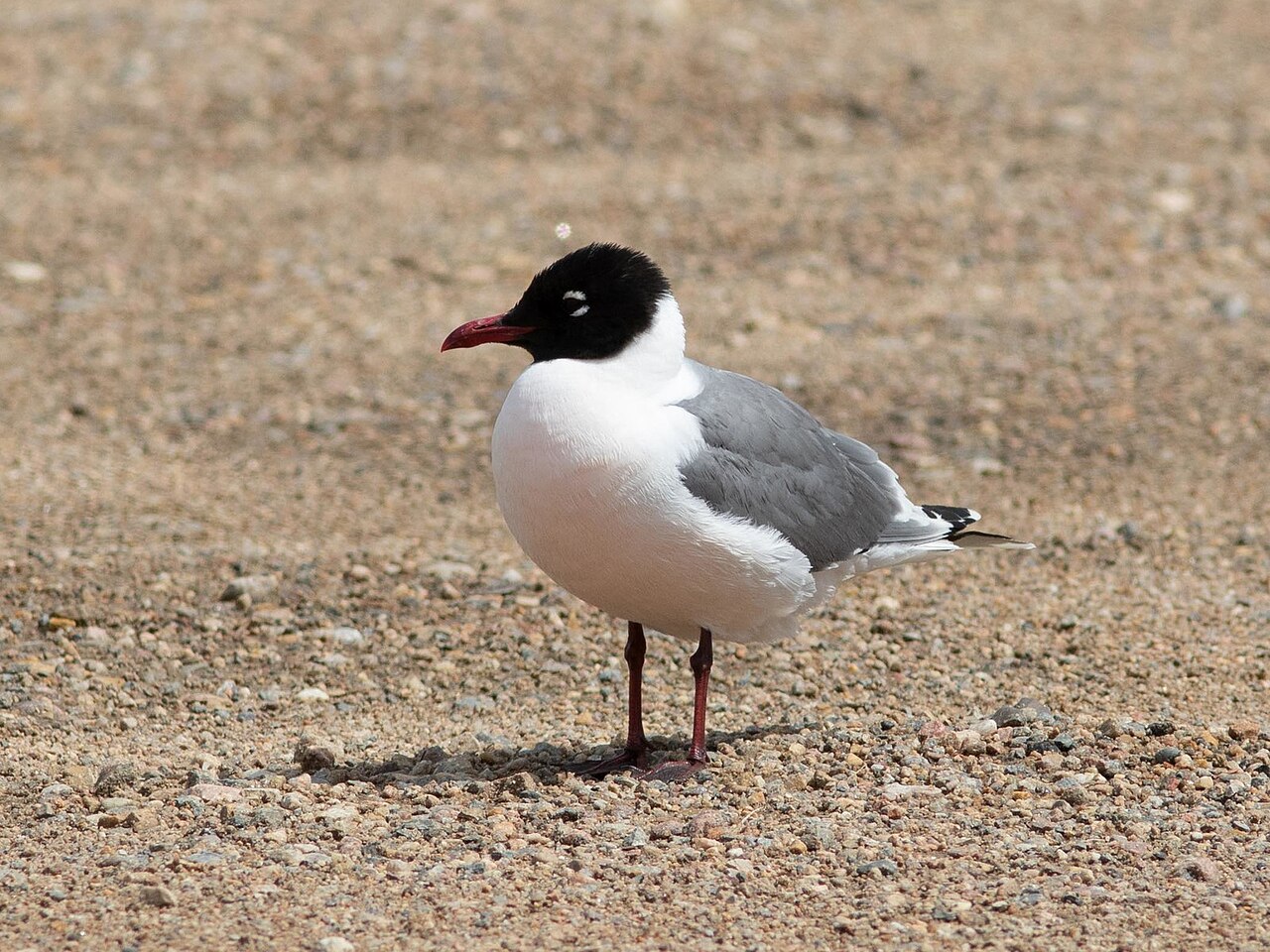
A small, short-billed gull with short legs and a round, gentle-looking head. In summer plumage a black hood with broad white eye crescents that nearly meet as spectacles, a dark red bill and legs, and white underparts often flushed with pink. In winter the hood is reduced to a clear dark half-hood covering crown, eye and ear coverts and standing out sharply against the white forehead; bill and legs turn black. The wingtip decides it: a white band runs between the grey of the wing and the black of the tip, and the black tip itself carries white mirrors. Juveniles resemble the winter bird but are brown-backed and have a black tail band, without that white band in the wing. Male and female are alike.
Confusion species
Laughing Gull (Leucophaeus atricilla) is the counterpart on the coast: larger, longer-legged, with a longer, slightly drooping bill and no white band between grey and black in the wingtip. In winter plumage the Laughing Gull shows only a blurred grey shadow on a white head, while Franklin's Gull keeps a sharply bounded dark half-hood — in the field this is the quickest usable difference. Bonaparte's Gull (Chroicocephalus philadelphia) is smaller still, with a fine black bill and a white wedge along the leading edge of the wing rather than a dark hood in winter. When a stray reaches the Atlantic coast in autumn it is nearly always among Laughing Gulls, and the half-hood is the first thing to catch the eye.
Compare gulls: legs, head, bill and wing tip side by side
Habitat
Breeds in shallow freshwater prairie marshes with reed, cattail and patches of open water, in colonies of hundreds to thousands of pairs; the nest is a floating raft of wet vegetation that the pair keeps building up through the season. Away from the colony it is a bird of open country: freshly ploughed fields, pasture, stubble, and the shores of reservoirs and sewage lagoons. On migration it follows the great river valleys and gathers by the thousand on shallow water in the evening. In winter it stands on beaches and in river mouths along the South American coast. Closed forest and the open ocean it avoids.
Where the bird is most often found, arranged by the USNVC — the vegetation classification of the United States and Canada — and CMECS for sea and coast.




Range and movements
The breeding range lies in the prairie marshes of western and northern Alberta east to southwestern Manitoba, and south from eastern Oregon to northwestern Minnesota. The whole population leaves: through the Great Plains, over passes above four thousand metres in the Rocky Mountains, and along the Middle American coast to the shores of Ecuador, Peru and Chile, reaching the Galápagos. Within the map window it is therefore a migrant almost everywhere and nowhere a winter bird of consequence south of the breeding range. Where prairie marshes were drained, colonies disappeared; where the water came back, they sometimes returned within a few years, for these birds shift their colonies readily.
- Resident
- Breeding (summer)
- Winter
- Passage
- dark = core range, pale = thinly spread
Where and when to look
Look for it in April and May over the ploughed fields of Nebraska, Kansas and the Dakotas: hundreds follow the tractor, and in low light the pink flush on the underparts shows well. At the end of the day they stream in long ribbons to a marsh or reservoir to roost — that is where to stand, with the sun behind you.
Conservation
Partners in Flight puts the global breeding population at about 830,000 birds, and the species is listed as Least Concern (LC). Estimates differ on the direction of the trend: North American counts point to a decline since 1968, while recent international estimates report an increase. The difference arises largely because colonies shift from year to year with the water level, which makes counting hard. The standing threats are marsh drainage, disturbance at colonies — the birds sometimes desert one entirely — and drought.
Scientific name
Leucophaeus pipixcan | (Wagler, 1831)
Wagler described the species in 1831 as Larus pipixcan, from a specimen taken in Mexico; because it has since been placed in another genus, author and year stand in parentheses. The genus Leucophaeus was introduced by Bruch in 1853, from Greek leukos for white and phaios for dusky. pipixcan is a Nahuatl name for a gull, taken from the sixteenth-century Mexican natural history of Hernández. The English name honours John Franklin, whose Arctic expedition of 1825 brought back the first North American specimens; those were described separately, but Wagler's name was older and so remained valid.