All species › Waders, gulls and terns › Skimmers, noddies, terns and gulls › Laughing Gull
Laughing Gull | Leucophaeus atricilla
Lachmeeuw | Gaviota guanaguanare
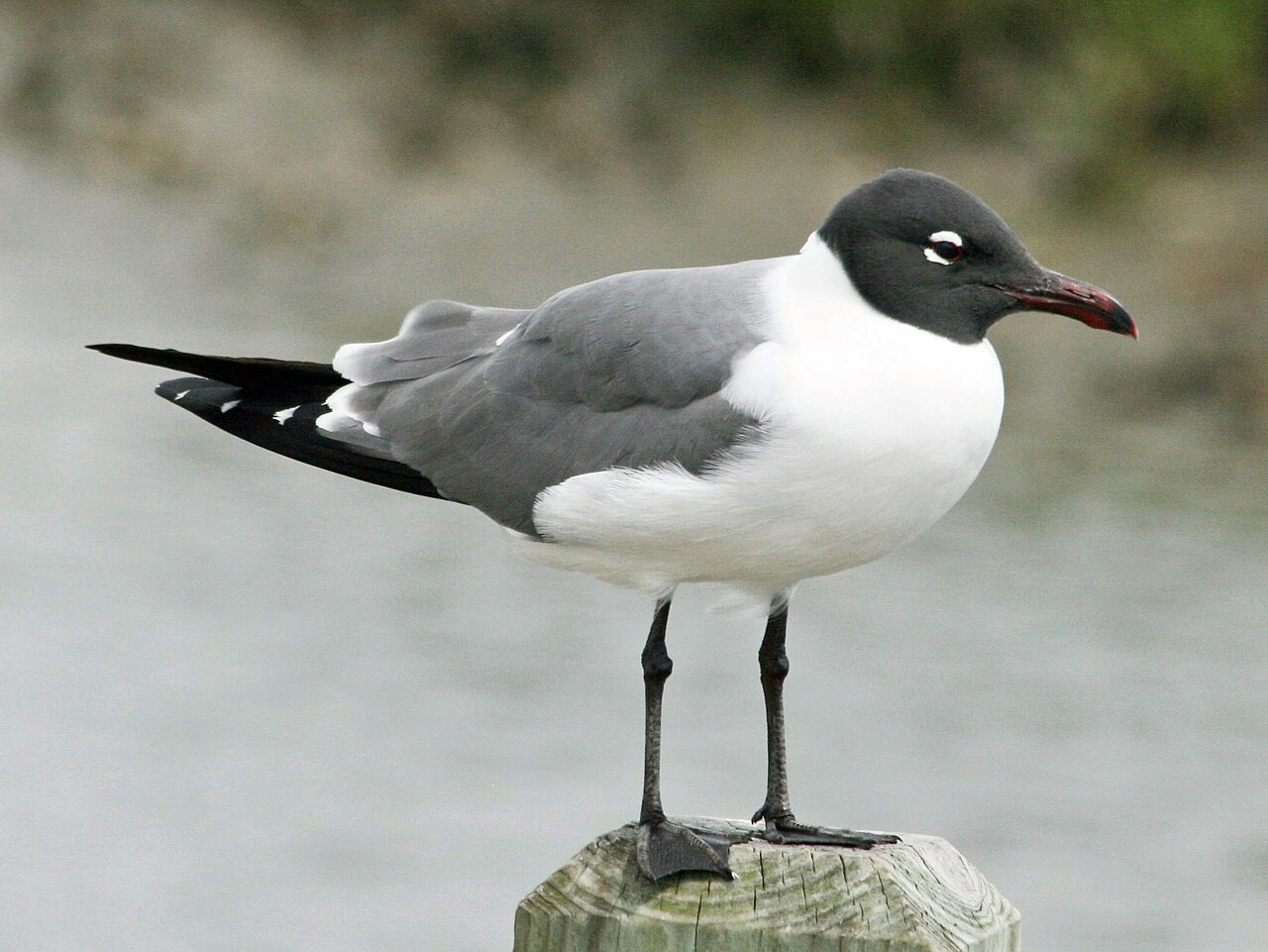
The Laughing Gull is the gull of the warm American coast: medium-sized, with a jet-black hood and a long, slightly drooping red bill. Its name comes from the call, a descending series of laughing notes that carries the length of a beach. In the Northeast it is a summer bird; from the Carolinas south it stays all year.
Voice
The call it is named for is a loud, descending series of laughing notes, ha-ha-ha-haah-haah, held for three seconds or more and often taken up by the whole colony. Come too close to a nest and you first get a short, stuttering alarm note, which turns into prolonged screaming if the threat stays. Begging young give a thin squeaky note, and a flock over a fishing pier keeps up a steady murmur of short cries. On a beach car park or a Gulf Coast pier this is usually the first bird voice you hear.
Recording: David Darrell-Lambert — CC BY-NC-SA 4.0 · Sizewell, Suffolk, England, United Kingdom · xeno-canto
Identification
A medium-sized gull with long pointed wings, long legs and a fairly long bill that droops a little at the tip. In summer plumage it wears a jet-black hood with crisp white crescents above and below the eye, a dark red bill, and dark red to black legs; the mantle is medium grey and runs into the black wingtip with no white break between them. In winter the hood breaks down into a blurred grey smudge behind the eye on an otherwise white head. Male and female look alike. Juveniles are brown with a paler head, white eye crescents and a black tail band, and take two to three years to reach adult plumage. In flight it is slim and long-winged, with an easy, sailing beat low over the surf.
Confusion species
Franklin's Gull (Leucophaeus pipixcan) is the hard one: smaller, shorter in bill and legs, with broader white eye crescents and — decisively — a white band separating the black wingtip from the grey of the wing. The Laughing Gull has no such band; grey runs straight into black. Range helps too: the Laughing Gull belongs to the salt coast, while Franklin's Gull breeds in prairie marshes and reaches the sea mainly on migration. Bonaparte's Gull (Chroicocephalus philadelphia) is much smaller, with a fine black bill and a pale translucent wedge along the leading edge of the wing. Young Laughing Gulls are confused with young Ring-billed Gulls (Larus delawarensis), which are paler, shorter-legged and have a thick two-toned bill.
Compare gulls: legs, head, bill and wing tip side by side
Habitat
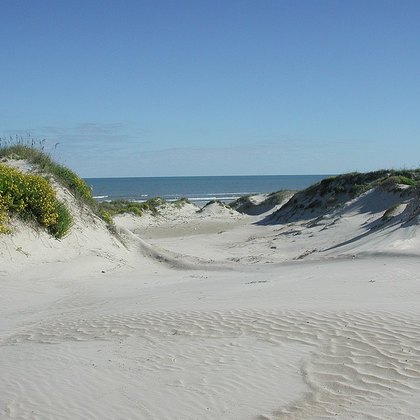
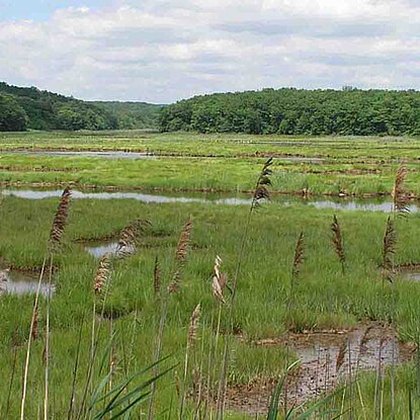
Beaches, sandbars, salt marsh, river mouths and lagoons; it stays on the salt coast and rarely goes far inland. Colonies sit on islets in salt marsh and on low sand islands, dredge-spoil islands included, and range from a handful of nests to twenty-five thousand pairs. Outside the breeding season it belongs to piers, fishing harbours, seafronts and shoreside car parks, living on refuse, carrion and discarded fish. What it needs is shallow salt water with a beach beside it; deep open water far offshore it avoids.
Where the bird is most often found, arranged by the USNVC — the vegetation classification of the United States and Canada — and CMECS for sea and coast.



Range and movements
Breeds along the Atlantic coast from Maine to Florida, around the whole Gulf of Mexico to Texas and Tamaulipas, and further on the islands of the West Indies and in the Gulf of California. North of Virginia it is a summer bird; from the Carolinas south it stays all year, and in winter part of the population moves on to the coasts of Central America and northern South America. In the nineteenth century it was hunted hard for eggs and plumes and all but vanished from the Northeast; after the bird protection law of 1918 it returned and spread north again as far as Maine. The landfills, fish docks and dredge-spoil islands that came with coastal development have done it no harm since.
- Resident
- Breeding (summer)
- Winter
- Passage
- dark = core range, pale = thinly spread
Where and when to look
Look for it in May and June on a pier or fishing jetty on the Gulf Coast or the southern Atlantic coast: the hood is then fully black, the bill deep red, and the laughing hardly stops. To separate it from Franklin's Gull, wait until it lifts off and watch the border between grey and black in the wingtip — on a Laughing Gull there is no white in between.
Conservation
The species is listed as Least Concern (LC); the continental population is put at well over half a million breeding birds and increased between 1966 and 2015. Recovery from the plume and egg trade is complete; locally it has become so numerous that it takes the eggs and chicks of terns and is actively kept away from tern colonies. The main threats now are the loss of salt marsh and low sand islands to coastal building, and disturbance of nesting islands by recreation.
Scientific name
Leucophaeus atricilla | (Linnaeus, 1758)
Linnaeus described the species in 1758 as Larus atricilla; because it was later moved to another genus, author and year stand in parentheses. The genus Leucophaeus was introduced by Bruch in 1853; the name is Greek, from leukos for white and phaios for dusky. atricilla is built from Latin ater for black and a cilla read as 'tail', after the black tail band of the young bird, though Linnaeus probably meant 'black-capped'. The specimen described came from America; the type locality was later fixed on the Bahama Islands, after the Catesby plate on which Linnaeus based his account.