All species › Birds of prey › Kites, Old World vultures, eagles and hawks › Broad-winged Hawk
Broad-winged Hawk | Buteo platypterus
Breedvleugelbuizerd | Busardo aliancho
The Broad-winged Hawk is the smallest buteo of the eastern woods: crow-sized and stocky, with a big head and a short tail crossed by broad black and white bands. In late summer it leaves the forest and migrates south to South America in swirling columns of hundreds to thousands of birds, known as kettles.
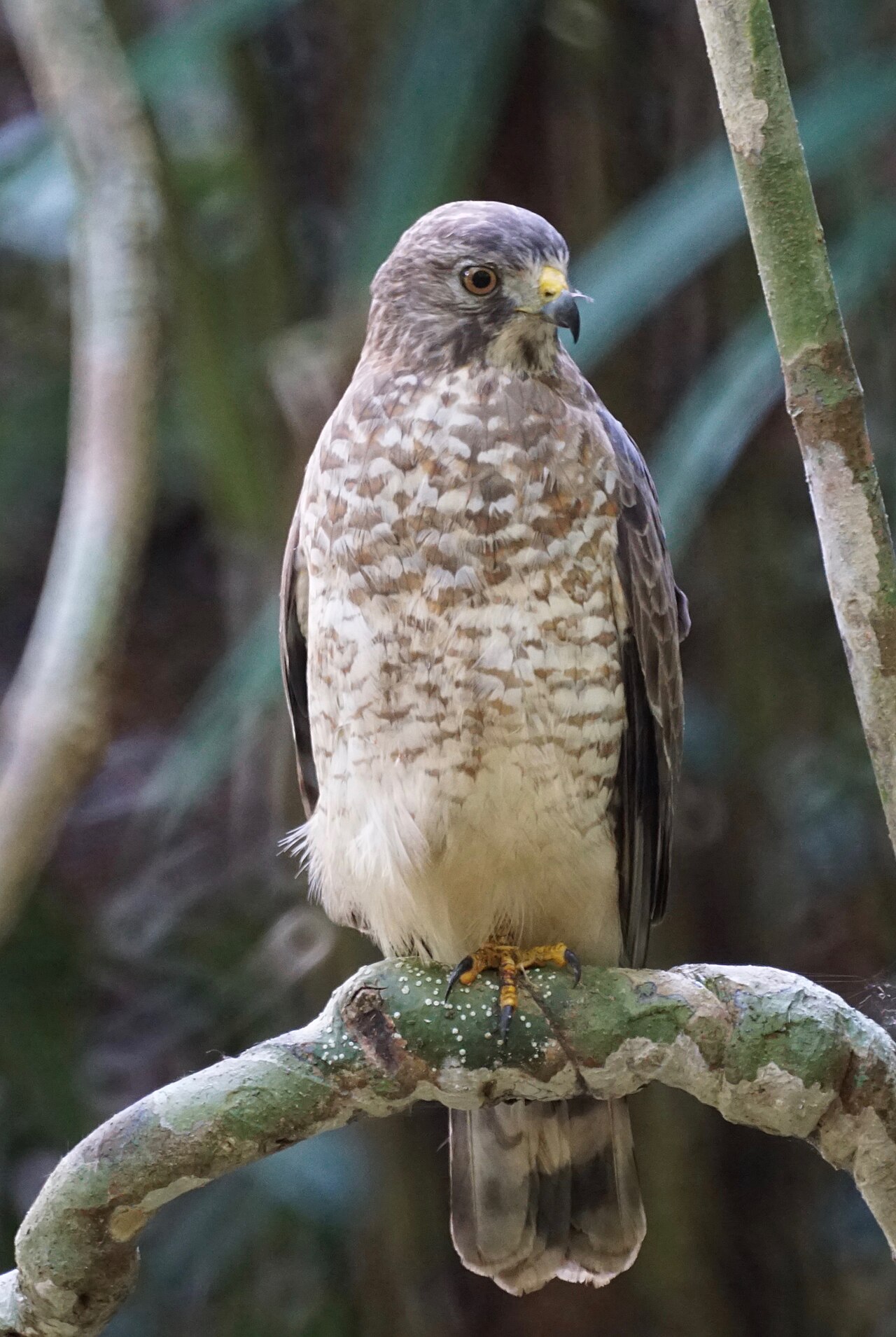
Click a thumbnail to switch the photo above.
Voice
The call is a plaintive, high whistle of two to four seconds, with a short first note and a long, sustained second one: kee-eeeeee. It is so thin and so even in pitch that it suggests an insect, or a braking train, rather than a bird of prey. The male calls an octave higher than the female, so that a pair over the wood can be told apart by pitch alone. Birds call all year, both from the nest and in flight, and in the breeding wood the whistle is usually the only sign that they are there.
Recording: Denis Dujardin — CC BY-NC-SA 4.0 · Le Robert, La Trinité, France · xeno-canto
Identification
The adult is plain dark brown above, with a reddish-brown head and reddish barring across breast and belly that merges at a distance into a warm bib. The tail carries broad black and white bands, of which one wide white band stands out most in the adult; the underwing is pale with a sharp dark border. The shape is compact: a solid body, a large head, and broad wings that taper noticeably to a point, with a short, square-cut tail. Juveniles are paler, with brown streaking on white underparts and a tail crossed by many narrow bars instead of one broad one. A rare dark morph exists, entirely sooty brown on head, body and underwing coverts but with the same banded tail; it breeds chiefly in the west of the range. The female is the larger sex.
Confusion species
Red-shouldered Hawk is the most similar: it is larger, with a longer tail carrying four or more narrow white bars rather than one broad band, rufous shoulders, checkered black-and-white upperwings, and at all ages a pale translucent crescent just inside the wingtip — a mark Broad-winged Hawk entirely lacks. Red-tailed Hawk is much bigger, with a dark belly band, a dark patagial bar along the leading edge of the underwing, and an unbanded tail. Cooper's Hawk and Sharp-shinned Hawk have short rounded wings and long barred tails and fly with bursts of flapping and gliding, where Broad-winged Hawk soars on a fixed wing. The dark morph is confused with dark Short-tailed Hawk; look for the broad white tail band of the Broad-wing.
Habitat
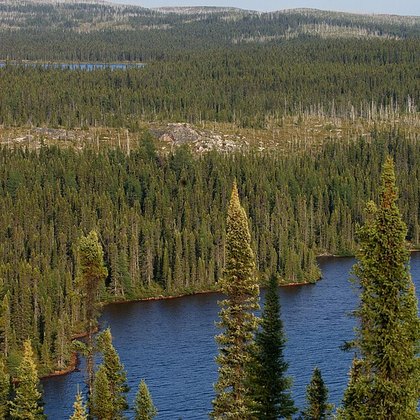
Large unbroken deciduous and mixed forest, preferably with clearings, tracks or water nearby to hunt over from a perch. In the breeding season it stays below the canopy; it avoids disturbed, fragmented woodland near houses. It hunts from a low perch, dropping to the ground for frogs, toads, mice, snakes and nestling birds. In winter it lives in tropical forest and along forest edges.
Where the bird is most often found, arranged by the USNVC — the vegetation classification of the United States and Canada — and CMECS for sea and coast.




Range and movements
Breeds across eastern North America, from Alberta and north-eastern British Columbia east to Nova Scotia and south to eastern Texas and northern Florida, and winters from southern Mexico to Brazil and Bolivia. Five subspecies live all year on Caribbean islands, among them Cuba and Puerto Rico, and do not migrate. Migrating birds cover three to six thousand kilometres in about seventy days and then spend the whole winter within a few square kilometres. Numbers rose slightly between 1966 and 2019, particularly in Canada, and a few immature birds now winter in southern Florida.
- Resident
- Breeding (summer)
- Winter
- Passage
- dark = core range, pale = thinly spread
Where and when to look
Go in the second half of September to a hawk watch on a ridge or a coastline — Hawk Mountain in Pennsylvania, Hawk Ridge in Minnesota, or the coastal plain of Veracruz in Mexico, where hundreds of thousands pass. Do not look for single birds but for a turning column: dozens to thousands of hawks circling up together in one thermal and streaming off the top of it in single file. A cool, clear day with a northerly wind behind a front produces the largest counts.
Conservation
Partners in Flight puts the breeding population at 1.9 million birds and gives the species 9 out of 20 points on the Continental Concern Score (a 1–20 scale), which counts as low concern. Numbers increased slightly between 1966 and 2019. The largest threat is forest loss on the wintering grounds, where the birds are also hunted. In the Florida Keys wintering birds are regularly killed by traffic.
Scientific name
Buteo platypterus | (Vieillot, 1823)
Vieillot described the species in 1823 as Sparvius Platypterus; because it now stands in the genus Buteo and has therefore changed genus, author and year are given in parentheses. The species name is Greek: platys means 'broad' and pteron 'wing', hence 'broad-winged'. Buteo is the ordinary Latin word for a buzzard. The type locality is Pennsylvania, more precisely the Schuylkill River, after the bird Alexander Wilson described there.