All species › Pelicans, herons and ibises › Herons, egrets and bitterns › Cattle Egret
Cattle Egret | Ardea ibis
Koereiger | Garcilla bueyera
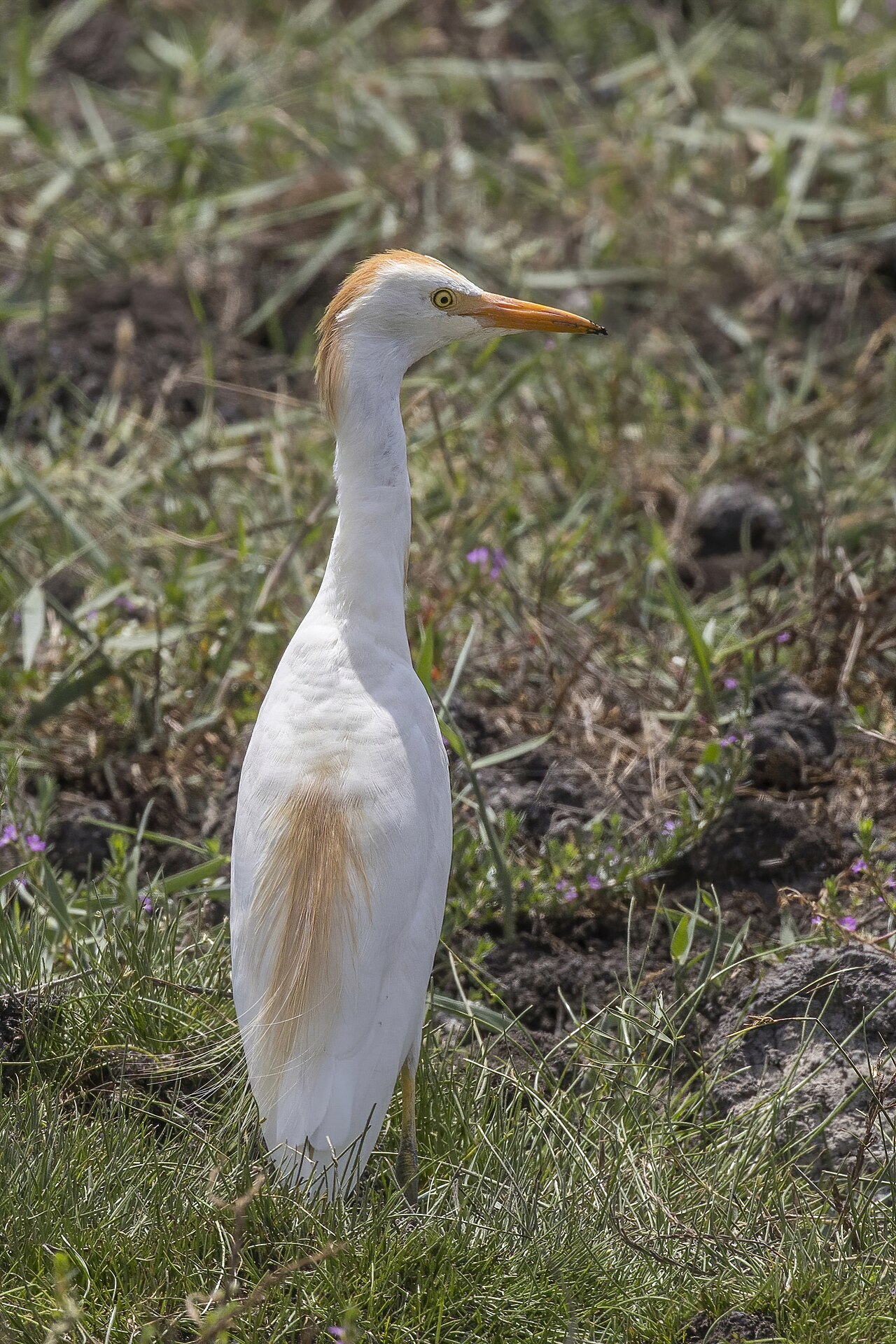
The Cattle Egret is a stocky, short-necked heron rarely found in water: it walks among grazing livestock and farm machinery, snapping up the insects they disturb. It is one of the few herons not tied to water, and one of the few birds to have spread across an entire continent unaided by people, in under a hundred years. In breeding plumage it takes on a wash of buff-orange on crown, breast and back; otherwise it is pure white.
Voice
Away from the colony the Cattle Egret is almost silent. At the nest it gives a soft, guttural rick-rack, repeated between partners while exchanging nest material or during a dispute with a neighbour. Displaying birds also give short, harsh throat calls while bobbing the head and showing off their plumes.
No recording with a suitable Creative Commons licence has been found for this species yet; what to listen for is described below.
Identification
In non-breeding plumage the Cattle Egret is entirely white, with a short, thick yellow bill, a short, thick neck and a compact, somewhat rounded build that sets it apart from the slender true egrets. In breeding plumage the crown, breast and back turn buff to orange, the bill flushes coral-red with a bluish base, and the legs shift from yellow to dark red. Young birds are pure white with a yellow bill and dark legs, barely distinguishable from non-breeding adults. The short neck and thick bill also show in flight, which is performed with the neck drawn in and quick, somewhat stiff wingbeats.
Confusion species
Snowy Egret (Egretta thula) has a long, thin black bill and yellow feet on black legs, unlike the Cattle Egret's short yellow bill and dark to flesh-coloured legs. Immature Little Blue Heron (E. caerulea) is likewise white but shows a grey-blue bill tip and greenish-yellow legs, and is slimmer-built with a thinner neck. Great Egret is considerably larger, with a long yellow bill and a much longer, snake-like neck — when in doubt, the Cattle Egret's stocky, short-necked build is the quickest clue at any distance.
Habitat
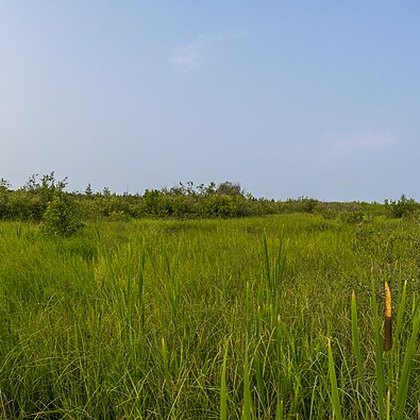
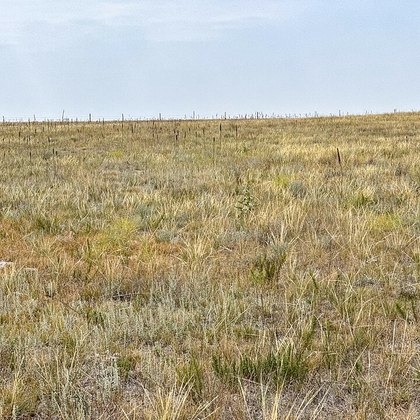
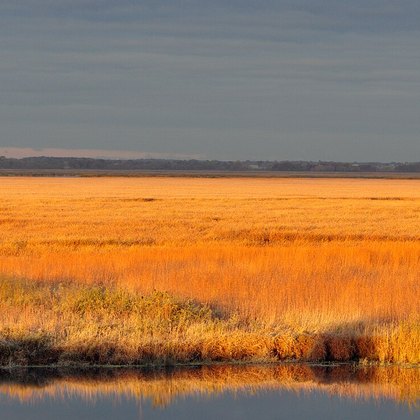
Unlike most herons the Cattle Egret seeks out dry land: grassland, pastures with livestock, freshly ploughed fields and damp meadows, where it catches insects flushed by grazing animals or farm machinery. It uses water mainly for breeding, usually in mixed colonies in trees and shrubs over or beside marsh. It avoids dense forest and desert without livestock or irrigation, but is otherwise one of the least particular herons when it comes to habitat.
Where the bird is most often found, arranged by the USNVC — the vegetation classification of the United States and Canada — and CMECS for sea and coast.


Range and movements
Originally a species of Africa and southern Asia, the Cattle Egret crossed the Atlantic under its own power around 1877, reaching the Guianas, became established there during the 1930s, and was first seen in Florida in 1941. The first North American breeding record followed in 1953 near Lake Okeechobee, Florida, after which the species spread across almost the whole continent within a few decades, breeding in Canada for the first time in 1962 and now ranging from the East Coast to California. Northern breeders withdraw in winter to the southern United States, Mexico, Central America and the Greater Antilles; birds remain year-round in Florida, along the Gulf Coast and in parts of California.
- Resident
- Breeding (summer)
- Winter
- Passage
- dark = core range, pale = thinly spread
Where and when to look
Do not look for the Cattle Egret at the water's edge but in the pasture: it is the only white heron regularly found among grazing cattle or horses, often perched on the animal's back or right beside it. Just after a field is ploughed, dozens can gather at once.
Conservation
The international Red List still lists the Cattle Egret under its old name Bubulcus ibis and rates the species, with a global population of 3.8 to 6.7 million birds, as Least Concern (LC), with no sign of recent decline. In parts of its new range the Cattle Egret is instead viewed as an aggressive coloniser, with consequences for flight safety and as a possible spreader of tick-borne disease among livestock.
Scientific name
Ardea ibis | Linnaeus, 1758
Linnaeus described the species in 1758 as Ardea Ibis; unlike most herons that changed genus, author and year carry no parentheses, because recent DNA studies placed the species back in Ardea after two centuries in its own genus, Bubulcus, Latin for 'herdsman'. The epithet ibis was borrowed from the sacred ibis of ancient Egypt, with which the Cattle Egret was mistakenly confused — the two are not close relatives. The type locality is Egypt, after the region Linnaeus based his description on.