All species › Waders, gulls and terns › Skimmers, noddies, terns and gulls › Common Gull
Common Gull | Larus canus
Stormmeeuw | Gaviota cana
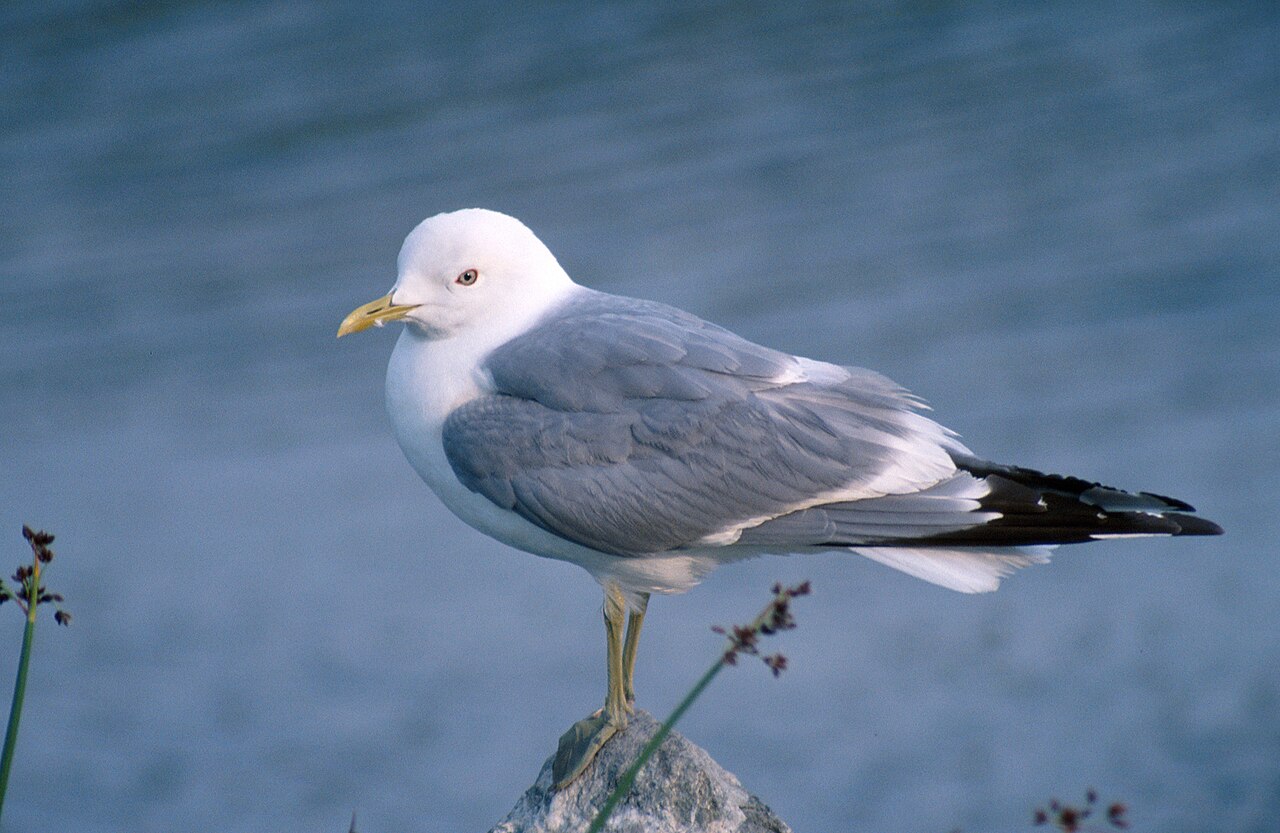
The Common Gull is a medium-sized gull with an unmarked greenish-yellow bill, yellow legs and a dark eye that gives it a gentle expression. It belongs to Europe and northern Asia; in North America it is only a visitor, annual in small numbers in Newfoundland and turning up in spring in western Alaska. Since the Short-billed Gull was split off as a species of its own in 2021, every Larus canus on this continent is a bird from across an ocean.
Voice
High, nasal and plaintive, far thinner than the barking of the big gulls: the usual call is a drawn-out kee-ya that pinches upward at the end. The long call, given with the head first lowered and then thrown far back, is a fast series of high yelping notes that falls away in pitch. When disturbed it gives a short barking gag-ag-ag. In North America it is almost never heard: the birds that winter there stand silent among hundreds of other gulls.
Recording: Lucien Hueber — CC BY-NC-SA 4.0 · Tréflez, Finistère, Brittany, France · xeno-canto
Identification
A gull between Ring-billed and Short-billed in size, with a round head, a short tapered bill and a soft look that comes from the dark eye. The adult is medium grey above and white on head and underparts; in breeding plumage the bill is a clean greenish yellow with no ring and the legs are yellow. The wingtip is black with two large white mirrors on the outer two primaries — more white than on any other gull of this size. In winter the head is finely streaked, mainly on crown and hindneck, bill and legs fade to grey-yellow, and a dull dark ring often shows on the bill. First-year birds have a grey back, a brown-scalloped wing, a sharply defined black tail band and a flesh-coloured bill with a black tip. In flight the narrow pointed hand and the broad white trailing edge stand out.
Confusion species
Short-billed Gull (Larus brachyrhynchus), which replaces it in the west, is smaller, with a finer and shorter bill, a darker grey mantle and, in winter, a head washed with blurry grey-brown smudges rather than fine streaks; on the spread wing its black runs as an even V around the tip, where the Common Gull shows a more solid black triangle. Ring-billed Gull (Larus delawarensis) is larger and paler, has a pale yellow eye instead of a dark one, a heavier bill with a crisp black ring, and far less white in the wingtip. California Gull (Larus californicus) is clearly bigger, has greenish-yellow legs and both a red and a black spot on the lower mandible. For any suspect bird the rule is the same: only a sharp photograph of the fully spread wing settles it.
Compare gulls: legs, head, bill and wing tip side by side
Habitat
In Europe and Asia it breeds on islets in lakes and peat bogs, on salt marsh and on shingle banks along rivers, and in recent decades on flat roofs in harbour towns as well. Outside the breeding season it is a bird of sheltered coast: bays, river mouths, harbours and the tideline of sandy beaches. Unlike the big gulls it likes to feed on foot on short grass and ploughed land, picking up earthworms and leatherjackets. It avoids the open ocean, and uses landfills less than Herring or Ring-billed Gulls do.
Where the bird is most often found, arranged by the USNVC — the vegetation classification of the United States and Canada — and CMECS for sea and coast.





Range and movements
The range runs from Iceland and the British Isles through Fennoscandia and Russia to Kamchatka and northern Japan, with three subspecies that replace one another gradually. It reaches North America from two directions: European birds, probably mostly Icelandic, arrive in Newfoundland every year in small numbers and more rarely in New England; birds of the Kamchatka subspecies appear in spring in western Alaska. On the Avalon Peninsula they can be found with some confidence in winter, birds of all ages, but they do not breed there. A bird ringed on the White Sea was recovered in Notre Dame Bay in 1956, proof that Russian birds make the crossing too.
Where and when to look
Look for it in January and February in the harbours of St. John's and along the Avalon Peninsula coast, among the Ring-billed Gulls: watch for a gull that is slightly smaller, dark-eyed and unmarked on the bill. Take your time over the wingtip — you cannot see it on a swimming bird, so wait until it stretches or takes off. In Alaska the best chance is the western Aleutians in late May.
Conservation
In Europe and Asia the species is numerous, at roughly a million pairs, more than half of them in Europe. Larus canus, also in its present, narrower sense after the split, is listed as Least Concern (LC). In North America the numbers run to a few dozen birds a year, which is not a population.
Scientific name
Larus canus | Linnaeus, 1758
Linnaeus described the species in 1758 as Larus canus, the name it still bears, so author and year stand without parentheses. Larus is the Latin word for a seabird, and canus means grey or hoary, after the mantle. The type locality was originally simply Europe and was later restricted to Sweden. Thomas Pennant coined the English name Common Gull in 1768; the American birds that long shared that name have been called Short-billed Gull since the split.