All species › Waders, gulls and terns › Skimmers, noddies, terns and gulls › Yellow-footed Gull
Yellow-footed Gull | Larus livens
Mexicaanse meeuw | Gaviota de Cortés
The Yellow-footed Gull is the only large gull with bright yellow legs beneath a slaty-black back, and it belongs in one place only: the islands and shores of the Gulf of California. After breeding, several hundred birds move north to the Salton Sea, the one place in the United States where it can be found every year. With about forty thousand birds it has one of the smallest ranges of any gull in the world.
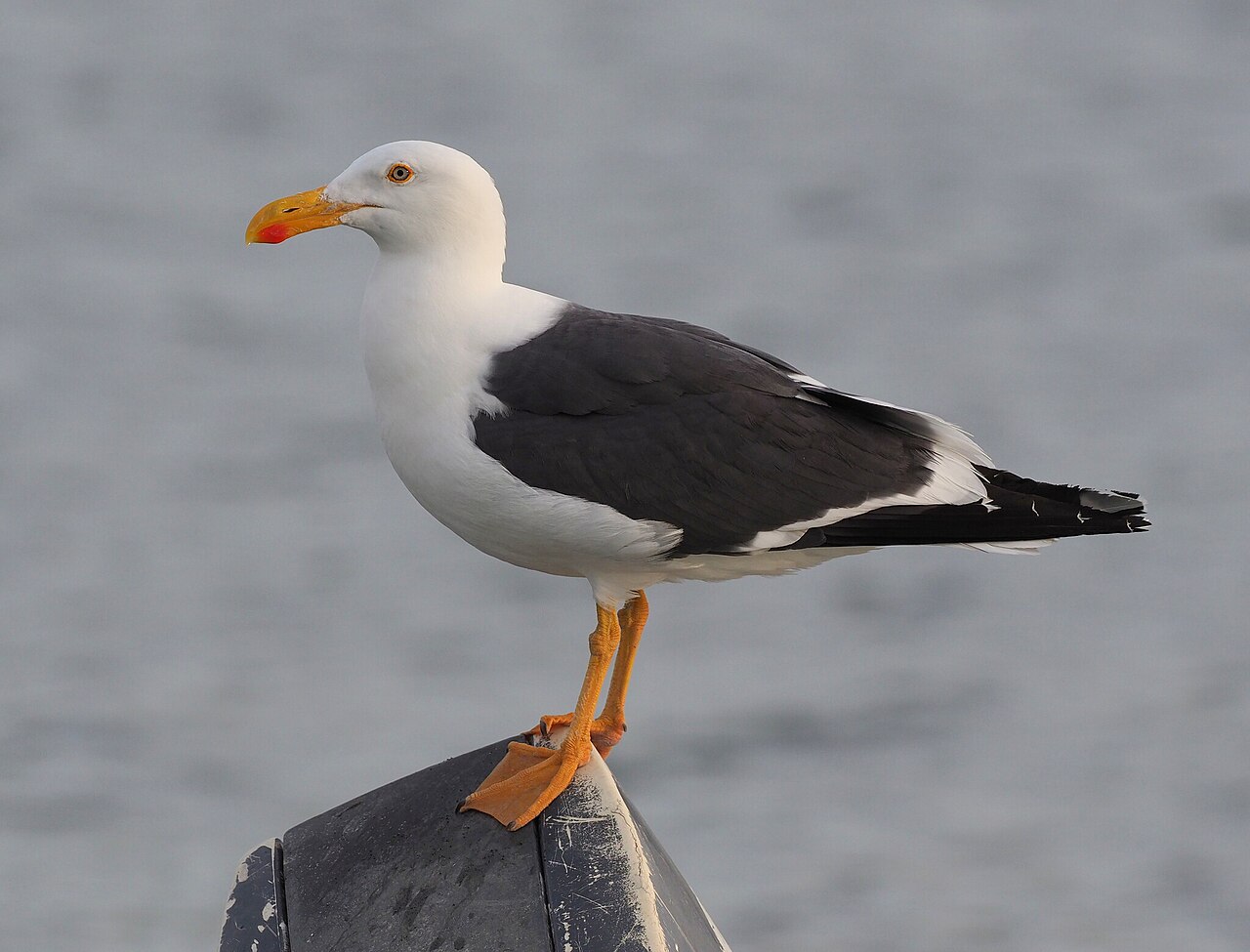
Click a thumbnail to switch the photo above.
Voice
A heavy, hoarse shouting, noticeably lower and fuller than that of the Western Gull, with which it shares much else. The long call opens with a few deep drawn-out notes and runs into a fast descending series, the head first lowered and then thrown far back. At the nest there is a short nasal alarm, and between partners a soft mewing kee-ow. In August it is the loudest sound over the water along the west shore of the Salton Sea.
Recording: Manuel Grosselet — CC BY-NC-SA 4.0 · Bahía de los Ángeles, Ensenada, Baja California, Mexico · xeno-canto
Identification
A large, heavily built gull: white head and underparts, a slaty-black mantle and upperwing, and a bill that is massive even for a big gull — yellow, with a bulbous tip and a large red spot on the lower mandible. Everything turns on the legs: bright yellow in the adult, still flesh-coloured in first-year birds, and already yellowing in the second year. Unlike most large gulls it takes only three years to reach adult plumage: a second-year bird already has a largely dark back, where a Western Gull of the same age is still brown and blotched. First-year birds are mostly brown with a black bill and a dark mask around the eye. In flight the hand is broad and the wingtip almost entirely black, with little white.
Confusion species
Western Gull (Larus occidentalis) is the only species it can really be confused with — it was treated as a subspecies of it until 1982 — but has pink legs instead of yellow, a slightly less massive bill, and four years rather than three to adult plumage; the two ranges also barely meet. At the Salton Sea it stands among Ring-billed Gulls (Larus delawarensis) and California Gulls (Larus californicus): both are far smaller and much paler grey on the mantle, and the California Gull has greenish-yellow legs and a slim bill with both a black and a red spot. From American Herring Gull (Larus smithsonianus) it differs in mantle shade — nearly black against pale grey — and again in leg colour, for the Herring Gull's are dull pink at every age. When in doubt: look at the legs first, then count the years in the plumage.
Compare gulls: legs, head, bill and wing tip side by side
Habitat
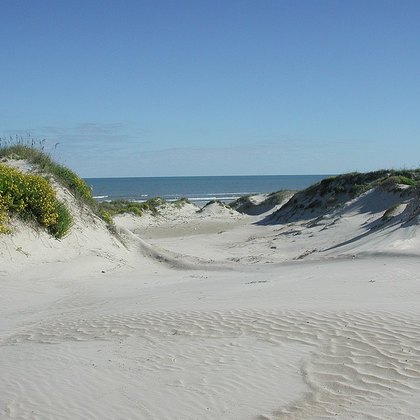
Breeds on the bare desert islands and sandy shores of the Gulf of California, in colonies of twelve to fifteen pairs and sometimes several hundred, the nests set in a line just above the tideline. Forages along beaches, in the intertidal zone, in fishing harbours and at sea within a few kilometres of shore. Outside the breeding season it comes to the bare, salty shores of the Salton Sea and the flooded fields behind them. It is rarely found far inland or far out on the open ocean.
Where the bird is most often found, arranged by the USNVC — the vegetation classification of the United States and Canada — and CMECS for sea and coast.




Range and movements
The whole range lies in the Gulf of California, from Roca Consag in the north to the Bay of La Paz in the south, and along both shores: Baja California and Sonora. From late June birds move north to the Salton Sea in California, with the highest numbers in August; some stay through the winter. That northward movement grew over the twentieth century — where it once meant scattered individuals, it now means several hundred. Beyond this the species is a decided rarity, with only a handful of records along the Pacific coast.
- Resident
- Breeding (summer)
- Winter
- dark = core range, pale = thinly spread
Where and when to look
One site is the west shore of the Salton Sea in August: work along the shoreline until you see a gull clearly larger than everything around it, then look at the legs. To see it in the breeding season you need a boat in the Gulf of California, but from the mainland at San Felipe or Bahía de los Ángeles it stands at the tideline all year round.
Conservation
The population is put at about forty thousand birds and appears stable; the Red List places the species in the Least Concern (LC) category, but Partners in Flight puts it on the yellow watch list because of the small range. The chief threat is disturbance at the breeding islands: visitors flushing whole colonies, and the collecting of eggs. Overfishing and pollution of the Gulf of California play a part in the background.
Scientific name
Larus livens | Dwight, 1919
Jonathan Dwight described the bird in 1919 as Larus occidentalis livens, that is, as a subspecies of the Western Gull; because the genus has not changed since, author and year stand without parentheses. Only in 1982 was it officially recognised as a species of its own. livens is Latin for leaden or blue-black and refers to the dark mantle, not to the feet its English name points at; the Dutch name simply names the country where the species breeds. The described specimen came from Isla San José, an island off the east coast of Baja California Sur.