All species › Waders, gulls and terns › Sandpipers and allies › Gray-tailed Tattler
Gray-tailed Tattler | Tringa brevipes
Siberische grijze ruiter | Playero Siberiano
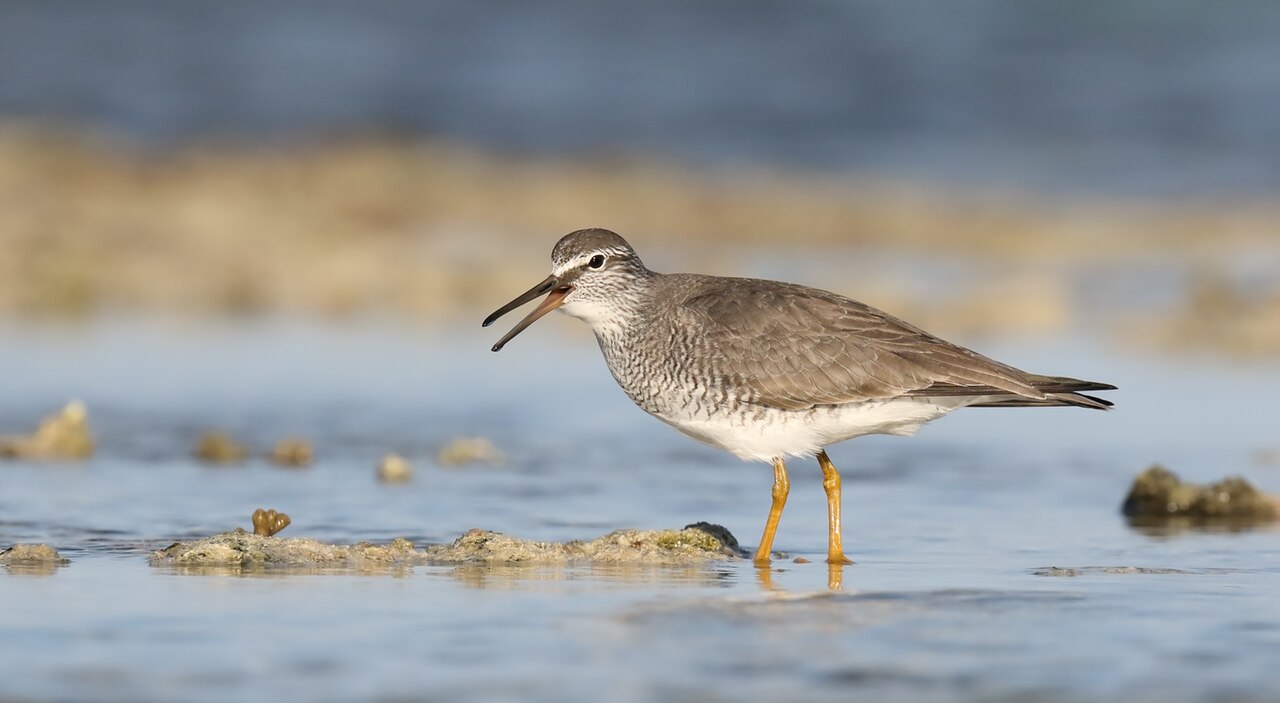
The Gray-tailed Tattler breeds along mountain streams in eastern Siberia and winters on the coasts of South-East Asia and Australia; it reaches North America only in the far west of Alaska. It is plain slate grey above and white below, with short yellow legs, and bobs its rear end continuously as it walks. Anyone who finds one has to separate it from the Wandering Tattler, and the call does that most reliably.
Voice
The call is a clear two-syllable whistle rising at the end: too-weet, usually repeated at the moment the bird takes off. That rising couplet is the surest character of the species, because the Wandering Tattler gives instead a fast rippling trill on one pitch. When the bird is uneasy the whistle becomes shorter and sharper and follows in series. On the Siberian breeding streams the male delivers a sustained run of whistled notes in a slow display flight. In Alaska you will hear almost nothing but the flight call, from a bird lifting off a draining mudflat.
Recording: Ross Gallardy — CC BY-NC-SA 4.0 · Kin, Okinawa Prefecture, Japan · xeno-canto
Identification
A compact wader with a straight black bill a little longer than the head, short yellow legs and a long, low body. In breeding plumage the upperparts are plain slate grey without pattern, and fine grey bars run across breast and flanks; belly and undertail stay clean white. In winter plumage it is uniformly grey above, with a grey breast band and white below. The white supercilium is narrow but distinct and runs behind the eye, set against a dark lore. Male and female look alike; juveniles have fine pale spots along the edges of the scapulars and wing feathers. In flight it is uniformly grey, with no wingbar and no white rump — unusual in a shank.
Confusion species
Wandering Tattler (Tringa incana) is the only real confusion species and in winter plumage is all but identical. The call settles it: the rising too-weet against a rippling trill on one pitch. In breeding plumage the barring of T. brevipes is finer and confined to breast and flanks, leaving a white belly, while in T. incana the bars are heavier and carry on across belly and undertail. At rest the wingtips of the Gray-tailed Tattler reach about to the tail tip, those of the Wandering clearly beyond it. Where the bird stands helps too: the Gray-tailed on mud and in sheltered bays, the Wandering on hard rocky shore in the surf.
Habitat
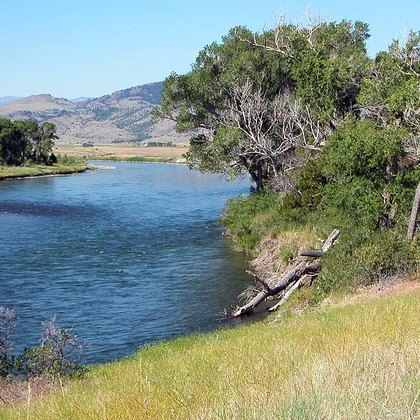
On passage in western Alaska it stands on mud and sand flats in sheltered bays, along the edges of lagoons and on the weed banks of quiet shorelines. It does not avoid surf-beaten rock altogether, but it rarely chooses it. On the breeding grounds it is a bird of the high Siberian mountains, on gravel bars along fast tundra streams. In the Asian and Australian winter quarters it uses tidal flats, mangrove edge and drying reef. What it needs everywhere is a soft or weed-covered surface it can walk over and pick from.
Where the bird is most often found, arranged by the USNVC — the vegetation classification of the United States and Canada — and CMECS for sea and coast.



Range and movements
The breeding range lies entirely in Siberia, from the montane tundra of Krasnoyarsk and the Yana east to Kamchatka; the winter range runs from the Malay Peninsula through Micronesia and western Polynesia to northern Australia. North America lies off that route, and yet the species turns up there every year in small numbers: in the outer Aleutians, on the Pribilofs and at Gambell on St. Lawrence Island, chiefly from late May to mid-June and again in August. Further south it is a major rarity, with scattered records along the coasts of British Columbia and California and a few on the Atlantic side. Breeding in North America has never been established, and the birds that arrive are overshoots from Asia.
Where and when to look
Look for it in late May and early June in the outer Aleutians or at Gambell, on mud exposed by the falling tide, and work along the weed banks at the tideline. Wait for it to call or put it up: the rising too-weet clinches the record, which the plumage of a winter bird will not do. Meanwhile check the wingtips against the tail tip and note whether the barring carries on to the belly. One photograph of the folded wing from the side is worth more afterwards than ten of the back.
Conservation
The world population is put at a few tens of thousands of birds and the species is assessed as Least Concern (LC), though the trend is downward. The heaviest pressure is on the tidal flats of the Yellow Sea, the refuelling stop between Siberia and Australia, where large areas have been reclaimed. There is no management task of its own in North America: no birds breed here and the numbers reaching Alaska are small. What the species yields here is mainly knowledge of how far Asian waders cross the Bering Sea.
Scientific name
Tringa brevipes | (Vieillot, 1816)
Vieillot described the species in 1816 as Totanus brevipes; because it was later placed in another genus, author and year stand in parentheses. The description appeared in volume 6 of the new edition of the Nouveau dictionnaire d'histoire naturelle, on page 410; no locality was given, but the specimen described came from Timor. brevipes is Latin for 'short-footed', from brevis 'short' and pes 'foot', after legs that are short for a shank. The two tattlers long stood in a genus of their own, Heteroscelus, and are now placed in Tringa. The English name points to the grey tail, the Dutch and Spanish names to the Siberian breeding grounds.