All species › Waders, gulls and terns › Sandpipers and allies › Wandering Tattler
Wandering Tattler | Tringa incana
Amerikaanse grijze ruiter | Playero Vagabundo
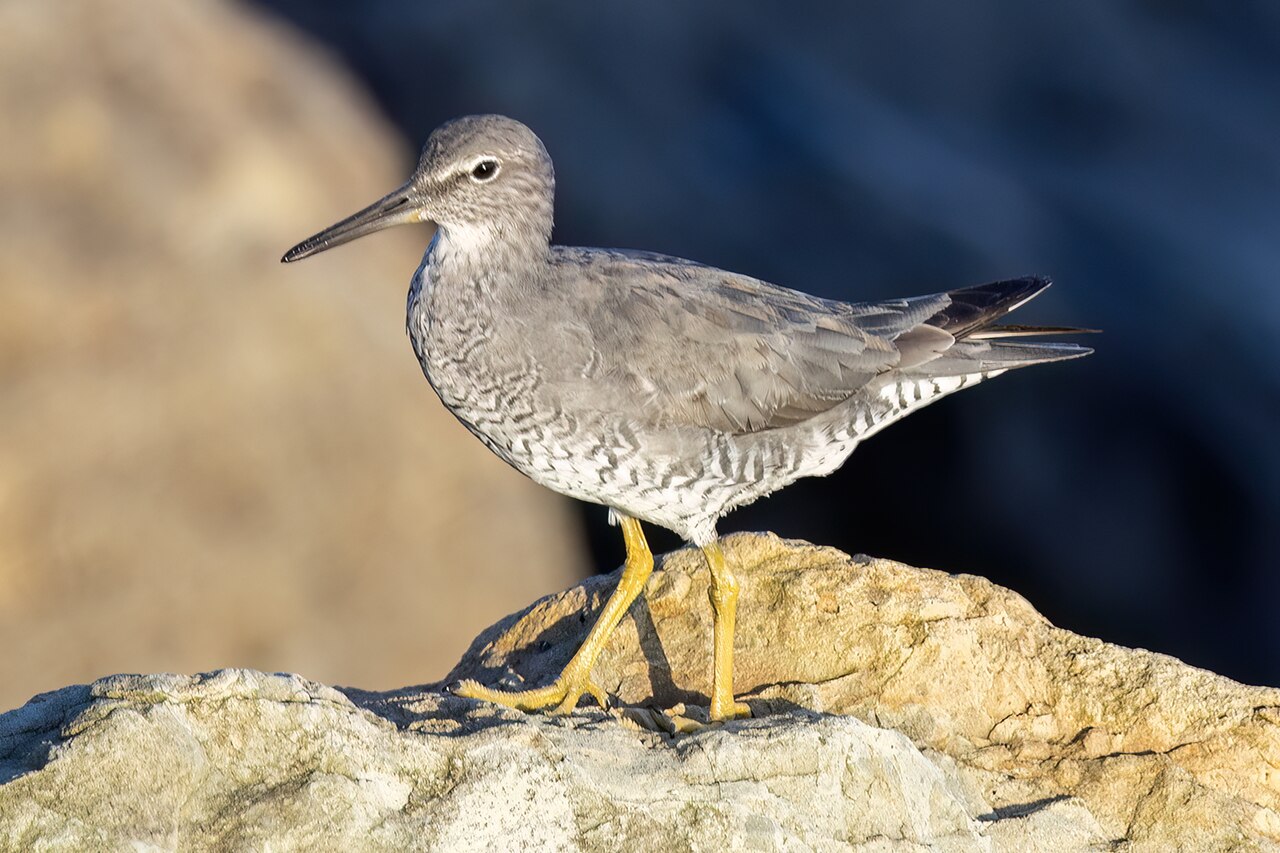
The Wandering Tattler is a uniformly slate-grey wader of surf-washed rocky shores, and on that wet dark stone it only shows itself when it moves. It breeds somewhere quite different: on the gravel bars of clear mountain streams in the tundra of Alaska and Yukon, sometimes hundreds of kilometres from the sea. The rear body bobs ceaselessly up and down, and on take-off comes a clear rippling series of whistles on one pitch.
Voice
The characteristic sound is a rippling series of six to ten clear whistles at roughly the same pitch, pew-pew-pew-pew-pew, accelerating slightly towards the end and carrying over the noise of the surf. It gives that series almost invariably as it takes off, so that a bird on the rocks is heard before it is seen. On the breeding grounds a drawn-out, trilling version of the same series sounds over the stream valleys, delivered in a slow display flight on stiff wings. In alarm at the nest it becomes a short, hard kleep.
Recording: Logan McLeod — CC BY-NC-SA 4.0 · Stikine Region (near Bear Camp), Stikine Region, British Columbia, Canada · xeno-canto
Identification
Above, the bird is entirely plain slate grey, without markings, without a wingbar and without a white rump — a wader that looks completely uniform from above in flight. In breeding plumage the underside is white with dense, coarse grey bars running from the throat right through to the undertail coverts. In non-breeding plumage and in juveniles that barring is gone and a grey wash remains across breast and flanks, with a white belly. Above the eye runs a short, faint pale line that hardly reaches past the eye, and the eye itself sits in a dark lore. The bill is straight, dark and about as long as the head; the legs are short and bright yellow. Male and female cannot be told apart; the bird bobs its rear end continuously, even while walking.
Confusion species
Gray-tailed Tattler (Tringa brevipes), which appears as a vagrant in western Alaska, is the only species that closely resembles it. In breeding plumage it is barred on breast and flanks only, with a white unbarred belly and white undertail coverts, while in Wandering Tattler the barring continues right under the tail. Gray-tailed also has a longer, clearly white supercilium that runs well behind the eye and often across the forehead, and in non-breeding plumage it is paler and cleaner grey with a whiter face. The surest character is the voice: Gray-tailed gives a rising two-note whistle, too-weet, Wandering the rippling series of six to ten notes on one pitch. Surfbird has a short thick bill with a yellow base and a white tail base with a black terminal band, and Black Turnstone is shorter, more pied and shows a great deal of white in flight.
Compare sandpipers, snipes and allies: bill, legs, wing bar and rump
Habitat
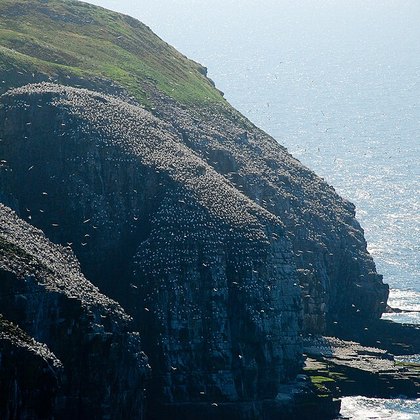
Outside the breeding season it is tied to hard, wet coasts: rock platforms washed by the surf, weed-covered ledges, reefs, piers, harbour moles and breakwaters, where it searches among barnacles and weed for crustaceans and worms. Sandy beaches and mudflats it almost always passes by; only at high water does it sometimes stand on an adjoining jetty. On the breeding grounds it chooses gravel and shingle bars along fast, clear mountain streams above the treeline, with open tundra and scree around them. The nest lies on the gravel, sometimes several kilometres from the water over which the display flight is performed.
Where the bird is most often found, arranged by the USNVC — the vegetation classification of the United States and Canada — and CMECS for sea and coast.




Range and movements
A breeder of the mountain tundra from Chukotka in north-eastern Siberia through most of Alaska, Yukon, north-western British Columbia and the Mackenzie Mountains of the Northwest Territories. Migration runs in a narrow band along the Pacific coast, in small numbers at a time and rarely anywhere inland. Wintering is on rocky coasts from central California south along Mexico and Central America to Ecuador and Peru, and across the whole Pacific besides: Hawaii, Micronesia, Melanesia, Polynesia and as far as Australia, some birds covering more than ten thousand kilometres. In Hawaii it is a common winter visitor on every reef; on the mainland it remains everywhere a bird seen one at a time.
- Resident
- Breeding (summer)
- Winter
- Passage
- dark = core range, pale = thinly spread
Where and when to look
In August or September walk a harbour mole, a breakwater or a rock platform on the Pacific coast as the tide comes in, and watch the waterline: a plain grey wader on dark wet rock becomes visible only when it bobs or walks away. Do not flush it too early, but learn the sound — the rippling series on take-off is often the best find of the morning. In Hawaii it stands on almost every reef from September to April, and sometimes even on a lawn near the shore.
Conservation
The Red List assesses the species as Least Concern (LC), but the estimates of its numbers are low: Partners in Flight arrives at about eighteen thousand breeding birds worldwide and counts it among the species that have lost more than half their number in fifty years. The breeding range is thinly occupied and hard to reach, so the figures remain uncertain. On the tundra the spread of shrubs along the stream valleys is a risk, and in the wintering areas it is building, disturbance and the loss of rocky shore to sea-level rise and coastal defence. Because a large part of the population winters on Pacific islands, the state of reefs and rock platforms there weighs heavily.
Scientific name
Tringa incana | (Gmelin, 1789)
Gmelin described the species in 1789 as Scolopax incana, among the snipes; because it was later placed in another genus, author and year stand in parentheses. incana is Latin for 'grey' or 'hoary', after the plain slate grey of the upperparts. The type locality lies far from the breeding range: Eimeo, now Moorea in the Society Islands, and the Palmerston Islands, where the birds were collected in winter during Cook's voyages. For a long time the species stood in the genus Heteroscelus; it now stands with the other shanks in Tringa.