All species › Owls › Owls › Great Horned Owl
Great Horned Owl | Bubo virginianus
Amerikaanse oehoe | Búho cornudo
The Great Horned Owl is the owl that fills the night across almost all of North America, from the treeline to the desert and from swamp forest to city park. It is heavy enough to kill a skunk or a young hawk, and it starts nesting in January, when there is still snow on the rim of the nest.
Voice
The sound everyone knows is a deep series of four or five muffled hoots, hoo-hoo-hoohoo … hoo hoo, the male lower and slower than the slightly higher-pitched female. Pairs answer each other through late autumn and winter, often deep into the night and sometimes an hour before sunset. Besides that there is the hoarse screeching of begging young, coming from the same clump of trees evening after evening for weeks, a sharp wac-wac-wac when the bird is uneasy, and bill-snapping if you come too close to the nest.
Recording: Richard E. Webster — CC BY-NC-SA 4.0 · Portal, Arizona, United States · xeno-canto
Identification
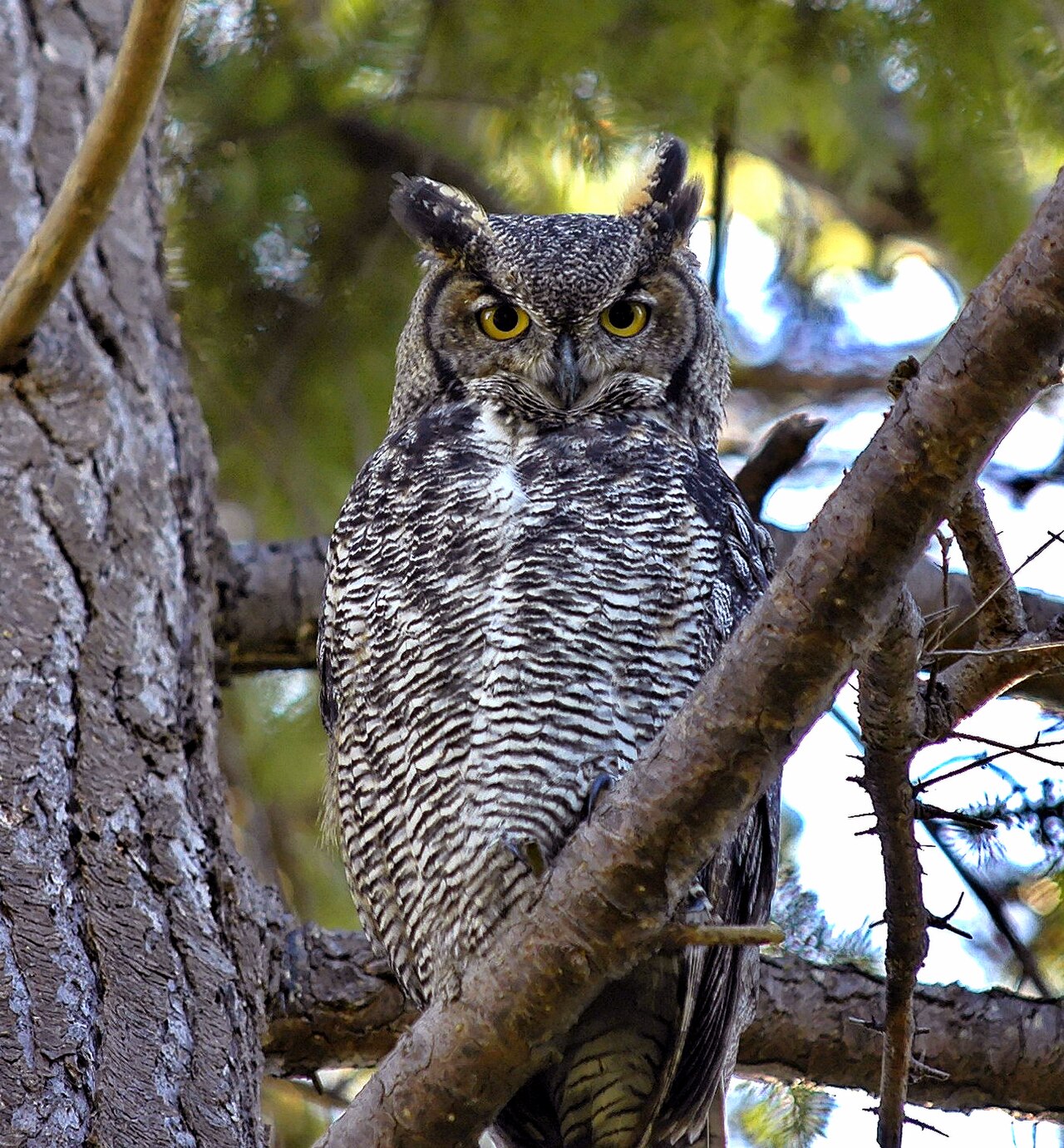
A heavy owl with a barrel-shaped body, a large head and two widely spaced ear tufts that rise as soon as it is alert. The facial disc is rusty brown and closed off by a black rim; the eyes are yellow and a white throat patch swells out when the bird calls. The underside is finely barred, the upperside mottled in brown, grey and black. Male and female are marked alike, but the female is larger; birds of the prairies and the northwest are far paler than those of the Pacific coast, which are almost dark brown. Young birds keep a downy head with short tufts and grey-brown barring through their first summer. In flight it is broad and short-tailed, with slow silent beats and short glides between them.
Confusion species
Snowy Owl sits on the same posts above winter fields, but is white with dark barring, has a round head without ear tufts and an open, pale facial disc. The pale prairie form of the Great Horned Owl comes closest to it, but always keeps its ear tufts and the dark rim around the face. American Barn Owl is far more lightly built, with a heart-shaped white face, black eyes and no tufts. By day on a post above grassland it is taken for a Red-tailed Hawk, which has a small head with no facial disc and a longer, narrower tail.
Habitat
It uses almost any landscape that offers trees or rock to roost in and open ground to hunt over: deciduous woodland and hedgerows, riverside woods along the rivers of the west, conifer forest up to the treeline, thorn scrub in the desert, and the old trees of city parks and cemeteries. What it needs is a nest it does not build itself — usually an abandoned nest of a hawk, a crow or a squirrel, or a ledge in a canyon wall. It avoids unbroken forest without clearings, and the bare tundra north of the treeline. In large cities it breeds in parks of only a few dozen hectares.
Where the bird is most often found, arranged by the USNVC — the vegetation classification of the United States and Canada — and CMECS for sea and coast.





Range and movements
Resident from the treeline in Alaska and Labrador south through Central America, and on through South America to Argentina, outside the area covered by this guide. It is absent from the Caribbean islands and from Hawaii. It does not migrate: ringed birds usually stay within a few kilometres of the nest for life, and only young birds wander further in their first winter. In the north, birds do drop south in years when snowshoe hares have crashed, but that is not regular migration. Clearing of the east helped it: the mosaic of woodlots and fields that took shape in the nineteenth century offers more hunting ground than the closed forest before it.
- Resident
- Breeding (summer)
- Winter
- Passage
- dark = core range, pale = thinly spread
Where and when to look
Look for it in January and February, when pairs are calling and the trees are bare: stand at a woodland edge on a still evening, half an hour after sunset, and listen for the four or five deep hoots. By day, a mob of crows or Blue Jays screaming around one tree almost always marks a roosting owl. Then read the silhouettes in the branches: a thick upright block with two points on top.
Conservation
Numerous and spread across the whole continent, with an estimated population of several million birds and a slightly downward trend. The main causes of death are collisions with vehicles, with wire and barbed wire, and poisoning by rodenticides that build up in the owl through mice and rats. Persecution has fallen sharply since owls became legally protected in the United States and Canada.
Scientific name
Bubo virginianus | (Gmelin, 1788)
Johann Friedrich Gmelin described the species in 1788 as Strix virginiana, in the genus that then held all owls; because it was later placed in another genus, author and year stand in parentheses. The genus Bubo was introduced by Duméril in 1805; bubo is the Latin word for the Eurasian Eagle-Owl and is formed in imitation of the bird's call. virginianus means 'of Virginia': the specimen described came from colonial America, and the type locality was later restricted to Virginia. The Dutch name places it beside the Eurasian Eagle-Owl of Europe and Asia, which stands in the same genus; the English and Spanish names name the ear tufts.